BG Wealth Sharing (bgwealthsharing.com) was a confirmed Ponzi scheme seized by the FBI, DOJ, and Secret Service on May 2, 2026.
The platform promised daily returns of 1.3% to 2.6% through its fake crypto trading arm, DSJ Exchange — returns no legitimate investment can guarantee.
Victims across the US, Canada, Philippines, India, and Pacific Island nations were targeted, with over $92 million laundered across chains in a single week.
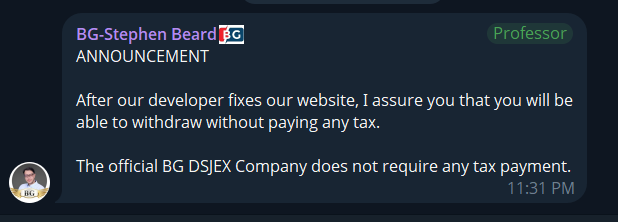
Before the site went dark, a man calling himself CEO Stephen Beard demanded a 12% “IPO tax” from users just to access their own funds — a classic advance fee trap.
If you or someone you know lost money, there are specific steps to take right now — and a dangerous wave of recovery scams already targeting victims.
If you visited bgwealthsharing.com today, you would not find a crypto investment platform — you would find a federal seizure notice.
The site is gone, replaced by the logos of the FBI, the Department of Justice, and the U.S. Secret Service. What was once marketed as a life-changing wealth opportunity for everyday investors turned out to be one of the most brazen crypto Ponzi schemes to surface in recent years.
For those on a journey toward genuine financial freedom, BG Wealth Sharing is a powerful and painful reminder that not every door labeled “opportunity” leads somewhere safe. Understanding what happened here — in detail — can protect you from the next version of this scam, which is already being built somewhere right now. ScamAdviser and communities like r/Scams on Reddit played an important role in early warnings, but millions were still lost before authorities stepped in.
My Personal Experience With BG Wealth Investing
bg wealth sharing scam 2026
Earlier this year, a buddy of mine and I started exploring BG Wealth Investing together. At the time, it did not feel reckless or dangerous, and it certainly did not feel like we were stepping into something that would later unravel into confusion, withdrawal problems, emotional stress, and growing allegations surrounding what many people are now calling one of the biggest AI professor-style crypto schemes we have seen in recent years.
Like many people online today, we approached it with cautious optimism.
I think there is a misconception people often have when they hear stories about investment collapses, crypto scams, or Ponzi-style operations. There is this tendency to imagine that everyone involved was acting carelessly or blindly chasing impossible riches, but honestly, that was not the reality I personally saw inside our own group experience.
Most people were simply searching for additional income streams during difficult economic times. Some were parents. Some were trying to recover financially from previous setbacks. Some were older individuals looking for more stability. Others were simply curious about AI trading and crypto because those topics are now everywhere online. And many people, including myself, were trying to approach it slowly rather than impulsively.
My friend Drew had created a small chat group where we all shared updates, screenshots, concerns, and experiences together. Over time, the group became surprisingly supportive and interactive. People were discussing trades almost daily, encouraging each other, asking questions, and slowly trying to understand the system better.
That emotional group dynamic is actually something I think deserves much more attention when people study schemes like this.
Because what pulls people in is often not only the platform itself.
It is the emotional environment surrounding it.
It is the feeling that everyone is learning together.
That people are helping each other.
That maybe this time things are different.
That perhaps this really could become something sustainable over the long term.
And little by little, you stop seeing only a platform and start emotionally attaching yourself to the future you imagine it might help create.
For me personally, my intention had always been long-term. I initially started with $500 and planned to simply let it grow slowly over time rather than aggressively trying to chase fast profits. I was not treating it like some overnight lottery ticket. I approached it much more cautiously than that.
At first, things appeared relatively calm inside the community. There were constant conversations around AI trading, professors, signals, market movements, assistants, and educational-style narratives that made everything feel sophisticated and organized. Looking back now, I can clearly see how carefully constructed the psychological atmosphere around these platforms often becomes.
There is usually a polished structure.
Professional branding.
Confident leadership.
A sense of exclusivity.
And constant emotional reinforcement from the community itself.
People share successful withdrawals.
People post profits.
People reassure each other.
And slowly, the emotional trust inside the system grows stronger than the actual transparency behind it.
Toward the end of April 2026, however, the atmosphere changed dramatically.
At first, many of us genuinely believed Bon Chat had simply been hacked. That was the explanation circulating through different groups while confusion started spreading almost overnight. The energy inside the chats shifted from optimism to anxiety extremely quickly, and suddenly people who had previously felt calm started asking much harder questions.
Almost immediately, many of us stopped trading altogether because something no longer felt right.
What followed was honestly emotionally difficult to witness in real time.
People started attempting to withdraw their funds, but many of those withdrawals simply never arrived. Some members in our group had already completed wallet binding procedures and KYC verification because they fully believed they were dealing with a legitimate long-term operation. Once concerns escalated publicly, they desperately tried getting their money out, but for many people it already appeared to be too late.
At this stage, many people are still trying to understand what role certain leaders may have played within the overall structure of the scheme. Personally, I think this deserves much deeper investigation because these systems rarely operate as randomly as they initially appear. Once I gather more information, I plan to write a completely separate article breaking down the different key players, leadership structures, emotional manipulation techniques, and behavioral patterns surrounding BG Wealth Investing in much greater detail.
Especially because the similarities between these so-called “AI professor” systems are becoming increasingly difficult to ignore.
After researching both theAintuition collapse and now the BG Wealth situation, I started noticing recurring themes that appear again and again: mysterious professors, assistants, trading education narratives, emotionally persuasive mentorship structures, vague AI explanations, highly controlled group environments, and constant psychological reinforcement designed to maintain trust inside the system for as long as possible.
When I first got involved with BG Wealth Sharing, I honestly did not immediately recognize the patterns that I now see much more clearly in hindsight. Part of the reason was because the structure felt very different from many of the obvious crypto schemes people usually warn about online.
Neither Professor Beard nor Elena ever directly pressured me to recruit people or aggressively build a team underneath me like professor Brook and Sofia did.
Communication also did not happen through the typical Telegram setup that so many questionable projects use, but instead through BonChat, which initially made the entire environment feel more organized, exclusive, and somehow more legitimate psychologically.
What also made everything feel convincing was the sheer amount of visible community involvement surrounding the platform. There were charismatic and seemingly genuine leaders like Gagan who appeared deeply committed to the project.
Some people even opened physical BG Wealth Investing offices with branded logos, organized local meetings and gatherings, and created the impression of a rapidly growing international business community rather than a temporary online scheme.
There were local events, celebrations, success stories, luxury presentations, and even reports of Tesla giveaways that reinforced the emotional belief that this was something large, stable, and financially successful.
When people see physical offices, branded merchandise, public events, confident leadership figures, and communities gathering together in real life, it naturally lowers suspicion because it creates the appearance of permanence and legitimacy.
And of course, there were the Saturday live Zoom calls with Gagan and Professor Beard himself, which in hindsight became one of the most psychologically convincing parts of the entire experience.
These were not short prerecorded videos or anonymous text messages hidden behind fake usernames somewhere online. They were long, interactive live sessions where people from the community would gather together, listen to market discussions, hear updates, ask questions, and emotionally engage with what felt like a real leadership structure operating in front of everyone’s eyes.
Gagan would speak directly with Professor Beard during these calls, ask him questions in real time, discuss the market, address concerns from the audience, and create the feeling that people were witnessing genuine leadership communication unfold live in front of them.
And honestly, for the average person watching these calls, the experience felt incredibly real.
Professor Beard did not come across as robotic, emotionless, or artificial in any obvious way. Quite the opposite, actually. He appeared articulate, emotionally intelligent, calm under pressure, highly knowledgeable, and surprisingly persuasive. He spoke with confidence about the markets, investing psychology, patience, discipline, and long-term vision in a way that felt thoughtful and convincing to many people listening.
What made the situation even more psychologically complex was that he constantly spoke about scams himself.
He repeatedly warned people about fake platforms, negativity, fear-driven rumors, and outside criticism. Community members were often reminded not to fall into “negative thinking” or be influenced by people online attacking BG Wealth or questioning the legitimacy of the project.
And that is one of the most fascinating psychological elements looking back at all of this now.
At the time, all of those layers created an incredibly convincing emotional reality.
Because when people see:
live Zoom calls,
public leadership figures,
emotional interaction,
organized events,
apparent legal filings,
branded offices,
visible success stories,
and a large international community,
the human mind naturally lowers its defenses.
It no longer feels like “a possible scam.”
It starts feeling like a real movement, a real company, and a real business ecosystem with real people emotionally invested in it.
That is why the later revelations became so shocking for many members.
When highly specialized AI experts later began analyzing Professor Beard and publicly suggesting that the figure itself may actually have been AI-generated or heavily manipulated, it completely changed the emotional perception of everything people thought they had experienced live.
Because for the normal eye, these interactions felt authentic.
People were not simply watching a static avatar or some obvious deepfake clip. They were emotionally engaging with what appeared to be a highly intelligent, emotionally responsive, articulate human being speaking live to an audience week after week.
And I think that realization deeply disturbed many people psychologically once the situation started unraveling.
Not only because of the financial implications, but because it forced people to question the nature of trust itself in an era where AI, emotional storytelling, and technology have become sophisticated enough to simulate human connection in ways most ordinary people are simply not prepared for yet.
That is perhaps one of the biggest lessons I personally take away from all of this.
The next generation of online schemes may not look obviously fake anymore.
They may look emotionally intelligent.
Professional.
Interactive.
Convincing.
Comforting.
And deeply human.
And I think that is one of the most important psychological lessons I personally learned through this experience.
Not all schemes look chaotic or obviously suspicious in the beginning.
Some are built very carefully around social proof, emotional trust, community identity, lifestyle imagery, and visible public participation. The more real people emotionally commit themselves publicly to something, the more believable the entire structure begins to feel to everyone involved.
Looking back now, I can see how powerful that atmosphere truly was psychologically. It was not only the platform itself people believed in. It was the people, the energy, the momentum, the community, and the emotional reassurance constantly surrounding it all.
Ironically, because my own funds remained technically “in trade,” my balance is still visible inside the exchange today. Since my original approach had been long-term and cautious, I had not rushed through the same withdrawal setup process others completed earlier. As of today, the account still displays a balance of $1,576.46.
I made screenshots of everything for documentation purposes and for authorities if needed in the future.
And honestly, seeing that number still sitting there while knowing so many others cannot access their funds anymore creates a very strange emotional feeling. It almost feels like looking at money trapped behind glass — visible, but emotionally disconnected from reality because trust in the system itself has already collapsed.
What affected me most emotionally, however, was not necessarily my own balance.
It was watching the emotional impact this situation had on other people in real time.
Behind every delayed withdrawal was usually a very human story.
People trying to improve their lives.
Families hoping for financial relief.
Individuals who trusted the wrong narrative at the wrong moment.
People who genuinely believed they were participating in something innovative and legitimate.
And I think that is why these conversations matter so much.
Not to shame people.
Not to mock victims afterward.
But to study the patterns honestly so fewer people repeat the same painful experiences in the future.
One positive thing that unexpectedly came out of all of this, however, was the direction our own small group eventually decided to take.
Instead of collapsing emotionally after everything happened, Drew made the decision to completely shift the purpose of the chat group into something educational and much more grounded in reality. Rather than continuing to chase hype or emotionally driven promises, the group slowly evolved into a space where we openly discuss questionable platforms, recognize scam patterns earlier, and learn how to approach the crypto world in a much more realistic and informed way.
If you would like to join our small private group and learn how to better recognize red flags before getting involved in the next questionable opportunity, feel free to contact me here or send me a DM so I can personally add you.
We regularly discuss platforms, projects, and anything that looks potentially suspicious or misleading, while Drew also shares the much more transparent and realistic strategies he is personally using to generate income in the crypto market today. And honestly, I think that decision changed the emotional atmosphere for many people in a very healthy way.
Rather than continuing to chase hype, people started focusing on actually learning trading properly, understanding risk management, recognizing manipulation tactics, studying scam psychology, and learning how to identify dangerous patterns before becoming emotionally invested in platforms like this again.
What began as disappointment slowly transformed into something far more real and sustainable.
People started rebuilding confidence through education instead of promises.
And perhaps that has ultimately become one of the biggest lessons this entire experience taught me personally:
Real growth rarely comes from emotionally charged promises of easy money. It usually comes slowly through patience, education, transparency, critical thinking, and learning how to stay emotionally grounded even when online environments are designed to pull people into excitement and urgency.
Today, I trust calmness far more than hype.
I trust transparency far more than charismatic narratives.
And I trust slow, sustainable growth much more than emotionally persuasive systems promising extraordinary outcomes without extraordinary proof.
🌿Want More Honest Opportunity Reviews?
Join my newsletter for calm reviews, scam awareness, and smarter online income ideas.
If reflections like this resonate with you, you may enjoy the Working With Kirsten newsletter, where I occasionally share deeper thoughts about building a meaningful online lifestyle, navigating digital communities, and creating environments that encourage curiosity and personal growth.
Inside the newsletter, I often expand on many of the themes explored here on the blog — including the evolving culture of the online world, the importance of thoughtful communities, and the small habits that quietly shape how life feels from day to day.
✨ Reflections on building a thoughtful internet lifestyle 🌱 Insights on personal growth and digital communities ☕ Behind-the-scenes perspectives from my own journey online
If these ideas interest you, you’re always welcome to join the conversation.
No noise. Just thoughtful ideas and quiet reflections about building a life that feels genuinely rich.
The Salt Lake City Event and the Illusion of Permanence
One of the moments that now feels especially surreal looking back was the large BG Wealth event held in Salt Lake City, where community members gathered together for presentations, celebrations, recognition, and even luxury giveaways including a car presentation on stage.
At the time, events like these played an enormous psychological role inside the community because they created the impression that BG Wealth was not simply an online crypto platform, but a rapidly expanding international business with real leadership, real momentum, real infrastructure, and long-term stability.
The atmosphere looked polished and successful.
People were dressed professionally.
Leaders spoke confidently on stage.
Community members celebrated achievements together.
Recognition and rewards were publicly showcased.
And Gagan herself appeared presenting at the event, reinforcing her position as one of the most visible and trusted leadership figures inside the BG Wealth ecosystem.
For ordinary members watching these events online or attending in person, experiences like this naturally lowered suspicion.
Because when people see:
physical gatherings,
stage presentations,
large audiences,
branded events,
luxury prizes,
emotional speeches,
and confident public leaders,
the human brain automatically interprets those things as signs of legitimacy and permanence.
It starts feeling less like “an internet opportunity” and more like a real global movement that is continuing to grow successfully.
And I think this is one of the reasons so many intelligent people emotionally trusted BG Wealth for as long as they did.
The platform did not only exist digitally.
It existed socially.
Emotionally.
Publicly.
And visually.
There were Zoom calls.
Live events.
Leadership presentations.
Community gatherings.
Recognition ceremonies.
Success stories.
Physical offices.
And constant reinforcement that this was supposedly a serious long-term company building something enormous for the future.
That is why the later collapse became so psychologically shocking for many members.
Because people were not simply trusting a website.
They were trusting an entire emotional reality that had been carefully constructed around them over time.
And looking back now, the Salt Lake City event almost feels symbolic of the final stage of confidence and expansion being publicly projected right before the growing withdrawal concerns, BonChat confusion, Telegram migrations, and broader unraveling of the entire situation started becoming impossible to ignore anymore.
The BG Wealth Sharing Scam — Here Is Exactly What Happened
BG Wealth Sharing aka Professor Dr. Beard and his assistant Elena operated as an investment platform that claimed to offer daily profits through crypto trading guidance. It aggressively recruited members using social media advertising, referral bonuses, and tiered reward structures designed to keep money flowing in. Multiple national regulators began flagging the platform as early as 2025, but the scheme continued pulling in victims across multiple continents before it finally collapsed.
The implosion happened fast. Between April 27 and May 3, 2026, criminals behind the operation laundered over $92 million across blockchain networks to cover their tracks. Law enforcement moved quickly in response.
Website Seized by FBI, DOJ, and Secret Service on May 2, 2026
On May 2, 2026, U.S. federal authorities seized bgwealthsharing.com as part of a coordinated multi-agency operation. The FBI, Department of Justice, and U.S. Secret Service all participated in the takedown. Anyone visiting the site now sees only the official seizure banner — a clear signal that this platform is not coming back in its current form.
Official Seizure Notice — bgwealthsharing.com
“This domain has been seized by the United States Government as part of a law enforcement action targeting fraud and financial crime. Operation Level Up | Scam Center Strike Force.”
The seizure was not just symbolic. It was the result of a coordinated effort between multiple agencies specifically formed to dismantle operations exactly like this one.
Operation Level Up and Scam Center Strike Force Led the Takedown
Two task forces drove this operation: Operation Level Up and the Scam Center Strike Force. These are not general law enforcement units — they are purpose-built to hunt down large-scale financial fraud operations that use digital platforms and cryptocurrency to exploit victims globally. Their involvement signals just how significant the BG Wealth Sharing case was in the eyes of federal authorities.
Countries Targeted: US, Canada, Philippines, India, and Pacific Nations
BG Wealth Sharing was not a local scam. It spread aggressively across international borders, hitting communities in the United States, Canada, the Philippines, India, and Pacific Island nations including Samoa. The Central Bank of Samoa had already issued a public warning in April 2025 identifying BG Wealth Sharing as an investment scam, urging investors to stay away. That warning came nearly a full year before the federal seizure — and still, the scheme kept growing.
How the BG Wealth Sharing Ponzi Scheme Actually Worked
Every Ponzi scheme needs a believable story. BG Wealth Sharing’s story was built on the booming interest in crypto investing, the promise of passive income, and a recruitment structure that turned victims into unwitting recruiters.
Daily Yield Promises of 1.3% to 2.6% Were the Core Hook
The platform advertised a daily yield of 1.3% to 2.6% on deposited funds, framed as profits from crypto trading guidance and market activity through the DSJ Exchange. To put that in perspective, a 2% daily return compounded over one year would theoretically turn $1,000 into over $1.3 million. No legitimate investment product on earth delivers that consistently — not hedge funds, not index funds, not even the highest-performing venture capital portfolios over long periods. The number was designed to dazzle, not to reflect reality.
Referral Commissions and Rank-Based Bonuses Fueled Recruitment
Beyond the daily yield, BG Wealth Sharing layered in a multi-level recruitment structure. Members earned referral commissions for bringing in new depositors and unlocked higher-tier benefits through rank-based bonuses. This is a textbook feature of Ponzi and pyramid scheme hybrids — it turns existing victims into active recruiters, expanding the pool of new money needed to pay earlier members.
This structure also made it deeply personal. People were not just losing their own money — they were losing the trust of friends, family members, and community contacts they had personally recruited into the scheme.
The AI Persona of “Dr. Stephen Beard” on Live Zoom Calls
As the BG Wealth and DSJ Exchange situation continued unraveling, one of the most disturbing questions many members began asking was whether “Dr. Stephen Beard” himself was ever a real person in the way the community believed.
For months, members watched videos, Zoom meetings, presentations, interviews, and leadership messages featuring a calm, articulate, emotionally intelligent figure presented as the CEO and visionary behind the larger ecosystem. He spoke confidently about trading, leadership, investor protection, long-term growth, regulation, attacks against the company, and the future of DSJ Exchange.
To the average person watching these videos, the experience felt completely authentic.
He did not appear obviously fake or robotic. In fact, what made the situation so psychologically convincing was precisely how emotionally human the persona appeared. He was articulate, persuasive, calm under pressure, and highly skilled at emotionally reassuring the community during moments of uncertainty.
But as researchers, AI specialists, and independent investigators started analyzing the videos more closely, growing concerns emerged that the “Dr. Stephen Beard” identity itself may have been AI-generated or heavily manipulated through advanced AI avatar technology.
And honestly, that possibility changes the emotional understanding of this entire case completely.
Because if the public face people trusted for months was not even a real individual in the traditional sense, then members were not simply interacting with misleading leadership. They may have been emotionally connecting with a carefully engineered artificial persona specifically designed to gain trust, authority, and emotional influence inside the community.
That is what makes this case feel so psychologically different from many traditional crypto scams.
This was not just anonymous text on a website.
It involved:
live Zoom interactions,
emotional speeches,
leadership presentations,
public videos,
interviews,
community reassurance,
and emotionally persuasive communication that felt deeply human to ordinary members.
And perhaps that is the most unsettling realization of all.
We are entering a period where AI-generated personalities may become sophisticated enough that most ordinary people simply cannot distinguish them from real individuals anymore.
Looking back now, many members are no longer only asking:
“Was BG Wealth a scam?”
They are asking something much larger and far more unsettling:
“How many of the people we emotionally trusted were ever real to begin with?”
DSJ Exchange Was the Fake Crypto Trading Platform Behind It
DSJ Exchange (DSJEX) was presented as the legitimate trading infrastructure powering BG Wealth Sharing’s returns. It gave the scheme a veneer of credibility — a named exchange, technical-sounding operations, and an implied layer of professionalism. In reality, DSJ Exchange was part of the same fraudulent operation. There was no real trading generating real returns. The “profits” paid to early members came directly from new deposits, the defining mechanism of a Ponzi scheme.
When the scheme collapsed, DSJ Exchange collapsed with it. Both domains went dark, and the money that had flowed through them was rapidly being laundered across multiple blockchains by the time law enforcement moved in.
The Future Plans Presented by the DSJ Exchange Leadership in Mid April
In multiple videos and presentations, including public appearances from the supposed DSJ Exchange owner, the long-term vision being presented to the community went far beyond simple crypto trading.
The leadership repeatedly described BG Wealth and DSJEX as a rapidly expanding global financial ecosystem that would continue growing internationally through AI-driven trading systems, education, investment opportunities, leadership development, and large-scale community expansion.
Members were told the company had a major long-term roadmap ahead involving:
expansion into additional countries,
larger trading infrastructures,
deeper integration between BG Wealth and DSJEX,
more advanced AI technology,
leadership programs,
physical offices,
large-scale global communities,
and future financial products connected to the ecosystem.
The messaging was always presented with extraordinary confidence and emotional certainty.
The owner of the DSJ exchange spoke calmly and professionally about protecting investors, fighting “attacks” against the company, strengthening the platform, and building something designed to last for many years into the future. In several appearances, criticism against BG Wealth was framed as negativity, misinformation, jealousy, or malicious attacks from outsiders attempting to damage the company’s reputation.
And honestly, that long-term vision became one of the most psychologically convincing parts of the entire experience for many members.
Because scams are often imagined as chaotic operations focused only on short-term money collection. But what made BG Wealth and DSJEX feel emotionally believable to many people was the opposite: the illusion of permanence.
The platform presented itself as something growing steadily into a massive international financial movement with:
leadership structures,
educational systems,
office locations,
conferences,
community recognition,
global expansion plans,
and carefully constructed future projections.
That creates a completely different emotional perception inside people’s minds.
It no longer feels temporary.
It starts feeling institutional.
Established.
Almost inevitable.
And that psychological shift is incredibly powerful because people begin emotionally investing not only in what the platform currently is, but in the future version they are being told it will become.
Looking back now, however, many members are questioning whether those future plans were ever real at all or whether they primarily served as part of a much larger emotional narrative designed to maintain trust, delay panic, and keep people psychologically committed for as long as possible.
Especially once DSJ exchange withdrawal issues escalated, communication systems shifted, and increasing scrutiny began surrounding the identities behind the leadership itself.
The Mysterious Role of the DSJ Exchange Owner & His Explanation of Future Plans
Another figure who raised many questions throughout this entire situation was the supposed owner and public face connected to DSJ Exchange, Stephen Beard.
Over time, DSJ Exchange and BG Wealth Sharing became increasingly interconnected inside the community narrative. Members were constantly reassured that the exchange, the trading systems, the legal structure, and the leadership behind everything were legitimate, professionally managed, and fully operational.
Stephen Beard regularly appeared in videos, presentations, Zoom calls, and official communications as the intelligent and emotionally composed “CEO” figure guiding the project forward. He spoke confidently about regulation, investor protection, trading systems, attacks against the company, and the future growth of the platform. To ordinary members watching these videos, the experience felt very convincing and highly professional.
However, as the entire situation started collapsing and more investigators, researchers, and AI specialists began analyzing the videos and public appearances more closely, serious questions started emerging about whether the Stephen Beard persona itself may also have been artificially generated or heavily manipulated through AI technology.
At this stage, many members are asking an unsettling question:
Was there ever a real “Stephen Beard” behind the public image at all, or was the DSJ Exchange owner simply another carefully constructed AI-driven character designed to emotionally gain trust inside the community?
Personally, I cannot definitively answer that question yet, and I think it is important to remain factual and responsible while investigations continue.
But after everything that has already been uncovered surrounding AI-generated identities, manipulated videos, fake leadership structures, and emotionally persuasive communication systems, I do think these questions deserve serious attention rather than immediate dismissal.
Because if these identities truly were artificially constructed personas, then this case may represent something far larger and more psychologically sophisticated than a traditional crypto scam.
It may represent a disturbing glimpse into what future AI-driven financial manipulation could start looking like in the years ahead.
Heavy Social Media Advertising Targeted Vulnerable Communities
BG Wealth Sharing did not rely on word of mouth alone. The platform advertised heavily on social media, specifically targeting communities that had shown high interest in crypto investing, passive income, and financial independence.
Expat communities, immigrant networks, and developing-nation audiences were disproportionately affected — groups where distrust of traditional banking can make alternative “investment opportunities” feel more appealing and where tight-knit social networks accelerate referral growth.
The Questions Surrounding Gagan’s Role – Just A Superstar Level Leader or Insider?
This is also why I started paying much closer attention to the video Gagan released on May 2nd, 2026, and right around the exact time the entire BG Wealth situation was beginning to publicly unravel.
In the video, she attempted to calm members, address concerns surrounding withdrawals, and reassure the community during a moment where confusion, panic, and uncertainty were spreading extremely quickly across different groups and communication channels.
At the time, many people still trusted her deeply because she had become one of the most visible and emotionally influential leaders inside the BG Wealth community. She appeared consistently involved, highly committed, emotionally invested in the project, and publicly connected to Professor Beard through the Zoom meetings and leadership structure people had trusted for months.
But looking back now, the situation naturally raises difficult questions.
Was Gagan herself also a victim who genuinely believed in the system until the very end?
Or did higher-level leaders know more than ordinary members about what was really happening behind the scenes as the situation started collapsing?
Personally, I do not yet have enough evidence to make definitive claims about her role, and I think it is important to stay responsible and factual while continuing to ask questions. However, I also think these questions deserve serious examination because of how central certain leadership figures became in emotionally reinforcing trust throughout the community.
And perhaps the biggest psychological question many members now struggle with is this:
How could someone who interacted so closely with Professor Beard through repeated Zoom calls, leadership discussions, and community communication not realize that the entire persona may have been AI-generated or heavily manipulated?
That question alone reveals just how sophisticated and emotionally convincing this entire operation may have been.
Because if experienced leaders who spent months interacting with these personalities were themselves unable to recognize what was happening in real time, then ordinary members had very little chance of recognizing it either.
And that may ultimately become one of the most disturbing aspects of this entire case, not only the financial losses, but how convincingly artificial identities may have been integrated into emotionally trusted online communities without most people realizing it until everything started collapsing.
At this point, however, many members are beginning to ask very serious questions. Do the people behind this still genuinely believe the community continues trusting the leadership narrative, or do they believe ordinary members will simply continue accepting shifting explanations despite everything that has already unfolded?
For many people affected by this situation, the story already feels painfully clear. Authorities have reportedly stepped in, withdrawals remain a major concern, communication systems have collapsed into confusion, and yet new explanations and reassurances continue appearing as though trust inside the community has not already been deeply damaged.
And I think that is one of the hardest emotional realities for many victims to process and realizing that even after so many warnings.
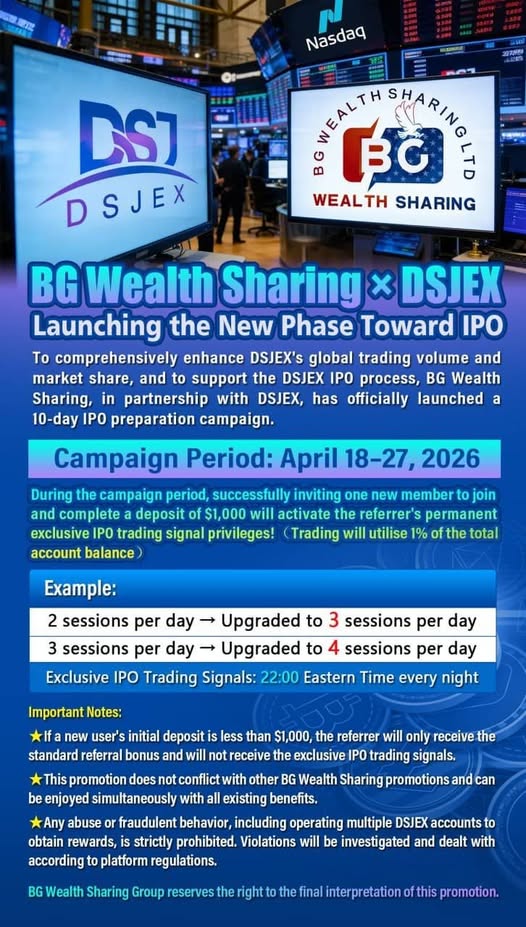
IPO Promotions Introduction Right Before the Collapse
The promotion was closely connected to the larger DSJ Exchange vision and the public leadership narrative surrounding the supposed CEO figures behind the platform. Members were constantly encouraged to think long term and position themselves early before what was presented as the next major stage of expansion for the company.
One of the biggest incentives during this period involved the so-called “IPO bonus trade.”
The structure worked roughly like this: if a member brought in a new participant who funded an account with at least $1,000, the sponsor would unlock an additional third bonus trade each day. That extra trade made a very significant difference financially because the earnings inside the system were constantly compounding.
In my own case, without the IPO bonus trade, I was typically earning around $20 per day through the two standard daily trades. But members who qualified for the additional IPO trade could potentially earn substantially more each day because the profits were compounding continuously as account balances increased over time.
And that compounding effect was psychologically extremely powerful.
Every day, balances appeared to grow.
Daily earnings appeared to increase.
People started calculating future projections.
Members imagined what the accounts might look like months later if the momentum continued uninterrupted.
That is one of the reasons the IPO promotion became so emotionally persuasive inside the community. It encouraged people to think not only about current earnings, but about exponentially larger future growth if they continued compounding and expanding their accounts.
Looking back now, however, the timing of the promotion raises very difficult questions.
Because even as concerns surrounding withdrawals, BonChat, and communication systems were escalating publicly toward the end of April, the IPO campaigns and expansion messaging continued being heavily promoted inside the community. In some cases, the promotional periods were even extended further toward the exact moment the entire situation was beginning to unravel.
And naturally, many members are now questioning why aggressive growth and funding campaigns continued during a period where the system itself may already have been experiencing severe underlying problems.
At the time, however, most members did not interpret these promotions as warning signs.
They interpreted them as proof of confidence.
Proof that the company was still expanding.
Proof that leadership remained optimistic.
Proof that the future roadmap was still moving forward.
And that is precisely what made the emotional structure surrounding BG Wealth and DSJ Exchange so psychologically convincing while it was happening in real time.
People were not only investing in the present.
They were emotionally investing in the future version of the system they believed was steadily growing larger every single day.
The Final Rug Pull: Stephen Beard’s 12% “IPO Tax” Lie
Just before the platform went dark, the operation executed one final attempt to extract money from trapped victims. It was brazen, calculated, and revealed the true nature of the people running this scheme.
A man presenting himself as CEO Stephen Beard appeared in a video address to users over the weekend before the seizure. He told investors that DSJ Exchange was on the verge of an initial public offering (IPO) — a story designed to create excitement and legitimacy at the worst possible moment for victims. But the real ask was what followed: he told users that a 12% tax on account balances was required before anyone could access their funds as part of the IPO process.
Beard Told Users a 12% Tax Was Required to Unlock Withdrawals
This “12% IPO tax” was a textbook advance fee fraud — one of the oldest tricks in the financial scam playbook. Victims who were already unable to withdraw their money were being asked to send even more money for the promise of unlocking what they believed they had already earned. The Washington State Department of Financial Institutions confirmed this framing, identifying the demand as a hallmark advance fee scam tactic. Anyone who paid the 12% simply lost that additional amount on top of everything else already gone.
Washington State DFI Confirmed It Was an Advance Fee Scam
The Washington State Department of Financial Institutions (DFI) was among the regulators that publicly identified BG Wealth Sharing’s final demand as a classic advance fee scam. In this type of fraud, victims are told they must pay an upfront fee — framed as a tax, processing charge, or legal requirement — to unlock funds they are owed. The fee is never the last one, and the money never comes.
What made this particular version especially cruel was the timing. Victims had already watched their accounts freeze, withdrawals get blocked, and customer support go silent. Beard’s video appeared at precisely the moment when people were most desperate, most emotionally invested, and most willing to believe one more payment might fix everything. That is not an accident — it is a deliberate psychological tactic used by scam operators globally.
The DFI’s confirmation matters because it creates an official public record. If you were targeted by this specific demand and paid the 12% fee, that interaction is documented and should be included in any fraud report you file with law enforcement.
Advance Fee Fraud — How to Recognize It:
“Any investment platform that requires you to pay a fee, tax, or charge in order to withdraw your own money is committing advance fee fraud. Legitimate platforms never require payment to release your existing balance. This is true regardless of how the fee is framed — whether called an IPO tax, processing fee, government levy, or verification charge.”
— Washington State Department of Financial Institutions
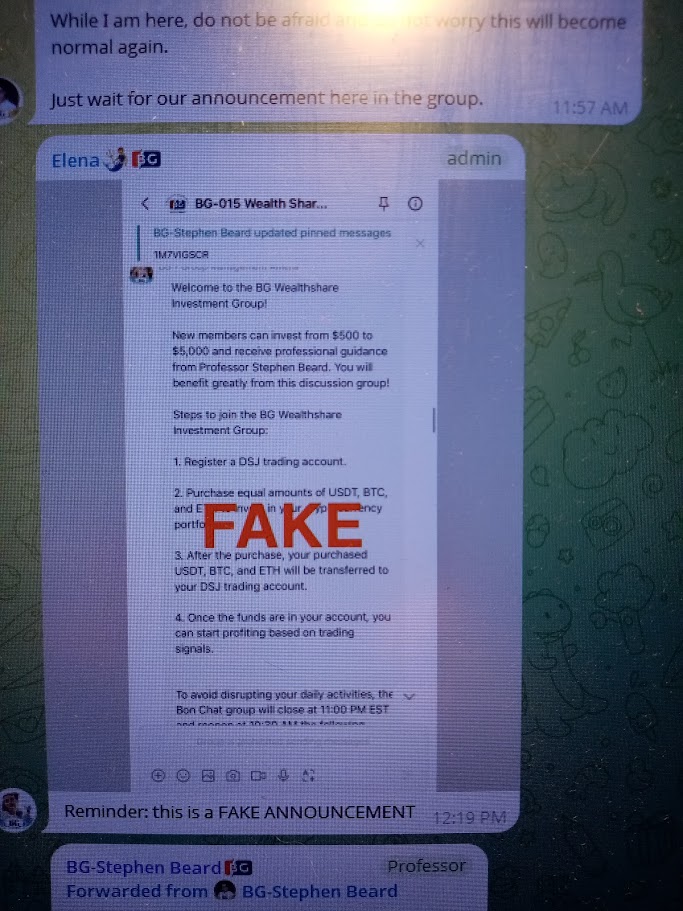
BonChat “Hack” Exit Into the BG-015 Wealth Sharing Investment Group on Telegram
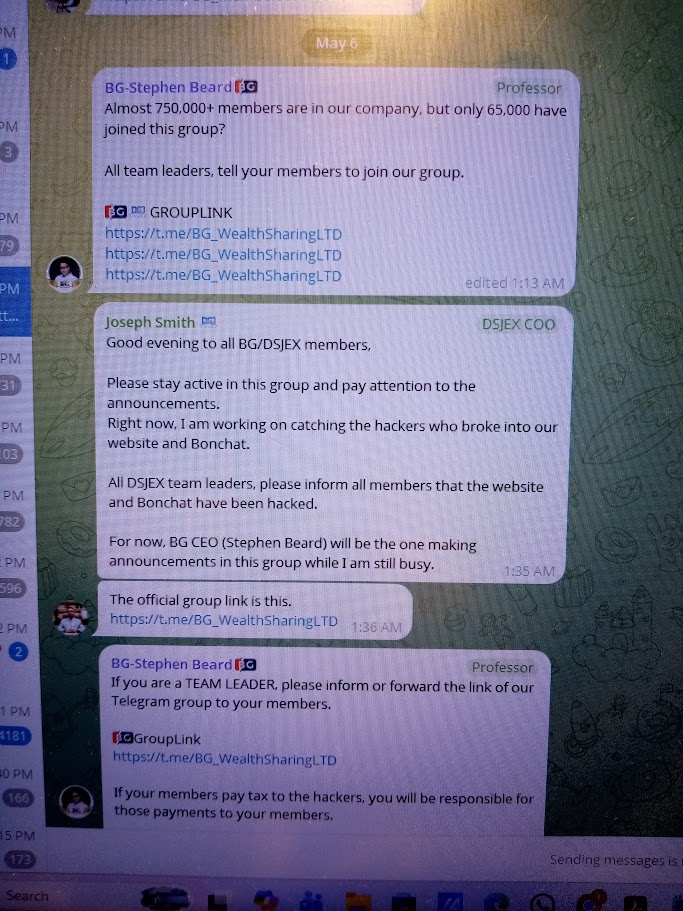
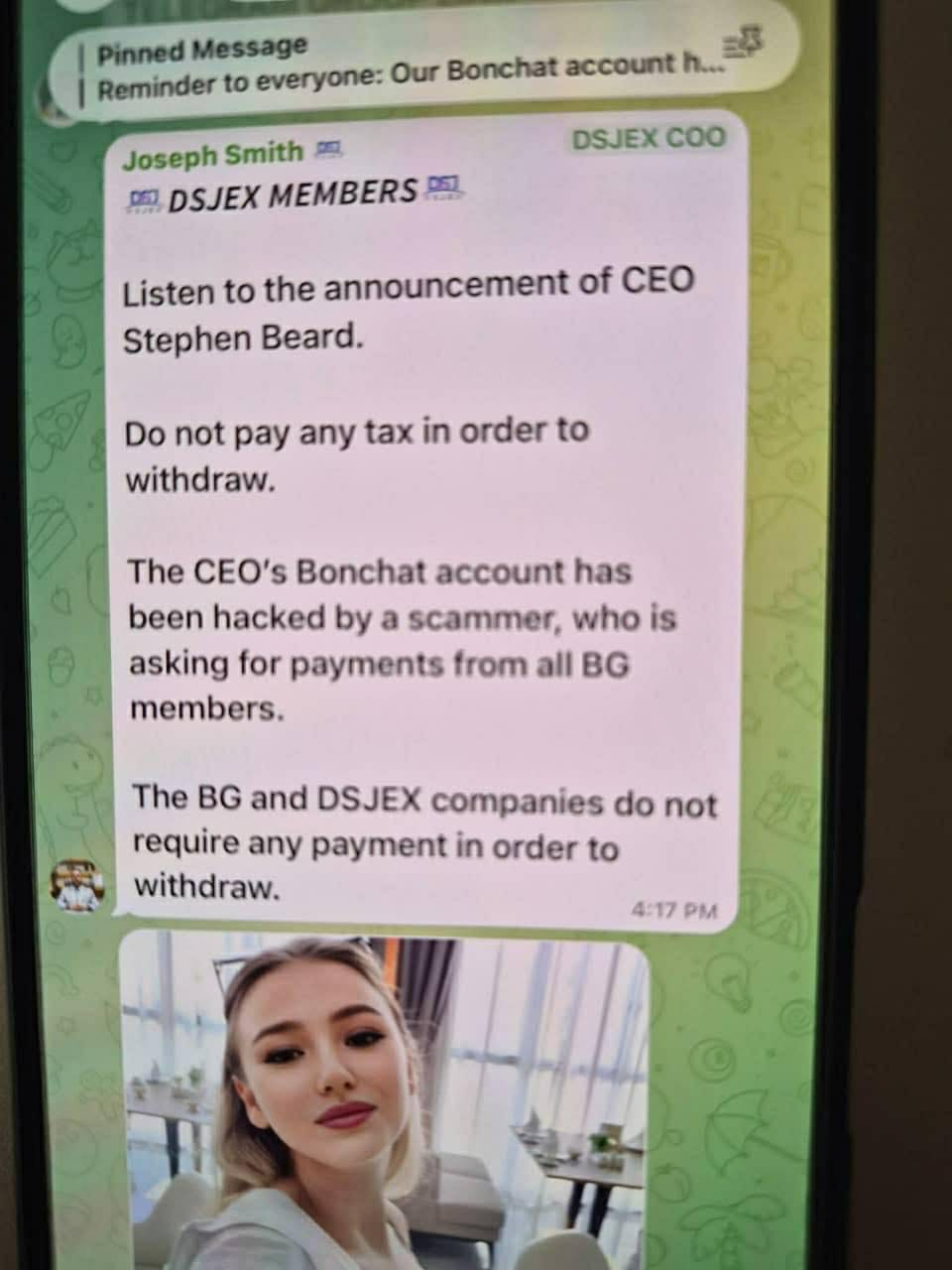
One of the most psychologically confusing phases of the entire BG Wealth situation began when the narrative suddenly shifted toward claims that BonChat had been “hacked” by Chinese hackers.
At the time, many people inside the community genuinely believed this explanation because the communication happened so quickly, emotionally, and with a sense of urgency that made the situation feel chaotic and dangerous in real time.
Almost overnight, leaders from BG Wealth began instructing their teams to immediately leave BonChat and stop trusting the information appearing there. Members were warned not to click on links being shared inside the platform, not to follow the trading codes allegedly being posted by the hackers, and especially not to pay the widely discussed “12% tax” that suddenly started appearing as part of the unfolding situation.
People were told that hackers had taken over BonChat and were now attempting to manipulate users financially.
At the same time, members were urgently redirected into Telegram groups that leadership figures claimed were now the “real” communication channels being used by Professor Beard and Elena moving forward.
Looking back now, this moment feels incredibly important psychologically because it created a transition phase where confusion itself became part of the emotional control mechanism surrounding the community.
People were scared.
Confused.
Emotionally overwhelmed.
Desperate for updates.
Desperate for reassurance.
And desperately trying to understand who or what could still be trusted.
In emotional situations like that, people naturally gravitate toward whoever appears calm, organized, and authoritative.
That is exactly why the Telegram migration worked so effectively for many members at the time.
The groups presented themselves as safe spaces away from the alleged hackers. Leaders reassured members that the “real team” was still operating behind the scenes and that communication would now continue safely through Telegram instead.
But when I look back at this phase now with much more emotional distance, several things stand out very differently to me.
One major red flag was the fact that many of these Telegram groups had only been created very recently.
At the time, however, most people did not focus on that detail because emotions were running extremely high and everyone was searching for stability, guidance, and answers. The sudden migration itself created an atmosphere where people stopped critically analyzing the structure of what was happening because they were too emotionally focused on protecting their funds and staying connected to the supposed “real” leadership.
And that is one of the most psychologically fascinating aspects of situations like this.
Confusion can sometimes become an incredibly effective tool for maintaining emotional influence over large groups of people.
Because once fear enters the picture, people become far more willing to follow new instructions quickly without slowing down long enough to analyze the broader situation rationally.
What also made the entire experience feel believable at the time was that the warnings themselves sounded responsible on the surface. Members were repeatedly told:
not to pay anything,
not to click suspicious links,
not to trust random codes,
and not to interact with the alleged hackers.
not to watch the bonchat video of Professor Beard claiming a 12% ipo tax fee because the only real professor who is now on Telegram claims that the video of him in bonchat is not the real professor Stephen Beard but it is a fake video of him
Members were told not to watch the BonChat video featuring Professor Beard discussing the controversial 12% IPO tax fee because, according to the “real” Professor Beard who had now supposedly moved over to Telegram, the version of him appearing inside the BonChat video was allegedly fake.
Yes, read that again carefully.
At that stage, the narrative had become so twisted that members were essentially being told that the fake AI professor was now warning everyone about another fake version of the same fake AI professor.
Honestly, if someone had written this storyline into a psychological crypto thriller a few years ago, most people probably would have dismissed it as unrealistic.
And yet this was unfolding in real time inside emotionally invested communities where ordinary people were desperately trying to understand who, if anyone, was actually real anymore.
Ironically, that type of messaging still created the impression for many members that leadership was actively trying to protect the community rather than manipulate it, because the constant warnings, explanations, and emergency updates made the situation feel more like a company under attack than a system potentially collapsing from within.
Sadly enough for many ordinary members, that reinforced the emotional belief that Professor Beard, Elena, and the surrounding leadership structure were still legitimate victims of an external attack rather than participants in a much larger collapse unfolding underneath the surface.
Looking back now, however, this entire phase feels much more like a critical transition point in the emotional unraveling of the scheme itself.
Because once communication systems suddenly shift, narratives rapidly change, urgency escalates, and members are emotionally redirected into newly created channels while being told to distrust previous systems entirely, it becomes extremely difficult for ordinary people to separate truth from manipulation in real time.
Especially inside emotionally charged communities where trust has already been carefully built over many months.
I honestly think this can not get even more twisted than this or can it get even weirder?
My Personal Interpretation of the BonChat “Hack” Narrative
Elena, Professor Beard’s assistant
Looking back now, one of the biggest questions many members still have is whether the BonChat “hack” story itself may have been part of the larger unraveling process surrounding BG Wealth Investing.
At the time, members were told that Chinese hackers had taken over BonChat, were spreading malicious links, promoting fake trading codes, and attempting to convince users to pay a controversial 12% tax. Leaders urgently instructed people to leave BonChat and move into newly created Telegram groups that were presented as the new official communication channels connected to Professor Beard and Elena.
But in hindsight, the situation raises many difficult questions.
bg wealth sharing bonchat hack
The sudden migration away from BonChat, the emotional urgency, the confusion surrounding withdrawals, the rapidly changing communication structures, and the appearance of freshly created Telegram groups all became significant red flags for many people afterward.
Personally, I cannot definitively prove what happened behind the scenes, and I think it is important to remain responsible and factual when discussing situations like this. However, looking back at the sequence of events as a whole, many members understandably began questioning whether the alleged “hack” narrative itself may have played a role in the broader collapse and confusion surrounding the platform.
And I think that uncertainty is precisely what made the situation so psychologically difficult for many people involved.
bg wealth sharing scam
Because once communication systems collapse, narratives change rapidly, and trust begins breaking down inside emotionally invested communities, it becomes extremely difficult for ordinary members to separate truth, panic, manipulation, and misinformation in real time. At that stage, many people no longer even knew who the “real” Professor Beard was supposed to be and which communication channels were authentic versus fake.
The situation became even more disturbing once specialized AI analysts later began publicly claiming that the entire Professor Beard persona may itself have been artificially generated or heavily manipulated through AI technology, including the Zoom meetings, AI-generated videos, fake images of Professor Stephen Beard, and the public identity that had been presented to the community for months. Similar concerns were also raised surrounding the identity of his assistant, Elena.
professor Dr. Beard fake Ai zoom meetings
The question that still remains is this: who else, especially among the highest “superstar” leadership levels, may not have been who they appeared to be?
I will continue asking questions, documenting what I find, and releasing a series of related blog posts as more information becomes available in this case. I also encourage everyone who was involved to do the same: ask questions, preserve screenshots and records, report relevant information to the government agencies I mention below, and do not stop seeking answers until more pieces of the puzzle come together.
For me personally, I need to understand the full picture as clearly as possible. If new details emerge, I may update this article and add additional related articles to this series.
I have always believed that staying curious helps us understand life at a much deeper level. Curiosity keeps us grounded, aware, and willing to look beneath the surface instead of simply accepting whatever story is handed to us.
And in the age of AI, that curiosity matters more than ever.
I encourage everyone affected by this situation to stay curious about this entire AI phenomenon and to keep asking who the real people behind these identities were. I sincerely hope law enforcement and investigators uncover the truth piece by piece, so that innocent victims, especially those who lost their life savings, can one day find some measure of peace again.
Warning Signs That Were There From the Start for BG Wealth Sharing
The uncomfortable truth about BG Wealth Sharing is that the warning signs were visible long before the site was seized. Multiple regulatory bodies across different countries raised alarms. Online communities flagged suspicious recruitment tactics. And yet the platform kept growing, kept pulling in new depositors, and kept paying just enough early returns to maintain the illusion. Here is what was there from the beginning — and what to watch for in the future.
Central Bank of Samoa Called It a Scam in April 2025
In April 2025 — a full year before the federal seizure — the Central Bank of Samoa issued a public warning about BG Wealth Sharing. After receiving complaints from investors, the regulator updated its position and explicitly stated that BG Wealth Sharing was likely an investment scam, urging the public to avoid the platform entirely and not send any money.
A central bank warning is not a minor regulatory footnote. It is about as loud an alarm as a financial authority can sound without a court order. The fact that BG Wealth Sharing continued to operate and recruit victims for another year after that warning illustrates how effectively the platform used social media, fake success stories, and community trust networks to overwhelm credible official warnings.
Multiple Regulators Flagged BG Wealth as Unlicensed Since 2025
Beyond Samoa, several other financial regulators identified BG Wealth Sharing as an unlicensed investment entity throughout 2025 and into 2026. Operating without a license is not a technicality — it means the platform had no legal authorization to solicit investments, manage funds, or promise returns in the jurisdictions where it was actively recruiting. No audit trail. No regulatory oversight. No investor protections of any kind.
A licensed investment firm is required to maintain records, submit to audits, and follow strict rules about how client money is handled. BG Wealth Sharing had none of that accountability. When the money disappeared, there was no regulator, no insurance scheme, and no legal framework to protect the people who had trusted it.
Scammers Deployed Bots and Fake Victim Accounts to Silence Critics
One of the most disturbing tactics employed by BG Wealth Sharing was its active effort to suppress public warnings. Operatives behind the scheme monitored Reddit threads, YouTube warning videos, and other online discussions about the platform. When someone posted a credible warning, scam agents — sometimes using fake accounts posing as concerned relatives of victims — would flood the comments with positive testimonials, claims of successful withdrawals, and attempts to discredit the person raising the alarm. For more information, you can read about how the US government seized BG Wealth Sharing.
According to community members on r/Scams who tracked this behavior in real time, BG Wealth Sharing bots were actively deployed against their own warning threads. Fake comments claiming large, successful withdrawals were planted specifically to give hesitant new recruits the confidence to deposit. These were not organic community voices — they were coordinated disinformation planted by the people running the scam.
This is why community warnings alone are never enough. If you see overwhelmingly positive comments on a thread exposing a suspected scam, that uniformity itself is a red flag. Real investment communities have mixed experiences and open debate. Manufactured ones do not.
Why Ponzi Schemes Like This Keep Targeting Expat Communities
There is a reason BG Wealth Sharing concentrated its recruitment in the Philippines, India, Pacific Island nations, and immigrant communities in the US and Canada. Tight-knit diaspora communities share information quickly through trusted networks — WhatsApp groups, church communities, family chat threads. When a trusted person in the group vouches for an opportunity, skepticism drops dramatically. Scammers understand this social architecture perfectly and exploit it with precision. The referral commission structure was not just a growth tool — it was engineered specifically to weaponize community trust.
Add to that the genuine appeal of financial independence in communities where traditional wealth-building pathways feel blocked or slow, and you have an audience that is both highly motivated and, through no fault of their own, more exposed to risk. The path to real financial freedom requires recognizing that the shortcuts being offered in these schemes are not shortcuts at all — they are traps designed to look like doors.
What Victims of BG Wealth Sharing Should Do Right Now
If you lost money to BG Wealth Sharing or know someone who did, the window to act is now. The seizure of the domain is the beginning of an investigation, not the end of it — and what victims do in the coming weeks can directly affect the outcome for everyone involved.
Report the Fraud to the FBI’s Internet Crime Complaint Center (IC3)
File a complaint immediately at ic3.gov. Provide every detail you have: the amount you deposited, dates of transactions, any communications you received from BG Wealth Sharing or DSJ Exchange, wallet addresses you sent funds to, and any names or usernames associated with your account or your recruiter. The more specific your report, the more useful it is to investigators tracking the money trail across blockchain networks.
Contact Your Bank Immediately If You Sent Money
If any portion of your investment was sent via bank transfer, credit card, or payment app like PayPal or Zelle, contact your financial institution the same day you read this. Banks have dispute and fraud recovery processes, but they are time-sensitive. The longer you wait, the lower the chances of reversing a transaction.
Crypto transfers are harder to reverse, but not always impossible. Law enforcement has already partnered with Tether, Binance Security Team, and OKX in this case, which means some frozen or flagged wallets may be subject to asset recovery efforts. Document every wallet address and transaction ID you have access to — this information becomes evidence.
Here is a quick action checklist for BG Wealth Sharing victims:
File a complaint at ic3.gov (FBI Internet Crime Complaint Center)
Contact your bank or payment provider immediately to report fraud
Save all emails, screenshots, chat logs, and transaction records
Record every wallet address and transaction ID associated with your deposits
Report to your country’s financial regulator (e.g., FTC in the US, FCA in the UK)
Warn anyone you referred to the platform so they can also take action
Important: Do not delete any communications from BG Wealth Sharing, DSJ Exchange, or anyone who recruited you. Even messages that seem minor can be critical to investigators building a fraud case. Screenshot everything and store copies in multiple places.
Beware of Recovery Scams Posing as Helpers After the Takedown
This is urgent. Within days of a major scam collapse, a secondary wave of fraud always follows — recovery scams. These are fraudsters who specifically target known victims of collapsed schemes, posing as lawyers, government agents, crypto recovery specialists, or victim advocates. They promise to recover your lost funds for an upfront fee. They are scammers. There is no legitimate private recovery service that guarantees the return of crypto lost to fraud, and any group charging upfront fees to recover your money is running the same advance fee fraud BG Wealth Sharing used at the end. Report any such contact to the IC3 immediately.
Crypto Investment Scams Cost Americans $21 Billion in 2025 Alone
BG Wealth Sharing was not an isolated incident — it was one entry in an accelerating global epidemic of crypto investment fraud. The scale of losses is staggering and growing year over year as scam operations become more technically sophisticated, more psychologically refined, and more globally coordinated.
The $150 million suspected loss figure associated with BG Wealth Sharing alone represents thousands of real people — many of whom were not wealthy investors looking for high-risk plays, but ordinary people chasing financial stability, trying to build something for their families, and placing trust in a platform that was engineered from day one to steal from them. Understanding the true scale of this problem is not meant to discourage you from pursuing financial growth — it is meant to sharpen your instincts so that the next opportunity you evaluate gets the scrutiny it deserves.
How to Spot the Next BG Wealth Sharing Scam Before You Lose Money
The BG Wealth Sharing domain is seized, but the people who built it are not gone. They are regrouping, rebranding, and building the next version of this exact scheme under a different name, a different logo, and a different story. The mechanics will be identical. Your ability to recognize those mechanics is the only reliable protection you have. For more information on similar scams, you can read about how Binance froze $41.5M connected to a Ponzi scheme.
Genuine financial freedom is built on real assets, real returns, and real transparency. The gap between what BG Wealth Sharing promised and what any legitimate investment can actually deliver was so wide that a single question — how is this return being generated? — should have been enough to walk away. The answer they gave was vague by design. That vagueness is always a signal.
Here are the three most reliable red flags that would have identified BG Wealth Sharing as a scam from day one — and that will identify the next one just as clearly.
No Legitimate Investment Guarantees Daily Percentage Returns
BG Wealth Sharing promised a daily yield of 1.3% to 2.6%. At the lower end, that is a 474% annualized return. The S&P 500 averages roughly 10% per year over long periods. Warren Buffett’s Berkshire Hathaway has averaged around 20% annually over decades and is considered one of the greatest investment track records in history. Any platform promising daily percentage returns that compound to multiples of those figures is not offering a superior investment strategy — it is running a fraud. There are no exceptions to this rule.
Any Platform Requiring Fees to Withdraw Your Own Money Is a Scam
The moment BG Wealth Sharing demanded a 12% “IPO tax” before users could access their own balances, the scam was fully exposed. But this tactic had been in place informally long before Stephen Beard’s video — withdrawal delays, processing fees, and verification charges are all versions of the same trap.
A legitimate investment platform — whether a brokerage, a crypto exchange, or a fund — may charge standard trading fees or network gas fees on crypto transactions. What it will never do is require you to deposit additional money in order to withdraw the balance you already hold. If a platform blocks withdrawals and offers any reason why you must pay first, stop immediately. That is advance fee fraud. It does not matter how official the explanation sounds.
Unlicensed Entities With No Verifiable Leadership Are Red Flags
Search the platform name in your country’s financial regulator database before depositing anything
In the US, check FINRA BrokerCheck, the SEC’s Investment Adviser Search, and your state’s financial regulator
Verify that named executives actually exist — search their names, look for a professional history, cross-reference LinkedIn profiles for consistency
Check whether the platform appears in any regulatory warning lists from bodies like the FCA, ASIC, SEC, or central banks of targeted countries
Look for a physical address and independently verify it — PO boxes and virtual offices registered in offshore jurisdictions are immediate warning signs
BG Wealth Sharing had no verifiable licensed status in any jurisdiction where it actively recruited victims. The Central Bank of Samoa flagged it. Multiple other regulators flagged it. The name “Stephen Beard” was presented as the CEO, but no verifiable professional history, credential, or legitimate public identity supported that claim.
Real investment firms are built on accountability. Every licensed entity is findable, auditable, and legally obligated to protect client funds. If you cannot independently verify who is holding your money and what legal framework governs it, you are not investing — you are donating to a fraud.
The standard you apply before trusting a platform with your money should be at least as high as the standard you would apply before trusting a stranger with your house keys. Ask hard questions. Demand verifiable answers. Walk away the moment the answers are vague, emotional, or designed to make you feel like the skepticism itself is the problem. For example, authorities recently froze $41M connected to a Ponzi scheme, highlighting the importance of due diligence.
BG Wealth Investing Is Gone, But the Scammers Are Already Using New Domains
Domain seizures end one chapter, not the story. The operators behind BG Wealth Sharing and DSJ Exchange are experienced at this. Sophisticated scam networks typically have contingency infrastructure — alternate domains, mirrored platforms, and new brand names ready to deploy within days of a takedown.
Victims have already been warned to watch for new platforms making contact under different names but using the same referral structures, the same yield promises, and the same recruitment scripts. If anyone who previously promoted BG Wealth Sharing to you contacts you with a “new opportunity,” treat that contact as a continuation of the original fraud.
The best defense is a standing policy: no investment platform gets your money without passing a full verification process. Check the regulator databases. Search the brand name combined with the word “scam” or “warning.” Look for independent reviews that are not on the platform’s own social media channels.
Give yourself at least 48 hours and a conversation with someone you trust before moving any funds. Scammers always create urgency — limited-time offers, special early access, rank bonuses that expire. Legitimate investments do not disappear overnight. If the opportunity cannot survive two days of due diligence, it was never a real opportunity.
🌿Want More Honest Opportunity Reviews?
Join my newsletter for calm reviews, scam awareness, and smarter online income ideas.
If reflections like this resonate with you, you may enjoy the Working With Kirsten newsletter, where I occasionally share deeper thoughts about building a meaningful online lifestyle, navigating digital communities, and creating environments that encourage curiosity and personal growth.
Inside the newsletter, I often expand on many of the themes explored here on the blog — including the evolving culture of the online world, the importance of thoughtful communities, and the small habits that quietly shape how life feels from day to day.
✨ Reflections on building a thoughtful internet lifestyle 🌱 Insights on personal growth and digital communities ☕ Behind-the-scenes perspectives from my own journey online
If these ideas interest you, you’re always welcome to join the conversation.
No noise. Just thoughtful ideas and quiet reflections about building a life that feels genuinely rich.
Mistakes I Learned From BG Wealth Investing Scam
One of the hardest things about experiences like this is that the lessons usually arrive after the emotional attachment has already formed.
When people look at collapsed schemes from the outside, it can all seem obvious in hindsight. The red flags suddenly appear clearer. The inconsistencies become easier to recognize. The emotional manipulation becomes more visible once the entire structure begins falling apart publicly.
But when you are inside it in real time, especially when thousands of other people also appear convinced, hopeful, and emotionally invested, the situation feels very different psychologically.
That is one of the biggest lessons this experience taught me.
I learned that emotional environments can sometimes override critical thinking much more easily than people realize.
The combination of community excitement, constant success stories, AI terminology, charismatic leaders, group chats, professors, assistants, trading screenshots, and emotionally persuasive messaging slowly creates an atmosphere where people begin trusting the emotional momentum of the group more than their own instincts.
Looking back now, there were moments where I personally should have slowed down and questioned things more deeply instead of assuming that the appearance of professionalism automatically meant legitimacy.
I also learned how dangerous it can be when people emotionally depend on a platform succeeding.
Because once hope becomes emotionally attached to an outcome, the mind naturally starts protecting that hope. You begin rationalizing inconsistencies instead of confronting them directly. You tell yourself maybe the delays are temporary. Maybe the communication problems are misunderstandings. Maybe leadership simply needs more time.
And unfortunately, many schemes survive precisely because people want the story to remain true.
Another important lesson I learned is that large communities do not equal safety.
This is something I think many people misunderstand online today.
When thousands of members appear active, excited, and emotionally committed inside Telegram groups, Discord channels, chats, webinars, or livestreams, it creates a psychological sense of legitimacy. Human beings naturally assume that large numbers of people cannot all be wrong at the same time.
But history has repeatedly shown otherwise.
Some of the largest Ponzi schemes in history were surrounded by enormous communities of emotionally invested people right before they collapsed.
I also learned that AI terminology has become one of the most effective modern marketing tools for creating perceived credibility. The moment platforms begin combining artificial intelligence narratives with mysterious professors, exclusive systems, automated trading language, and luxury branding, many people automatically assume there must be advanced technology operating behind the scenes.
But sophisticated vocabulary does not replace transparency.
And finally, I learned something much more personal through this experience:
Peace of mind matters more than chasing emotionally exhausting opportunities that constantly leave you anxious, confused, or uncertain.
Today, I would rather grow slowly inside something transparent and understandable than constantly wonder whether an entire system is quietly unraveling underneath the surface.
That emotional stability matters more than people realize.
Legitimate Alternatives to Make Money Online After the BG Wealth Investing Scam
One of the saddest things I notice after large crypto collapses and online investment scandals is that many people begin losing trust in absolutely everything online afterward.
And honestly, that emotional reaction is understandable.
When people go through experiences involving delayed withdrawals, emotional manipulation, confusing leadership structures, AI narratives, pressure-filled communities, or platforms that slowly unravel in front of their eyes, it can leave behind a deep sense of disappointment and emotional exhaustion.
For some people, it even creates fear around trying anything online ever again.
But despite everything I have personally experienced over the years — including multiple scams, failed opportunities, disappointments, misleading platforms, and emotionally draining situations like BG Wealth Investing — I still do not believe the lesson is to become cynical about every opportunity that exists online.
There are ethical business models.
Real trading education communities.
Transparent platforms.
Sustainable income streams.
And genuine opportunities that reward patience, consistency, learning, skill development, and long-term effort.
The difference is that legitimate opportunities usually feel very different emotionally.
They do not rely heavily on secrecy, unrealistic guarantees, emotional pressure, mysterious professors, or constant reassurance to keep people committed.
Real opportunities are generally built on transparency, education, realistic expectations, and gradual progress over time.
That distinction matters enormously.
It is also why I personally take recommendations much more seriously today than I once did in the past.
I no longer believe in promoting random platforms simply because something is trending online or because people inside a group are emotionally excited about it. I also do not feel comfortable recommending opportunities I have never personally explored, tested, researched, or experienced firsthand myself.
My own approach today is much slower and far more grounded in direct experience.
Before I ever seriously recommend something, I prefer to:
Research the company, structure, and leadership carefully
Test the platform personally over time
Observe how communication changes during difficult moments
Evaluate transparency and consistency
Study the real user experience beyond the marketing
Assess whether the opportunity feels emotionally manipulative or educational
And most importantly, decide whether I genuinely believe it creates real value for people long term
I think that is one of the most responsible ways to approach online opportunities today.
Far too many people online either aggressively promote platforms they barely understand or harshly criticize things they have never personally experienced themselves. Both extremes create confusion, emotional noise, and misinformation.
Personally, I prefer a more balanced approach.
Research first.
Observe carefully.
Test slowly.
And speak honestly afterward — both about the positives and the negatives.
I also believe it is important to take personal responsibility for our own decisions online.
Even when something turns out badly, there is still value in the learning experience itself if we are willing to reflect honestly afterward instead of simply staying emotionally trapped in blame or bitterness.
Every experience teaches something.
Sometimes the lesson is financial.
Sometimes psychological.
Sometimes emotional.
And sometimes it simply teaches us how to recognize dangerous patterns earlier the next time.
That is partly why I am actually grateful for the direction our own small community eventually took after BG Wealth Investing began collapsing.
Instead of remaining emotionally stuck in fear or disappointment, Drew shifted our group toward genuine trading education, emotional discipline, market understanding, and learning how to recognize manipulation tactics before becoming emotionally attached to future schemes.
And honestly, that healthier and more transparent direction has already created far more real momentum than emotionally chasing unrealistic promises ever did.
If you are exploring opportunities online moving forward, my biggest advice is this:
Move slowly.
Research deeply.
Never invest money you cannot afford to lose.
Pay attention to emotional pressure.
And trust your instincts when something no longer feels transparent or grounded in reality.
You are also always welcome to reach out to me through my contact page or via my social platforms if you would like honest feedback, a second opinion, or simply a more realistic conversation about navigating the online business and crypto world without getting emotionally trapped inside hype-driven environments again.
Sometimes the healthiest thing we can do after disappointment is not to stop believing in ourselves completely.
It is simply to move forward wiser, calmer, more informed, and more emotionally aware than before.
My Final Verdict on BG Wealth Investing & AI Professor Beard and his Assistant Elena
After spending months observing the structure, community behavior, leadership communication, emotional manipulation patterns, withdrawal issues, professor narratives, and the eventual unraveling that began accelerating toward the end of April 2026, my personal conclusion is that BG Wealth Investing displayed many characteristics commonly associated with high-risk Ponzi-style operations and psychologically manipulative investment ecosystems.
What concerns me most is not only the financial damage itself, but the emotional architecture these systems create around people.
Because platforms like this rarely operate purely through logic.
They operate through hope.
They create emotionally immersive environments where people slowly begin building future dreams around the success of the platform itself. Financial relief becomes emotionally tied to the continuation of the system. Communities become emotionally dependent on maintaining optimism. Doubt becomes socially uncomfortable. And over time, people stop evaluating the situation objectively because too much emotional energy has already been invested into believing the narrative.
The AI professor structure itself also deserves much deeper public scrutiny.
After researching multiple schemes involving “professors,” assistants, AI trading education narratives, and emotionally persuasive mentorship systems, I personally believe these patterns are becoming increasingly common online. The names may change. The branding may evolve. The technology buzzwords may become more sophisticated. But the emotional mechanics behind these systems often remain remarkably similar.
That does not mean every trading educator or AI platform is automatically fraudulent. However, I do believe people should approach any platform involving guaranteed emotional certainty, mysterious leadership structures, unrealistic consistency claims, pressured community environments, or vague explanations around trading profits with extreme caution.
Especially when transparency disappears the moment harder questions begin surfacing publicly.
At this point, many people are still waiting for answers, waiting for withdrawals, and trying to understand exactly how deep the situation truly goes. Personally, I believe there is still much more to uncover regarding the leadership structures, promotional systems, and key figures surrounding BG Wealth Investing.
And once additional information becomes available, I plan to continue documenting these patterns in future articles because I think public awareness is one of the few real protections people have left in online financial environments increasingly driven by emotional manipulation and AI-powered marketing narratives.
More Resources & Recommended Reading
1. The Confidence Game
Why I Recommend Reading It
This book explores the emotional psychology behind scams, manipulation, persuasion, and why even highly intelligent people can become vulnerable under the right emotional circumstances. It is one of the best books I have personally read for understanding how trust is psychologically constructed inside schemes like these.
2. Influence: The Psychology of Persuasion
Why I Recommend Reading It
This book helps explain why urgency, authority figures, social proof, exclusivity, and emotionally persuasive environments are so effective online. After experiencing BG Wealth Investing unfold in real time, many of these psychological principles became impossible for me not to notice.
3. Thinking, Fast and Slow
Why I Recommend Reading It
An incredibly valuable book for understanding cognitive bias, emotional decision-making, and why human beings often ignore warning signs when emotionally invested in desired outcomes.
4. Extraordinary Popular Delusions and the Madness of Crowds
Why I Recommend Reading It
Although written long ago, this book remains surprisingly relevant today because it explores how crowd psychology repeatedly influences speculative financial behavior throughout history.
5. The Little Book of Common Sense Investing
Why I Recommend Reading It
This book serves as a powerful reminder that long-term financial stability is usually built slowly, transparently, and patiently rather than through emotionally charged promises of extraordinary returns.
Conclusion
After everything that happened, I think one of the most important things I have learned is that life is ultimately about investing in yourself, and real growth rarely happens without mistakes, setbacks, disappointments, or uncomfortable lessons along the way.
As emotionally difficult and confusing as this entire experience sometimes became, I can honestly say that I am still grateful for certain parts of it because it taught me lessons I probably would never have learned otherwise. It also introduced me to genuinely kind and thoughtful people I likely never would have met under different circumstances.
What started as a small chat group around BG Wealth Investing slowly evolved into something much more human once the situation began unraveling. Instead of everyone disappearing once things became uncertain, many of us continued supporting one another through the confusion, the stress, the disappointment, and the endless questions surrounding withdrawals and what was really happening behind the scenes.
My friend Drew especially played a very important role during that transition.
Rather than staying emotionally stuck in negativity or continuing to chase unrealistic promises, he decided to shift the focus of the group toward something educational and much more grounded in reality.
Instead of blindly following hype, people started genuinely learning about trading, market psychology, risk management, emotional discipline, and how to recognize dangerous patterns before getting emotionally trapped inside future schemes.
And honestly, that shift changed the atmosphere completely.
What originally began through a very bad experience slowly transformed into a real learning environment where people are now trying to rebuild confidence, knowledge, and momentum in a healthier and more transparent way.
For me personally, however, perhaps the most unexpected part of this entire experience was realizing that it quietly brought me back to the writer in me.
Long before blogging, online opportunities, crypto, or any of the things I discuss today, writing and publishing were actually my very first career path.
Storytelling, reflecting, observing people, emotions, psychology, and human behavior always came naturally to me.
But somewhere along the way, after years online and many different experiences in life and business, I think a part of me became creatively exhausted.
I slowly drifted into other projects, other goals, other distractions, multiple scams, and although writing never completely disappeared from my life, I do think I lost touch with that deeper emotional connection to it for a while.
And yet, when I really think about it honestly, this blog has always been proof that the writer in me never fully left.
Even during periods where I felt burned out creatively, I still kept returning to writing because it has always been one of the few places where I can fully process emotions, experiences, observations, disappointments, and personal growth in a meaningful way.
Ironically, this very difficult experience with BG Wealth Investing ended up challenging me emotionally in a way I did not expect. It forced me to revisit parts of myself and my past that I had quietly avoided for a long time. It pushed me to self-analyze more deeply, to reflect more honestly, and to confront emotions that are not always comfortable to unpack publicly or even privately.
And I think that is one of the hardest things about looking back at our own lives.
When we revisit the past, we often focus far too heavily on what went wrong, on missed opportunities, failures, regrets, disappointments, or the moments where life did not unfold the way we once hoped it would.
But at some point, I realized I do not want to stay emotionally trapped in that mindset anymore.
I want to turn the page.
Not by pretending difficult experiences never happened, but by allowing them to evolve into something meaningful instead of something that simply leaves emotional scars behind.
That is ultimately why I decided to channel so much of this experience into writing again. Instead of allowing this chapter to become only a negative memory, I want to use it creatively, honestly, and perhaps even artistically to explore the psychology, emotions, relationships, hopes, fears, and human behavior that exist underneath stories like these.
That is also what inspired me to begin writing my own crypto genre thriller based loosely around many of these bad crypto experiences. In many ways, the process of writing it has felt strangely healing because it allowed me to reconnect with a creative part of myself that I thought had become distant over the years.
And perhaps that is what I find most meaningful now looking back at all of this.
Even experiences that begin in disappointment can still unexpectedly lead us back toward parts of ourselves we thought we had lost.
Frequently Asked Questions
Here are the most common questions being asked about the BG Wealth Sharing scam in 2026, answered directly and without speculation.
Is BG Wealth Sharing still operating in 2026?
No. BG Wealth Sharing is not operating. The domain bgwealthsharing.com was seized by the FBI, the Department of Justice, and the U.S. Secret Service on May 2, 2026. The site now displays an official government seizure notice. Any platform currently using the BG Wealth Sharing name, branding, or claiming to be a continuation of that service should be treated as a fraud and reported to the IC3 immediately.
Who was behind the BG Wealth Sharing scam?
A man identifying himself as Stephen Beard presented himself as CEO of BG Wealth Sharing and DSJ Exchange, appearing in a video address to users just before the platform collapsed. However, no verified professional identity, regulatory registration, or credible public history has been confirmed for this individual. The use of a named figurehead is a common tactic in large-scale investment fraud — it provides an illusion of accountability while keeping real operators hidden. Investigations by the FBI and DOJ are ongoing, and the full identity of those responsible has not been publicly confirmed as of the seizure date.
Can victims of BG Wealth Sharing get their money back?
What victims should absolutely avoid is paying anyone who promises to recover their funds privately. Recovery scams are already targeting BG Wealth Sharing victims. No private firm can guarantee the return of crypto sent to a fraud scheme, and any group charging upfront fees for that promise is running a second scam against the same victims. Report any such contact to ic3.gov.
What is DSJ Exchange and how does it relate to BG Wealth Sharing?
DSJ Exchange, also referred to as DSJEX, was the crypto trading platform presented as the engine behind BG Wealth Sharing’s daily returns. It was marketed as a legitimate exchange through which user funds were actively traded to generate profits. In reality, DSJ Exchange was part of the same fraudulent operation — a constructed façade designed to add credibility to the Ponzi scheme. Both platforms collapsed simultaneously, and DSJ Exchange domain activity was implicated in the same $92 million laundering operation tracked across blockchain networks between April 27 and May 3, 2026.
How do I report a crypto investment scam like BG Wealth Sharing?
Start with the FBI’s Internet Crime Complaint Center at ic3.gov — this is the primary reporting channel for US-based victims and is actively used by federal investigators working on cases like BG Wealth Sharing. Include every transaction detail, communication record, and wallet address you have. The more specific your report, the more directly it can contribute to the active investigation.
Outside the US, report to your national financial regulator. In the UK, that is the Financial Conduct Authority (FCA) at fca.org.uk/consumers/report-scam. In Australia, report to ASIC via moneysmart.gov.au. In the Philippines, contact the Securities and Exchange Commission (SEC Philippines). In Canada, report to the Canadian Anti-Fraud Centre (CAFC) at antifraudcentre-centreantifraude.ca.
Also file a report with the Federal Trade Commission (FTC) at reportfraud.ftc.gov if you are in the United States. If you sent money via a payment platform like PayPal, Venmo, or Zelle, report the transaction directly to that platform’s fraud team as well. Each report filed across each channel strengthens the overall case and improves the chances that assets connected to BG Wealth Sharing and DSJ Exchange are traced, frozen, and ultimately returned to victims.
Please Share Your Personal Experience With BG Wealth Investing
If you personally experienced issues involving BG Wealth Investing, Professor Beard, Bon Chat, delayed withdrawals, wallet binding, KYC verification problems, AI professor schemes, or related trading groups, feel free to respectfully share your experience in the comments below.
Did you notice warning signs early?
Were withdrawals delayed for you as well?
Did leadership explanations start changing over time?
Were you emotionally affected by the collapse?
Did you lose funds or know someone who did?
I believe open conversations around these experiences matter deeply because public awareness may help other people recognize similar patterns before becoming emotionally or financially trapped inside future schemes.
And as I continue researching this topic further, I also plan to publish additional breakdowns covering the leadership structures, recurring professor narratives, assistant systems, emotional manipulation techniques, and broader scam patterns that appear to connect many of these operations together.
🌿Want More Honest Opportunity Reviews?
Join my newsletter for calm reviews, scam awareness, and smarter online income ideas.
If reflections like this resonate with you, you may enjoy the Working With Kirsten newsletter, where I occasionally share deeper thoughts about building a meaningful online lifestyle, navigating digital communities, and creating environments that encourage curiosity and personal growth.
Inside the newsletter, I often expand on many of the themes explored here on the blog — including the evolving culture of the online world, the importance of thoughtful communities, and the small habits that quietly shape how life feels from day to day.
✨ Reflections on building a thoughtful internet lifestyle 🌱 Insights on personal growth and digital communities ☕ Behind-the-scenes perspectives from my own journey online
If these ideas interest you, you’re always welcome to join the conversation.
No noise. Just thoughtful ideas and quiet reflections about building a life that feels genuinely rich.
Disclosure
Some of the links in this article may be affiliate links. This means that if you choose to make a purchase through one of these links, I may earn a small commission at no additional cost to you.
I only recommend books, services, products, tools, or communities that I genuinely find interesting, useful, or aligned with the ideas discussed on this site and that I am using myself.
My goal with WorkingWithKirsten.com is to explore thoughtful perspectives on online culture, digital entrepreneurship, and building a more intentional internet lifestyle. Any resources mentioned are shared with the intention of helping readers explore these topics further.
Thank you for supporting this work and for being part of the conversation.
Article-At-A-Glance: What You Need to Know About Aurum Before Reading Further
Before we go deeper, here are the main points worth holding in mind:
Aurum Foundation claims $30 million in assets under management and 18,000+ active partners — but verifying those numbers through independent sources is harder than it should be.
The platform promotes five tech products including AI trading bots, a NeoBank, crypto cards, an exchange, and gold/XAU packages — a wide product suite that raises questions about focus and sustainability.
Several online communities, including Reddit threads, have raised concerns comparing Aurum’s structure to known crypto recruitment schemes — not proof of wrongdoing, but worth knowing before you commit capital.
A polished website and confident leadership claims are not substitutes for audited financials — and the difference between the two is exactly what this guide unpacks.
Keep reading to find out the five questions every serious investor should ask before trusting any platform like Aurum with their money — including one question most people never think to ask.
The most important question is not whether Aurum looks exciting, but whether the claims behind it can be checked calmly, independently, and without relying on emotion.
In 2026, the most dangerous financial opportunities no longer look dangerous at all.
They arrive with sleek branding, AI-forward language, passive income promises, and leadership teams that name-drop major players in the crypto industry. Aurum Foundation is one such platform that has been generating significant buzz — and significant skepticism — across online financial communities. This guide is not here to tell you what to think. It is here to give you the tools to think clearly. For more resources on navigating financial decisions with confidence, WorkingWithKirsten.com provides ongoing guidance and insight for everyday investors trying to cut through the noise.
My Personal Experience & Honest Perspective
One reason I write articles like this is because I understand how emotionally charged financial decisions can become.
Many people online speak as if everyone makes decisions in a perfectly logical, detached, spreadsheet-style way. Real life is not like that. People make decisions while managing bills, uncertainty, family responsibilities, disappointment, hope, ambition, and the desire to finally get ahead.
I understand that reality deeply.
Over the years, I have seen opportunities that looked extraordinary on the surface but felt very different once time passed and more information emerged. I have also seen that not every unconventional path should be rejected simply because it is unfamiliar. Sometimes there are genuine opportunities hidden beneath skepticism, just as there can be serious risks hidden beneath beautiful branding.
That is why I no longer approach opportunities from excitement alone or cynicism alone.
I approach them with maturity.
I look for patterns. I pay attention to leadership. I observe whether people are being educated or merely emotionally sold. I ask whether the culture encourages responsibility or dependency. I notice whether transparency grows over time or becomes harder to access.
That perspective is what shaped this article.
My intention is never to tell readers what to do. My intention is to help people slow down enough to think for themselves, because thoughtful independence is far more valuable than blindly following promoters or blindly following critics.
If Aurum turns out to be a meaningful opportunity for some people, excellent. If it turns out not to be the right fit, that is equally fine. The true win is not forcing a yes or no answer. The true win is becoming the kind of person who can evaluate opportunities wisely.
And in today’s world, that kind of discernment may be one of the greatest assets anyone can build.
When Financial Opportunities Start Looking Beautiful
There was a time when questionable financial opportunities were easier to recognize.
They often arrived looking unfinished, rushed, or almost too obviously unrealistic. The language was clumsy, the promises were exaggerated, and the presentation itself gave people a reason to hesitate.
But the online world has changed.
Today, a financial platform can arrive beautifully packaged. It can have a sleek website, a modern logo, polished videos, carefully chosen words, and a confident message about innovation, artificial intelligence, passive income, and financial freedom. It can sound intelligent. It can look professional. It can feel, at first glance, like something serious.
That is why platforms like Aurum Foundation deserve a more thoughtful look.
Not because every polished platform is automatically suspicious, but because polish alone can no longer be used as proof of credibility. In 2026, the line between innovation and marketing can feel very thin, especially when people are tired, financially stretched, and looking for a way to create more breathing room in their lives.
This article is not written to tell you what to think. It is written to help you slow down, ask better questions, and separate presentation from proof.
Aurum Foundation Claims $30M AUM and 18,000 Partners — Here Is What That Actually Means
When a platform leads with headline numbers, those numbers are doing a job — and that job is building trust quickly. Aurum Foundation promotes $30 million in assets under management, 18,000+ active partners, and five launched tech products as proof of its legitimacy and scale. These are compelling figures. But compelling and verified are two very different things.
Assets under management, or AUM, is a standard financial metric used by regulated firms like hedge funds, wealth managers, and ETF providers. When a regulated firm reports AUM, that figure is subject to oversight, auditing, and legal accountability. When an unregulated or loosely regulated platform uses the same language, the number may reflect something far less structured — including user deposits that have not been independently verified or audited by a third party.
The 18,000+ active partners figure is similarly worth examining. The word partners is doing a lot of work here. In multi-level or affiliate-driven financial platforms, “partners” often means recruiters or affiliates — people who earn by bringing others in — rather than institutional investors or professional financial actors. That distinction matters enormously when you are trying to assess whether a platform has real market traction or just effective recruitment.
What Aurum Foundation Says It Is
Aurum Foundation presents itself as a fintech company operating at the intersection of artificial intelligence, cryptocurrency, and traditional financial services. Their public-facing materials describe a global operation with international licensing, a technology-first philosophy, and a mission centered on financial inclusion and wealth creation. The framing is modern, aspirational, and carefully constructed to appeal to people who feel left behind by traditional banking systems.
According to their promotional content, Aurum positions itself as more than just an investment platform — it frames itself as an ecosystem. That word, ecosystem, is increasingly common in crypto and fintech marketing because it implies interconnection, self-sustainability, and long-term value. Whether the underlying business actually functions as a cohesive ecosystem or simply markets itself as one is a question that requires deeper investigation than a homepage can answer.
Aurum’s product suite, as promoted publicly, includes AI trading bots, a NeoBank offering, crypto debit cards, a cryptocurrency exchange, and gold or XAU-backed investment packages. More recently, AI agents have also been mentioned in affiliated promotional materials. On the surface, this is an ambitious lineup — one that would place Aurum in competition with established players in each of those verticals simultaneously.
That breadth is worth flagging. Building one credible fintech product takes significant capital, regulatory compliance, and technical infrastructure. Building five — plus an exchange — simultaneously, while also running a global partner recruitment program, raises legitimate questions about resource allocation and operational maturity. Established firms like Coinbase or Revolut spent years and hundreds of millions of dollars building out individual product lines before expanding. The timeline and funding behind Aurum’s multi-product rollout has not been publicly documented to the same degree.
Leadership Claims and the Binance Connection
One of the more notable claims circulating in Aurum’s promotional materials is a connection to Binance — specifically, references to former Binance strategic partner involvement at the leadership level. Names like Bryan Benson, Drei Menza, and Leonardo Galindez have appeared in affiliated content, with Galindez in particular referenced in connection to Binance activity. It is important to note that being a former strategic partner of, or having worked adjacent to, Binance does not constitute an endorsement from Binance — nor does it verify the legitimacy of a separate venture. Binance itself has not publicly affiliated with or endorsed Aurum Foundation based on available information.
Why People Feel Drawn to Platforms Like Aurum
Understanding why intelligent people get drawn into high-risk or unverified financial platforms is not about condescension — it is about context. The economic environment of the mid-2020s has created a near-perfect psychological storm for platforms like Aurum to thrive in.
The Emotional Pull of Passive Income Promises
Passive income is one of the most emotionally resonant phrases in personal finance. It speaks directly to a desire that is both completely understandable and deeply human — the desire to earn without being trapped in a cycle of trading time for money. When a platform presents passive income not as a distant goal but as an immediate, accessible product, the emotional response can override the analytical one.
Aurum, like many platforms in this space, frames its offerings in language that makes passive income feel not only possible but imminent. AI trading bots that work while you sleep. Gold-backed packages that grow automatically. NeoBank features that optimize your holdings. Each product speaks to a version of financial freedom that resonates — and that resonance is a powerful marketing tool, regardless of whether the underlying mechanics support the promise.
How Rising Costs and Job Fatigue Make People Vulnerable
The cost of living increase across most developed and developing economies has pushed millions of people to look for income streams outside their primary employment. When rent, groceries, and energy costs rise faster than wages, the mental bandwidth available for careful financial due diligence shrinks — and the appeal of a simple, high-return solution grows disproportionately.
Job fatigue compounds this. People who are exhausted by demanding, low-reward work are not approaching investment decisions from a place of calm, analytical clarity. They are approaching them from a place of urgency and hope. Platforms that understand this — whether intentionally or not — tend to design their messaging accordingly: urgency cues, limited-time offers, community belonging, and the promise of a fundamentally different financial life.
This is not unique to Aurum. It is the operating environment that every high-yield, network-adjacent financial platform operates within right now. Recognizing that environment is the first step to making decisions that are driven by evidence rather than emotion.
Fear of Missing the Crypto Wave
FOMO — fear of missing out — has been one of the most documented behavioral drivers in crypto investment cycles. The narrative that early Bitcoin adopters became millionaires has created a lasting cultural belief that the next transformative crypto opportunity is always just around the corner, and that hesitation equals permanent loss. Platforms like Aurum are fluent in this narrative, positioning entry into their ecosystem as a time-sensitive opportunity in a rapidly evolving market.
What Public Information Actually Shows
Separating what Aurum claims from what can be independently confirmed is the most important analytical exercise any prospective participant can do. Marketing language and public record are rarely the same document.
What is publicly observable includes the platform’s promotional websites and affiliated social content, testimonials from self-identified members, and discussion threads on platforms like Reddit where users have openly compared Aurum’s structure to recruitment-heavy schemes. What is notably absent from the public record — as of available research — includes independently audited financial statements, verifiable regulatory licensing documentation from named jurisdictions, and transparent corporate registration details that trace clear ownership and legal accountability.
Verifiable Claims vs. Marketing Language
The gap between what a financial platform claims and what it can prove is where real risk lives. Aurum’s public materials are rich with impressive-sounding metrics — $30 million AUM, international licenses, AI-powered infrastructure — but none of these claims have been substantiated through independently audited reports or verifiable regulatory filings available to the public. That absence is not automatically proof of fraud. It is, however, proof of a transparency deficit that any serious investor should weigh carefully.
When legitimate financial institutions make claims about assets under management or regulatory compliance, those claims come attached to documentation — annual reports, FCA registrations, SEC filings, AMF authorizations. The existence of that documentation is not a formality. It is the mechanism through which accountability is enforced. Platforms that use the same language as regulated institutions without the same documentation are borrowing credibility they have not formally earned.
Aurum Foundation Compensation Plan Explained
Perhaps the most structurally significant thing to examine in any network-adjacent financial platform is how money actually flows through the compensation plan. When a platform rewards recruitment as aggressively as it rewards investment performance — or more so — the revenue model begins to resemble a structure where earlier participants are sustained by the capital of newer ones. That is the defining characteristic regulators look for when investigating pyramid or Ponzi-adjacent schemes.
Key Structural Red Flags in Network-Based Financial Platforms:
• Recruitment bonuses that match or exceed trading returns — When the fastest path to earnings is bringing in new members rather than investment performance, the business model is recruitment-dependent by design.
• Tiered commission structures — Multiple levels of commissions paid upward through a recruitment chain are a hallmark of MLM compensation design, not traditional fintech.
• Vague return attribution — If the platform cannot clearly explain which specific trading activity, product, or financial instrument generated a given return, that is a meaningful gap.
• Lock-in periods tied to rank advancement — Requiring members to maintain or upgrade membership levels to access earnings creates structural pressure to reinvest rather than withdraw.
• Income disclosure statements absent — Legitimate MLM and network companies in regulated markets are often required to publish income disclosure statements showing average earnings across all participant levels. The absence of this document speaks volumes.
Aurum’s compensation plan, based on publicly available promotional content, includes tiered partner levels and referral-based incentives. The specific mechanics — how returns are calculated, what percentage flows from trading versus membership fees versus recruitment — have not been transparently disclosed in a standardized format. That makes it structurally difficult to determine whether the model is investment-led or recruitment-led.
This is not a minor distinction. An investment-led model generates returns from real market activity and can sustain itself without continuous recruitment. A recruitment-led model requires constant new member acquisition to maintain payouts — and when recruitment slows, the structure becomes financially unstable. Knowing which type of model you are participating in before you commit capital is not optional due diligence. It is the most important question you can ask.
Community Reactions and Skepticism Already Online
Public skepticism about Aurum Foundation is not difficult to find. Reddit threads — particularly in communities focused on crypto and MLM awareness — have featured open discussions comparing Aurum’s structure to patterns seen in previous high-profile crypto recruitment schemes. Users have raised specific concerns about withdrawal delays, the dominance of recruitment in the income model, and the difficulty of verifying leadership credentials independently. It is important to note that online forum commentary is not definitive evidence of wrongdoing — but it is a meaningful signal that warrants attention.
The volume and consistency of skeptical commentary matters here. When isolated users express doubt, it may reflect personal experience or misunderstanding. When skepticism appears repeatedly, across multiple independent communities, citing similar structural concerns, that pattern deserves serious weight. Due diligence means reading both the testimonials on the official website and the threads where former or questioning participants share their unfiltered experiences.
🌿Want More Honest Opportunity Reviews?
If reflections like this resonate with you, you may enjoy the Working With Kirsten newsletter, where I occasionally share deeper thoughts about building a meaningful online lifestyle, navigating digital communities, and creating environments that encourage curiosity and personal growth.
Inside the newsletter, I often expand on many of the themes explored here on the blog — including the evolving culture of the online world, the importance of thoughtful communities, and the small habits that quietly shape how life feels from day to day.
✨ Reflections on building a thoughtful internet lifestyle 🌱 Insights on personal growth and digital communities ☕ Behind-the-scenes perspectives from my own journey online
If these ideas interest you, you’re always welcome to join the conversation.
No noise. Just thoughtful ideas and quiet reflections about building a life that feels genuinely rich.
5 Questions I Would Ask Before Trusting Any Platform Like Aurum
Before trusting any online financial platform with money, I would want clear answers to these five questions.
1. How exactly are returns generated?
“AI trading” is not enough of an answer.
A serious platform should be able to explain what markets are being traded, what strategies are used, who oversees the process, how risk is managed, and whether performance has been independently verified.
If the answer is vague, overly technical, or hidden behind marketing language, that is a reason to pause.
2. Are the claimed returns realistic?
Any platform that suggests unusually strong, consistent, or predictable profits deserves extra scrutiny.
Markets move. Trading involves risk. Even experienced professionals experience losses, drawdowns, and volatility.
When returns sound too smooth, too high, or too certain, the question is not whether we want them to be true. The question is whether they can be proven.
3. Which regulators can verify the licenses?
Licensing language can sound reassuring, but it must be specific.
A serious due diligence process should include checking the official public registers of relevant regulators. If a company claims licensing or authorization, you should be able to find the regulator, license number, jurisdiction, and exact legal entity.
Registration is not always the same as regulation.
And regulation in one jurisdiction may not protect customers in another.
4. Is the income model based on financial activity or recruitment?
This is one of the most important questions of all.
If most income comes from trading, banking services, exchange fees, or legitimate product use, that points in one direction.
If most income appears tied to new memberships, rank advancement, referral bonuses, or package sales, that points in another.
The difference is not small. It goes to the heart of sustainability.
5. What happens when people withdraw larger amounts over time?
Early withdrawals can create trust, but they do not always prove long-term stability.
The more useful evidence comes from people who have been involved for longer periods and have withdrawn meaningful amounts without delays, excuses, changing rules, or added conditions.
A platform should be judged not only by how easy it is to join, but by how cleanly people can leave.
Why a Beautiful Website Is Not the Same as an Audit
There is a cognitive shortcut that most people rely on when evaluating unfamiliar organizations — and it is increasingly unreliable. When something looks professional, modern, and technically sophisticated, the brain interprets that as a signal of legitimacy. In previous decades, building a credible-looking financial platform required significant capital and infrastructure. Today, a convincing website, a polished explainer video, and a professionally designed whitepaper can be assembled for a fraction of that cost — and none of it constitutes financial accountability.
An audit, by contrast, is a formal examination of a company’s financial statements and records by an independent, qualified third party. It involves verification of actual transactions, account balances, and financial flows against documented evidence. No amount of design quality, AI language, or leadership credentials substitutes for that process. When evaluating Aurum — or any platform making significant financial claims — the single most clarifying question you can ask is: where is the independently audited financial statement? If that document does not exist or is not made available, everything else on the website is marketing.
Polished Branding vs. Financial Transparency
Aurum’s digital presence is undeniably well-constructed. The website uses clean design language, professional photography, and the kind of confident, forward-looking copy that signals competence to a casual visitor. But visual sophistication and financial transparency are not the same thing — and conflating them is one of the most common and costly mistakes individual investors make when evaluating emerging platforms.
Financial transparency has a specific meaning. It means audited accounts, published risk disclosures, verifiable licensing, clear ownership structures, and documented performance records that have been reviewed by parties with no financial interest in making the numbers look good. None of those elements can be communicated through a homepage hero image or a slick product demo video. When you strip away the visual layer of any financial platform and ask what verifiable documentation remains, you get a much clearer picture of what you are actually dealing with.
The Pattern of Marketing Outpacing Accountability
Aurum is far from alone in this pattern. Across the crypto and alternative finance space, marketing infrastructure consistently outpaces compliance infrastructure — because marketing generates momentum and momentum generates recruitment, while compliance generates costs and friction. The platforms that collapse most publicly are almost always the ones where the brand was built faster than the business. Promises scaled faster than infrastructure. Community grew faster than governance.
The warning sign is not the quality of the marketing. The warning sign is the absence of accountability structures that should exist alongside it. A platform with genuine institutional backing, real trading performance, and verifiable regulatory standing has every incentive to lead with that documentation — because it is the strongest possible trust signal available. When that documentation is consistently absent, replaced instead by testimonials, lifestyle imagery, and recruitment incentives, the gap itself becomes the most important data point.
My Personal View on Aurum in 2026
After spending time researching Aurum, looking at the public-facing materials, reviewing the language used in promotions, and considering the wider online conversation surrounding the platform, my view is a balanced one.
I do not believe people should approach Aurum with blind excitement, but I also do not believe every emerging opportunity should be dismissed simply because it is modern, crypto-based, or uses referral structures. Many people make the mistake of living at one extreme or the other. They either trust too quickly because something looks polished, or they reject too quickly because something is unfamiliar.
A wiser position usually sits somewhere in the middle.
Aurum appears to be a platform with ambition, momentum, and a vision built around alternative finance, technology, and community growth. For some people, that may feel aligned with where the future is heading.
For others, the lack of traditional structure, public familiarity, or easily accessible documentation may create hesitation. Both responses are understandable.
My honest view is that Aurum may be worth exploring for people who understand the risks, do their own due diligence, and approach it responsibly rather than emotionally. It should not be treated as a guaranteed solution, nor as something to join under pressure or because someone else appears excited.
It should be approached the same way any higher-risk emerging opportunity should be approached: thoughtfully, carefully, and with full personal responsibility.
For readers who are curious, financially disciplined, and comfortable learning as they go, Aurum may be worth researching further as part of a broader strategy rather than as a single answer to everything.
My Final Verdict on Aurum – Is Aurum Foundation Legit?
Aurum appears to be a modern opportunity that may appeal to people interested in crypto, technology, community-based growth, and alternative ways of building income outside traditional systems. It is not something I would frame as “easy money,” nor something I would suggest entering carelessly. However, for the right person — someone who understands risk, starts modestly, and remains grounded — it may be worth considering.
I would personally view Aurum as an opportunity to explore, not a certainty to depend on.
That distinction matters greatly.
If you decide to look into it, I would recommend:
Start small and stay sensible.
Never use money needed for essentials.
Learn the platform rather than rushing in.
Build slowly instead of emotionally.
Diversify rather than relying on one source.
Stay alert, informed, and personally accountable.
Sometimes the best opportunities are not found through hype, but through patient observation and disciplined action over time.
In Today’s World, the Real Danger Looks Beautifully Credible
The financial threats that defined previous generations were easier to spot. Bad grammar in cold emails. Pressure calls from unknown numbers. Promises that arrived without polish or plausibility. The threats that define this generation are different. They arrive with professional design teams, AI-powered product suites, and leadership figures who speak fluently in the language of innovation and disruption.
That shift does not mean every polished platform is dangerous — it means the visual presentation of a platform can no longer be used as a proxy for its safety or legitimacy. The real danger in 2026 is not something that looks suspicious. It is something that looks exactly like what trustworthy financial innovation is supposed to look like — right up until the moment it does not. The only reliable protection against that is disciplined, documentation-first due diligence, every single time, with no exceptions made for compelling branding or persuasive community energy.
Why This Matters Beyond Aurum
Although this article focuses on Aurum, the deeper lesson reaches far beyond one platform or one company. We are living through a period where millions of people are rethinking how they earn, save, invest, and create security for themselves. Traditional systems no longer feel as dependable to many households as they once did, and because of that, people are naturally exploring new paths.
That search for alternatives is not foolish. In many ways, it is rational. People want flexibility, more control over their income, and opportunities that reflect the digital age rather than outdated financial models. They want to believe there are still doors open for ordinary people who are willing to learn and take action.
The challenge is that genuine innovation and aggressive marketing often exist side by side. Some platforms truly are building something valuable, while others may simply be selling the appearance of progress. Telling the difference requires patience, emotional discipline, and a willingness to look deeper than surface presentation.
That is why articles like this matter. They are not about fear. They are about discernment. They are about helping everyday people make decisions from a place of clarity rather than urgency. They are about remembering that financial wellbeing is usually built through steady thinking, not rushed reactions.
Whether someone chooses Aurum, another platform, or none at all, the real goal should always be the same: to make thoughtful decisions that protect long-term peace, preserve dignity, and create options for the future.
Questions Worth Asking Before Joining Any Financial Opportunity Like Aurum
Before joining any platform, ask yourself:
Do I understand how money is actually made here?
Is the model sustainable without constant new people joining?
Would I still feel confident if no one else was promoting it?
Am I acting from clarity or from urgency?
Would I be comfortable explaining this decision to my future self?
Those questions alone can save people from many expensive mistakes.
Explore Aurum for Yourself
If Aurum resonates with you and you would like to research it personally, there is nothing wrong with taking a closer look and making your own informed decision.
Sometimes the smartest path is not to follow noise from either side, but to quietly study, ask questions, and decide based on your own judgment.
As always, I encourage readers to do their own research, move responsibly, and never invest more than they can comfortably afford to lose.
More Resources & Recommended Reading
For readers who want to become wiser, calmer, and more independent when evaluating money decisions, online opportunities, and modern wealth-building claims, I always believe books can be one of the best investments a person makes. A strong book can save you years of confusion, costly mistakes, and emotional decision-making.
These are titles I would genuinely recommend reading, along with why each one matters.
1. The Psychology of Money – The Psychology of Money
This is one of the most valuable modern books on wealth because it explains that money decisions are rarely about spreadsheets alone. They are often shaped by emotion, ego, fear, impatience, insecurity, and personal history. If someone wants to understand why people chase risky opportunities or panic during uncertainty, this book offers beautiful perspective.
Why I recommend it: Because financial success is often less about intelligence and more about behavior, patience, and emotional steadiness.
2. Thinking, Fast and Slow – Thinking, Fast and Slow
This book explores how the human mind makes decisions through two systems: fast emotional thinking and slower rational thinking. It helps readers understand why urgency, hype, fear of missing out, and social proof can influence judgment without us realizing it.
Why I recommend it: Because anyone researching platforms like Aurum should understand how easily emotion can disguise itself as logic.
3. Influence – Influence
A classic book on persuasion and why people say yes. It covers principles such as authority, scarcity, reciprocity, consistency, and social proof — all tactics often used in marketing, recruiting, and sales environments.
Why I recommend it: Because once you understand persuasion psychology, you become far harder to manipulate.
4. The Millionaire Fastlane – The Millionaire Fastlane
This book challenges traditional beliefs about wealth-building and explores entrepreneurship, leverage, scale, and creating value rather than simply exchanging time for money. While bold in tone, it offers useful mindset shifts for readers wanting alternatives to the standard path.
Why I recommend it: Because it encourages readers to think creatively about income rather than believing there is only one road to financial progress.
5. Rich Dad Poor Dad – Rich Dad Poor Dad
Though widely known and sometimes debated, this book helped many people begin thinking differently about assets, liabilities, financial education, and building income streams outside employment.
Why I recommend it: Because even when readers do not agree with every point, it often awakens a deeper curiosity about money.
6. Atomic Habits – Atomic Habits
Many people search for financial breakthroughs while ignoring the daily habits that create long-term results. This book explains how tiny repeated improvements compound into meaningful change over time.
Why I recommend it: Because wealth is often built quietly through habits long before it is seen publicly.
7. The Richest Man in Babylon – The Richest Man in Babylon
A timeless classic written through simple parables, teaching principles such as saving first, living below your means, and letting money grow wisely over time.
Why I recommend it: Because old wisdom often remains relevant, especially in a world obsessed with shortcuts.
8. Your Money or Your Life – Your Money or Your Life
This book invites readers to rethink their relationship with money, consumption, work, and what a meaningful life truly looks like. It is especially valuable for people who feel trapped in endless earning without deeper fulfillment.
Why I recommend it: Because not every financial goal should be measured only by numbers. Lifestyle matters too.
A Personal Note on Reading
Whenever I research opportunities like Aurum, I often notice that many people are searching for a shortcut when what they may need most is stronger financial thinking.
A good book may not promise instant returns, but it can quietly build discernment, patience, confidence, and independence — qualities that often become far more profitable over a lifetime than chasing every new opportunity.
Sometimes the smartest investment is not the platform you join next.
Sometimes it is the wisdom you build first.
Continue Exploring These Ideas
If you would like to learn more about how certain online financial opportunities can imitate existing platform concepts while repeating familiar pressure-based patterns, you may also find my deeper scam-awareness reflections helpful.
It is a useful companion read because the lesson is not only about one platform or one person. It is about learning how to notice patterns, ask better questions, and protect your peace before trusting any online promise with your time, money, or reputation.
Final Conclusion
After looking at Aurum through a thoughtful and balanced lens, I believe the most sensible conclusion is neither blind enthusiasm nor automatic dismissal.
Too often, people are encouraged to think in extremes when it comes to online opportunities. A platform is either presented as the greatest thing ever created, or condemned instantly without nuance. Real life is rarely that simple. Many modern companies exist somewhere in the middle — containing genuine potential, unanswered questions, strengths, risks, and room for growth all at once.
Aurum appears to be one of those cases.
It may appeal to people who are interested in cryptocurrency, emerging finance, digital ecosystems, and alternative ways of creating income beyond traditional employment. It also raises the kind of questions that any careful person should ask before committing capital, time, or trust.
That is why my final position remains grounded: Aurum may be worth exploring, but it should be explored intelligently.
The wisest path is never emotional urgency. It is calm evaluation.
Take time to understand the model. Learn how the platform works. Verify what you can. Begin modestly if you choose to participate. Stay responsible. Keep expectations realistic. Protect your essentials. Maintain personal accountability.
Financial wellbeing is rarely built through panic, pressure, or fantasy. More often, it is built through steady decisions made over time.
Whether Aurum becomes a meaningful opportunity for some people or not, the larger lesson remains valuable: in the modern online world, the ability to think clearly is one of the most profitable skills anyone can develop.
Aurum Foundation FAQ
Below are the most common questions people ask when researching Aurum Foundation — answered directly, without spin, based on what the available public record actually supports.
Is Aurum Foundation a Legitimate Investment Platform?
Based on publicly available information, Aurum Foundation has not provided the level of documented, independently verified evidence that would allow a definitive answer in either direction. What can be assessed are the observable characteristics of the platform against the benchmarks used to evaluate financial legitimacy. Those benchmarks include:
Independent audits: No publicly available independently audited financial statements have been identified.
Regulatory verification: Licensing claims have not been confirmed through publicly searchable regulatory databases of major jurisdictions.
Revenue model clarity: The balance between trading revenue and recruitment-based revenue has not been transparently disclosed.
Withdrawal consistency: Long-term withdrawal reliability across a broad participant base has not been independently documented.
Corporate transparency: Clear, traceable corporate registration and ownership structure information is not readily available through public records.
Each of these gaps does not independently prove illegitimacy. Together, they represent a pattern of opacity that distinguishes Aurum from platforms that have earned verifiable trust. Absence of proof is not proof of absence — but it is a legitimate reason for caution before committing capital.
If you are actively considering participation, the minimum acceptable step before proceeding is engaging an independent financial advisor who has no connection to the platform and asking them to review whatever documentation Aurum provides. Their assessment — not the platform’s promotional materials — should anchor your decision.
What Is Aurum Foundation?
Aurum is a decentralized fintech company, dedicated to the development of innovative crypto products and ai-powered algorithms that redefine how users manage and grow their digital assets.
Aurum offers a secure and efficient ecosystem where contribute capital, payments, and trading come together seamlessly, empowering both individuals and businesses to achieve their financial goals.
What Licenses Does Aurum Foundation Hold and Are They Verifiable?
Aurum’s promotional materials reference international licensing, but specific regulatory bodies, license numbers, and jurisdictions have not been publicly confirmed through verifiable independent sources as of available research. To check this yourself, search the public registers of the FCA (UK), SEC (USA), AMF (France), ASIC (Australia), and any other jurisdiction Aurum claims authorization in. Enter the company name and any associated entity names directly into those official databases. If the registration does not appear — or appears only under a low-scrutiny offshore registration — treat any licensing language in Aurum’s marketing materials with significant skepticism.
How Does the Aurum Foundation Compensation Plan Work?
Based on available promotional content, Aurum’s compensation plan includes tiered partner levels with referral-based incentives — meaning participants can earn commissions by recruiting new members into the platform. The specific percentages, tier thresholds, and the ratio of recruitment earnings to trading-based earnings have not been published in a standardized, auditable format. This structure is broadly consistent with multi-level marketing compensation design rather than traditional investment platform fee structures. Whether the recruitment component is incidental or central to the economic model is a question Aurum has not answered transparently in publicly available materials.
What Do Reddit and Online Communities Say About Aurum?
Online communities — particularly Reddit threads focused on cryptocurrency, passive income, and MLM awareness — contain multiple discussions questioning Aurum Foundation’s legitimacy. Common themes include concerns about recruitment pressure outpacing investment substance, reported difficulties with withdrawal processes over time, skepticism about the Binance connection claims, and comparisons to structural patterns seen in previous crypto platforms that ultimately collapsed. These community observations are not legal findings, and individual experiences vary. However, the consistency and geographic spread of skeptical accounts across unaffiliated forums is a signal that warrants serious attention.
It is equally important to note that Aurum has active advocates and promoters in online spaces who report positive early experiences. Positive early experiences — particularly around initial withdrawals — are common even in platforms that later encounter structural problems. Weigh the full range of community commentary, prioritizing long-term participant accounts over those from recent joiners with limited platform history.
What Should I Do Before Investing in Any Platform Like Aurum?
Pre-Investment Due Diligence Checklist — Use This Before Committing Any Capital
Due Diligence Step
What to Look For
Red Flag If…
Verify regulatory licenses
Search official regulator databases directly
Company does not appear or is only offshore-registered
Request audited financials
Ask for independently audited annual statements
None exist or access is refused
Analyze the compensation plan
Identify ratio of trading income vs. recruitment income
Recruitment earnings dominate the income model
Research withdrawal history
Find accounts from 12+ month participants
Withdrawal conditions have changed or delays are reported
Repeated structural concerns from diverse, independent sources
Start with the regulator search. It costs nothing, takes under five minutes, and immediately tells you whether the platform’s licensing claims hold up against the public record. This single step eliminates a significant proportion of illegitimate platforms without requiring any financial expertise.
Next, request documentation directly from Aurum. Ask specifically for independently audited financial statements, the full compensation plan with income disclosure data, and the license numbers with corresponding regulatory bodies. A legitimate platform will provide these without hesitation. A platform that deflects, delays, or responds with promotional materials instead of legal documentation has answered your question through its non-response.
Protect your downside before you calculate your upside. The most common mistake individual investors make with high-yield alternative platforms is spending their analytical energy on calculating potential returns before fully assessing potential losses. The question to ask first is never how much could I make — it is always what happens to my capital if this platform stops operating tomorrow, and what legal recourse would I have? In most cases with unregulated or lightly regulated platforms, the honest answer to that question is: very little.
Never invest capital you cannot afford to lose completely. This is not a disclaimer — it is the foundational principle of rational risk management. If a platform’s promised returns look like they could solve a significant financial problem in your life, that emotional context is precisely what makes the decision dangerous. Financial desperation and sound investment decision-making are structurally incompatible. Make sure any capital you consider allocating to a platform like Aurum is genuinely discretionary — money whose complete loss would not affect your housing, nutrition, debt obligations, or emergency reserves.
Share Your Personal Experience With Aurum
One of the most valuable parts of any financial conversation is hearing from real people who have actually experienced a platform firsthand.
Marketing pages will always highlight the best moments. Promotional videos will naturally focus on the positive side. Critics may focus only on concerns. But genuine reader experiences often provide the most balanced and useful perspective of all.
If you have personal experience with Aurum, I warmly invite you to share it in the comments below. Your story may help someone else make a calmer, more informed decision.
You might consider sharing:
How long you have been involved with Aurum
What first attracted you to the platform
Whether your experience has been positive, neutral, or disappointing
How easy or difficult deposits and withdrawals were
Whether the education, tools, or community felt valuable
If recruitment pressure was present or not
What you wish you had known before joining
Whether you would recommend it to others, and why
Both positive and negative experiences can be helpful when shared honestly and respectfully.
My goal with WorkingWithKirsten.com has always been to create a space where people can learn from one another without hostility, pressure, or unnecessary drama. Real experiences matter, especially in an online world where polished branding can sometimes speak louder than truth.
Please keep comments thoughtful, factual, and respectful of others. Different people may have had very different experiences, and those perspectives can all add value when shared constructively.
Your voice could be exactly what helps another reader pause, reflect, and make a wiser decision.
🌿Want More Honest Opportunity Reviews?
Join my newsletter for calm reviews, scam awareness, and smarter online income ideas.
If reflections like this resonate with you, you may enjoy the Working With Kirsten newsletter, where I occasionally share deeper thoughts about building a meaningful online lifestyle, navigating digital communities, and creating environments that encourage curiosity and personal growth.
Inside the newsletter, I often expand on many of the themes explored here on the blog — including the evolving culture of the online world, the importance of thoughtful communities, and the small habits that quietly shape how life feels from day to day.
✨ Reflections on building a thoughtful internet lifestyle 🌱 Insights on personal growth and digital communities ☕ Behind-the-scenes perspectives from my own journey online
If these ideas interest you, you’re always welcome to join the conversation.
No noise. Just thoughtful ideas and quiet reflections about building a life that feels genuinely rich.
Disclosure
Some of the links in this article may be affiliate links. This means that if you choose to make a purchase through one of these links, I may earn a small commission at no additional cost to you.
I only recommend books, services, products, tools, or communities that I genuinely find interesting, useful, or aligned with the ideas discussed on this site and that I am using myself.
My goal with WorkingWithKirsten.com is to explore thoughtful perspectives on online culture, digital entrepreneurship, and building a more intentional internet lifestyle. Any resources mentioned are shared with the intention of helping readers explore these topics further.
Thank you for supporting this work and for being part of the conversation.
Jordon Schultz’s bankruptcy case turned into a federal legal battle after his former business partner alleged he fraudulently undervalued a customer list worth potentially millions at just $778.60.
The case — Keyword Rockstar, Inc. v. Jordon Schultz — moved through both the Bankruptcy Appellate Panel of the Ninth Circuit and the Ninth Circuit Court of Appeals.
Schultz’s discharge was denied on one key claim, § 727(a)(7), even though he won on several others.
A house fire, custody battle, and mounting legal pressure all became part of the court’s analysis of his mental state and credibility.
The disputed customer list sat at the center of everything: ownership, valuation, and whether the bankruptcy schedules were truthful.
For anyone researching Jordon Schultz today, this is not just old legal history. It is part of a larger credibility record that should not be ignored.
Sometimes the Real Warning Sign Is Not the Sales Page — It Is the Paper Trail
There is something deeply unsettling about realizing that the truth behind a person can be far more complicated than the version most people encounter at first glance.
In the online world, first impressions are often carefully curated. A webinar may feel polished and persuasive. A mentor may speak with confidence and authority. A program can appear professional, structured, and full of promise. The overall presentation may leave people feeling as though they are standing at the threshold of a meaningful opportunity, one capable of changing their finances, their future, or the direction of their lives.
That is precisely why so many people trust appearances before they trust evidence.
Yet there are moments when curiosity leads someone to look beyond the presentation, and what emerges is something altogether different. Instead of a few scattered complaints or an isolated negative review, they uncover court filings, years of litigation, and a legal history that extends far beyond ordinary business friction. They find a dispute that did not quietly fade away, but instead expanded into a bankruptcy battle serious enough to reach the United States Court of Appeals for the Ninth Circuit.
That is why this case matters.
Because no matter how compelling someone may sound in a webinar, on a landing page, or inside a coaching program, public records often tell a steadier and more revealing story. They are less concerned with image and more concerned with facts, timelines, sworn statements, and consequences.
And in this instance, that story deserves to be taken seriously.
Why This Matters More Today
This is not simply a retrospective look at an old bankruptcy dispute. It remains relevant because people continue searching names like Jordon Schultz while trying to decide whether they should trust him, purchase from him, join something connected to him, or understand experiences they may have had themselves.
That is what makes this more than a technical legal article. It sits at the intersection of consumer trust, online business credibility, and the importance of informed decision-making.
When someone’s history includes serious customer complaints, allegations of misleading business practices, rebranded offers, blocked payouts, support problems, and later a federal bankruptcy case involving a denied discharge tied to false valuation issues, readers deserve access to the broader context. They deserve more than a polished sales narrative or the simplified claim that criticism is merely the result of “haters.”
They deserve the full picture.
And in this case, the fuller picture raises important questions about credibility under pressure, accountability when disputes arise, and what it means when a court concludes that a sworn version of events does not withstand scrutiny.
The Jordon Schultz Lawsuit Explained
This was not one simple lawsuit. It was a layered legal conflict that began as a civil dispute in 2015 and evolved into a bankruptcy fraud battle by 2017.
To understand what the courts actually decided, it helps to follow the timeline carefully.
At the center of it all was Jordon Wallace Schultz, the sole owner of JWS Publishing, Inc., a digital content company that sold instructional video products online. By 2016 and 2017, JWS was generating substantial revenue. That mattered later, because the plaintiffs argued that a business generating that kind of income should not have ended up presenting key assets as nearly worthless.
The case is formally known as Keyword Rockstar, Inc. v. Jordon Schultz, No. 19-60031, decided by the Ninth Circuit on June 25, 2020.
Who Is Jordon Schultz?
Jordon Wallace Schultz was the founder and sole owner of JWS Publishing, Inc. His company sold online instructional products and relied heavily on two business assets that later became the focus of the entire bankruptcy fight: a customer list and a lead list.
Those lists were not minor side assets. They were presented as core drivers of revenue. And once the bankruptcy filings placed a surprisingly low value on them, those numbers became one of the biggest credibility issues in the case.
The Core Dispute With Keyword Rockstar, Inc.
Keyword Rockstar, Inc., along with Jon Shugart and Luke Sample, filed an adversary complaint objecting to Schultz’s discharge under multiple provisions of 11 U.S.C. § 727. Their argument was that Schultz had behaved dishonestly in the bankruptcy process.
The allegation that mattered most was this: he had allegedly undervalued JWS’s customer list on the bankruptcy schedules, listing it at $348.60 when it may have been worth dramatically more.
Asset Valuation at the Center of the Case
Asset
Schultz’s Scheduled Value
Plaintiffs’ Argued Value
JWS Customer List
$348.60 ($0.10 per lead)
Up to $1 million
JWS Lead List
$430.00 ($0.02 per lead)
Disputed
Total Scheduled Value
$778.60
Argued to be significantly higher
That gap was not something a court could casually overlook.
And what made it especially difficult for Schultz was that the higher number did not come from nowhere. It came from his own prior public statements.
How the Joint Venture Fell Apart
Before there was a bankruptcy case, there was a business relationship.
Jon Shugart and Jordon Schultz had entered into a 50-50 profit-sharing joint venture. Shugart brought content and expertise. Schultz brought the business infrastructure of JWS Publishing, including access to the customer list.
On paper, that kind of arrangement can look straightforward.
In reality, it unraveled quickly.
What Schultz Discovered in May 2015
In May 2015, Schultz discovered that Shugart had sold copies of JWS video content to contacts on JWS’s customer list without authorization. Shugart described it as testing the strength of the list. Schultz viewed it as an unauthorized use of business assets and a breach of the agreement.
That was the fracture point.
From there, both sides began accusing the other of wrongdoing, and the conflict escalated into litigation.
The Civil Lawsuit Filed in August 2015
In August 2015, Keyword Rockstar, Inc., Jon Shugart, and Luke Sample filed a civil lawsuit against Schultz, JWS Publishing, and others in the U.S. District Court for the Central District of California.
This is important because the story did not begin in bankruptcy. Bankruptcy came later, after the business dispute was already in motion.
And this was not a one-sided case either. Both sides claimed the other owed money. That fact matters because it shows how entangled and contested the business relationship had already become.
The Disputed Ownership of the Customer List
One of the biggest unresolved issues in the civil case was ownership of the customer list itself. Both sides claimed rights to it.
That unresolved ownership issue later became one reason the bankruptcy trustee did not move forward with selling the list during the JWS bankruptcy. If title is under dispute, liquidation becomes far more complicated.
Personal Hardships That Led to Bankruptcy
By the time Schultz filed for bankruptcy in 2017, the lawsuit with Keyword Rockstar had been dragging on for nearly two years.
But the legal dispute was only one layer of pressure.
The 2016 House Fire
In October 2016, Schultz lost his home and its contents in a house fire. That event became part of the court’s understanding of how someone associated with a profitable digital business could still end up in financial collapse.
Child Custody Litigation
At the same time, he was also involved in a child custody battle concerning his infant son. That added another layer of emotional and financial pressure.
Why the Court Considered This
Schultz’s legal team argued that the combination of the house fire, custody battle, medications, and litigation stress affected his mental state and should have weakened any inference of fraudulent intent.
The court considered those arguments.
But in the end, they were not enough to overcome the credibility problems surrounding the valuation issue.
Schultz’s Chapter 7 Filings in 2017
Schultz filed his personal Chapter 7 petition on March 22, 2017.
Seven days later, on March 29, 2017, JWS Publishing filed its own Chapter 7 petition.
That sequence became crucial because the conduct in the JWS case would later be used against him personally under § 727(a)(7).
How the Customer List Was Valued at $778.60
In the JWS bankruptcy schedules, Schultz valued the customer list at $348.60 and the lead list at $430.00, for a combined total of $778.60.
He relied on comparable sales data supplied by his accountant, Benjamin Rucker.
Now, that method itself was not automatically improper. Comparable sales can be a legitimate approach in some contexts.
The problem was the contradiction.
Schultz had also publicly said in a webinar that the customer list was worth $1 million.
That is where the case became especially difficult for him. Courts can tolerate disputes over valuation. What courts struggle to tolerate is a major discrepancy between public claims and sworn filings when the explanation for that discrepancy is not convincing.
Why Plaintiffs Argued the List Was Worth Far More
Keyword Rockstar argued that the list should not be valued using a narrow comparable-sales model when it had allegedly generated millions in revenue.
Their position was that a revenue-generating asset of that size could not credibly be treated as if it were worth less than $800 total.
The court did not have to determine the exact number.
It only had to decide whether the scheduled value was materially false and whether Schultz knew it.
That distinction matters. Bankruptcy courts do not always need a perfect alternate valuation. They need enough evidence to decide whether the number submitted under oath was knowingly misleading.
The Trustee’s Decision to Abandon the Lists
More than a month after JWS filed bankruptcy, the Chapter 7 trustee abandoned the customer list and lead list.
Why?
Because ownership was still being disputed in the ongoing civil litigation, and the trustee did not see a clear path to liquidating assets with unresolved title.
That decision had a ripple effect. Since the lists were not sold, there was no market transaction to establish value. The courts had to rely instead on testimony, public statements, and competing valuation methods.
That left room for argument — but it did not eliminate the core credibility issue.
The Four-Day Bankruptcy Trial
The adversary proceeding went to trial over four days.
Witnesses included:
Jon Shugart
Jordon Schultz
Benjamin Rucker
Susanne Morgan
Joanna Morales
Schultz’s Testimony About His Mental State
Schultz described himself as functioning in a severely diminished state, affected by medications, trauma, and ongoing legal stress. His therapist offered supporting testimony.
But the court did not fully credit that explanation where it counted most.
In the end, this was not just about whether someone was going through a difficult season. It was about whether the court believed the explanation for the numbers in the schedules.
And on that issue, the court found his account lacking.
The Court’s Ruling on Each Claim
This case was not a total loss on every issue for Schultz, and that is worth stating clearly.
He prevailed on several claims.
Claims Where Schultz Won
§ 727(a)(3) — failure to keep adequate records: plaintiffs did not prove it.
§ 727(a)(4)(A) in his personal case — false oath: the Bankruptcy Appellate Panel reversed the bankruptcy court’s finding on that issue.
§ 727(a)(5) — failure to explain loss of assets: plaintiffs did not succeed.
So no, this was not a case where every accusation was upheld.
But that does not change what happened next.
The One Claim That Denied Schultz His Discharge: § 727(a)(7)
This was the claim that changed everything.
Section 727(a)(7) allows a court to deny someone’s personal discharge if they committed a disqualifying act in another bankruptcy case involving an insider.
Since Schultz was the sole owner of JWS Publishing, that insider relationship was clear.
The court concluded that he knowingly and fraudulently undervalued JWS’s customer list in the company bankruptcy. That finding then carried over into his personal bankruptcy through § 727(a)(7).
And that is the claim that survived appeal.
In simple terms: Schultz lost his personal discharge because of what the court found he did in the JWS bankruptcy case.
🌿Let’s Stay Connected & Continue the Conversation…
If reflections like this resonate with you, you may enjoy the Working With Kirsten newsletter, where I occasionally share deeper thoughts about building a meaningful online lifestyle, navigating digital communities, and creating environments that encourage curiosity and personal growth.
Inside the newsletter, I often expand on many of the themes explored here on the blog — including the evolving culture of the online world, the importance of thoughtful communities, and the small habits that quietly shape how life feels from day to day.
✨ Reflections on building a thoughtful internet lifestyle 🌱 Insights on personal growth and digital communities ☕ Behind-the-scenes perspectives from my own journey online
If these ideas interest you, you’re always welcome to join the conversation.
People do not usually search for bankruptcy appellate decisions because they are casually interested in federal procedure. They search because they are trying to decide whether they can trust someone now.
And this case gives them a reason to pause.
Credibility Does Not Reset Just Because Time Passes
If someone publicly describes a customer list as worth $1 million and then schedules it at $348.60 in federal bankruptcy papers, that does not become irrelevant simply because years go by.
A credibility problem on the record is still a credibility problem.
The Pattern Is What Readers Need to Notice
When this case is viewed alongside the other complaints you shared — hidden costs, aggressive coaching funnels, blocked payouts, support that disappears, refund problems, pressure tactics, and repeated rebranding — readers are not looking at one isolated issue.
They are looking at a pattern.
And patterns matter far more than polished branding.
Why You Should Run, Not “See for Yourself”
There is a phrase that appears again and again in the world of online business: Just see for yourself. It is often presented as a sign of confidence, openness, or fairness — as though the only reasonable path is to experience something personally before forming an opinion.
At first glance, that can sound sensible. After all, we are often encouraged to keep an open mind, avoid assumptions, and make decisions based on firsthand experience. In many areas of life, that is wise advice.
But in the context of questionable online offers, high-pressure sales systems, or businesses already surrounded by serious complaints, this phrase can become something very different. It can function less as an invitation to learn and more as a strategy to lower skepticism long enough for someone to pay first and ask harder questions later.
By the time many people “see for themselves,” they have already spent the money, entered the funnel, accepted the emotional pressure, or invested time and trust they cannot easily recover. The lesson is then learned the expensive way.
One of the most valuable forms of maturity in business is recognizing that not every warning must be personally experienced to be valid. Sometimes wisdom looks like research, discernment, and the willingness to walk away before the cost becomes your own.
There are moments in life when curiosity serves us well. There are other moments when discernment matters far more. Knowing the difference can save far more than money.
The Red Flags Are Already Enough
The warning signs are not isolated or incidental, but they form a pattern, and patterns are often where the clearest truth is found.
What emerges repeatedly are concerns such as unrealistic promises, pressure-driven webinars, vague or incomplete transparency, hidden or escalating costs, blocked access, payout issues, refund struggles, and support that appears weak, inconsistent, or absent when it is needed most. Added to that is business conduct serious enough to have resulted in a published federal appellate case.
Any one of these concerns might prompt caution on its own. When several appear together — and continue appearing over time — they deserve to be taken seriously.
At a certain point, a person does not need one more red flag in order to justify stepping back. They need the confidence to trust the ones already in front of them.
Discernment is not cynicism. It is the ability to recognize when enough information has already been provided, and when protecting your time, money, and peace of mind is the wiser decision.
Consistent warning signs to look out for:
unrealistic promises
pressure-heavy webinars
vague transparency
hidden or escalating costs
blocked access
payout issues
refund struggles
weak or vanishing support
business conduct serious enough to produce a published federal appellate case
Trust the Pattern More Than the Pitch
In the online world, polished presentations are easy to create. A smooth website, persuasive webinar, confident language, and carefully chosen testimonials can make almost anything appear credible for a moment. First impressions, especially when professionally packaged, can be remarkably persuasive.
But what matters most is rarely the front-end experience. It is what happens after payment that reveals the true nature of a business.
Does support remain available when questions arise, or does communication suddenly become difficult? Is access delivered as promised, or quietly restricted once the transaction is complete? Are refunds handled fairly and professionally, or turned into a prolonged struggle? Are payouts honored consistently, or delayed, disputed, and withheld when it matters most?
These moments are not minor details. They are often the clearest indicators of integrity. Anyone can design an appealing pitch. Far fewer can sustain trust once money has changed hands.
When support disappears, access is cut, refunds become exhausting battles, or payouts fail to arrive, the original sales message begins to reveal itself for what it may have been: not the truth, but the hook.
That is why wise consumers learn to study patterns rather than promises. A persuasive pitch can last an hour. A business pattern can speak for years.
The most important question is not how impressive something sounds before you join. It is how people are treated after they have paid, when the spotlight is gone and the marketing has done its job.
Trust is not proven in the presentation. It is proven in the follow-through.
Why Our Definition of “Due Diligence” Has to Change
There was a time when many people believed they had done enough research if a webinar looked professional, if the presenter sounded knowledgeable, or if the opportunity had been recommended by someone they already trusted. A polished sales page, a confident voice, and a familiar endorsement were often enough to create a sense of reassurance. For many years, that was how countless people judged whether something seemed legitimate.
Today, that standard is no longer sufficient.
The online world has evolved, and so have the methods used to persuade people. Sophisticated branding, attractive websites, smooth presentations, and carefully crafted testimonials can now be created with remarkable ease. What once appeared to be a sign of credibility may simply be a sign that someone understands marketing well. Those are not always the same thing.
Real due diligence now requires a deeper and more thoughtful approach. It means taking the time to look beyond the presentation and into the substance of what is being offered. It means searching public records when appropriate, reading independent reviews, paying attention to patterns of unresolved complaints, and noticing whether names, brands, or programs seem to change frequently whenever criticism begins to surface. It also means asking an often-overlooked question: what happens to customers after they have paid?
That final question can reveal more than any sales webinar ever could.
How a business treats people once the transaction is complete often tells the real story. Are customers supported when problems arise? Are refund policies honored fairly? Are questions answered respectfully? Do people feel helped, or simply processed and forgotten? These are the details that separate genuine businesses from operations built primarily on acquisition rather than service.
This shift in how we think about due diligence matters because many modern scams no longer look careless or obvious. They often appear polished, upscale, and convincing. They may borrow the language of success, community, mentorship, and opportunity. They may look far more sophisticated than the stereotypes people still imagine when they hear the word scam.
Yet appearance alone has never been evidence.
A beautiful presentation can be designed in a weekend. A compelling pitch can be rehearsed. Testimonials can be curated. Social proof can be manufactured. None of those things automatically confirm integrity.
What tends to matter far more is the paper trail left behind: court records, complaint histories, repeated patterns, broken promises, and the experiences of those who came before you.
In a world where image can be created quickly, substance remains slower, quieter, and infinitely more valuable.
Practical Reminders to Help You Avoid Falling Prey to Scammers Like Jordon Schultz
Research the people behind the opportunity and its leadership before investing your trust. A polished brand can be built quickly, but character usually reveals itself over time. Take the time to learn who is leading the company, how they have treated others, and what kind of reputation follows them.
Look beyond the sales page and into the real story. Search for public records, complaints, past ventures, unresolved disputes, and the experiences of those who came before you. What is hidden in the background often matters more than what is shining in the foreground.
Be cautious whenever urgency replaces clarity. Pressure to act quickly, limited-time language, or the feeling that you must decide immediately are often signs to slow down rather than speed up. Opportunities built on truth can withstand reflection.
Keep records of what was promised. Save screenshots, emails, presentations, and written claims before joining anything. Memory fades, but documentation brings clarity when confusion begins.
Pay attention to how people are treated after they join. Anyone can be warm and persuasive before payment. The real measure of a business is how it responds when questions arise, support is needed, or challenges appear.
Trust patterns more than presentations. A single charming pitch can be rehearsed. A repeated pattern tells the deeper truth. When similar concerns keep surfacing from different people over time, it is wise to pay attention.
Never hand over your peace of mind for the promise of easy success. If something feels rushed, murky, overly complicated, or ethically uncomfortable, honor that instinct. Peace, integrity, and self-respect are worth far more than any shiny opportunity.
Final Verdict on Jordon Schultz
After reviewing the federal bankruptcy case, the appellate outcome, the documented valuation dispute, and the broader pattern of complaints that continue to surround his name, my honest view is simple: Jordon Schultz is not someone I would trust with my money, my time, or my future.
This was not just a case of one unhappy customer or a misunderstood business disagreement. It became a published federal appellate matter with serious consequences, including the denial of his bankruptcy discharge under § 727(a)(7). That alone places this situation far beyond ordinary online criticism or casual internet gossip.
Just as importantly, the heart of the case was credibility.
When someone publicly describes an asset as being worth $1 million, then schedules it at $348.60 in sworn bankruptcy filings, reasonable people are entitled to ask serious questions. And when those questions end in a court ruling that survives appeal, those concerns do not simply disappear with time.
When that legal history is viewed alongside repeated complaints involving aggressive sales tactics, hidden costs, blocked payouts, refund problems, disappearing support, and rebranded offers, the overall picture becomes difficult to ignore.
My final verdict: there are far too many warning signs here for anyone to proceed casually. There are too many ethical educators, honest business opportunities, and transparent mentors available online to gamble on a track record like this.
Legitimate Alternatives to Make Money Online
One of the hardest parts after reading about a scammer like Jordon Schultz is that people can begin to doubt everything online. That reaction is understandable, but it is not entirely accurate.
There are legitimate ways to make money online. There are real platforms, ethical business models, and genuine opportunities that reward skill, consistency, patience, and effort. The key difference is that real opportunities do not rely on secrecy, unrealistic guarantees, or pressure tactics. They are built on value creation, transparency, and results that come through action over time.
That is also why I take recommendations seriously.
I do not believe in promoting random platforms I have never touched, nor repeating hype just because something is trending. I only recommend opportunities I have personally researched, signed up for, tested, applied, and gained real experience with myself.
My approach is simple:
Research the company, model, and leadership
Join and test the platform firsthand
Apply the methods consistently
Evaluate the real user experience
Review the results honestly — good or bad
Recommend only what I genuinely stand behind
I believe that is the only responsible way to speak about making money online.
Too many people online criticize or promote opportunities they have never even used. That creates noise, confusion, and unnecessary negativity. My preference is a more grounded and unbiased approach: test first, speak second, and take responsibility for your own choices. Even when something does not turn out to be a success, you have still invested in your own learning and experience.
If something does not work out for me, I am honest about it. But I do not bash the person who recommended it, because ultimately the decision was mine. Building any business takes time, resources, effort, and money. If you do not have enough of those available, I do not recommend pursuing these kinds of opportunities in the first place.
Never invest in something you cannot afford to lose, and never shift responsibility onto others for a decision you chose to make yourself.
Sometimes the best path forward after disappointment is not to give up, but it is simply to choose wiser, do your own research first, get facts and proof, and pick more transparent opportunities next time.
Resources and Recommended Reading
When stories like this surface, it is easy to focus only on one person or one program. But the wiser path is to use situations like this as an opportunity to become stronger, sharper, and more informed for the future.
That is why I always recommend combining practical consumer resources with books that improve judgment, discernment, and decision-making. Protecting yourself is not only about reacting after something goes wrong — it is about learning how to spot warning signs earlier next time.
The FTC is one of the best places to learn how scams operate, how to report deceptive business practices, and how to recognize common fraud tactics before they cost you money.
If something happened online, this is an important place to understand reporting options for internet-based fraud, misleading digital offers, and online financial deception.
Many people forget this resource exists. State consumer protection offices often provide useful guidance and complaint channels for misleading business conduct.
Ripoff Report is a long-running consumer platform where individuals can publish complaints, reviews, and warnings involving scams, fraud, lawsuits, deceptive business practices, and unethical schemes. It also allows consumers to file their own reports and share firsthand experiences to help inform others.
Its broader purpose is consumers educating consumers. By making complaints and patterns publicly visible, the platform aims to help people avoid costly mistakes before they happen.
According to figures published by the platform, it estimates that consumers have avoided more than $15.7 billion in losses since 1997, and that over 2.6 million reports have been filed involving scammers, fraudsters, illegal operations, Ponzi schemes, and other harmful business conduct.
Why I recommend reading it: This book helps you understand why people make rushed emotional decisions under pressure. It is powerful for anyone who wants to become less vulnerable to urgency-based marketing and polished promises.
2. Influence: The Psychology of Persuasion by Robert Cialdini
Why I recommend reading it: This is one of the most practical books ever written on persuasion. It teaches how scarcity, authority, social proof, and urgency are used to influence buying behavior.
3. The Confidence Game by Maria Konnikova
Why I recommend reading it: It explains how trust is built and then exploited. A valuable read for anyone who wants to understand why intelligent people can still be deceived.
4. Duped: Why Innocent People Believe Lies by Abby Ellin
Why I recommend reading it: This book is excellent for understanding the emotional side of deception — why hope, trust, and wanting something to be true can cloud judgment.
5. Scam Me If You Can by Frank Abagnale
Why I recommend reading it: It offers practical modern scam awareness and teaches how fraud has evolved in the digital world.
6. The Laws of Human Nature by Robert Greene
Why I recommend reading it: This book helps readers understand ego, manipulation, charm, hidden motives, and recurring human behavior patterns.
Finally, please check out the other article “Jordon Schultz Mobile CPA & Traffic Sellers Club Coaching Scam” I wrote about my personal experience with
I also recommend to check out the other article I wrote about him: “Jordon Schultz Mobile CPA & Traffic Sellers Club Coaching Scam,” where I share my personal experience, what I encountered firsthand, and the lessons I believe others can learn before making the same mistake.
Conclusion
In the end, this story is about far more than one individual, one lawsuit, or one disputed business venture. It is about the modern world many people now navigate every day, where confidence is often mistaken for competence, where polished branding can create the illusion of credibility, and where persuasive marketing can sometimes hide problems that only become visible after money has already changed hands.
That is why discernment matters more than ever.
We live in a time when a sleek webinar, a professional website, a charismatic voice, or an impressive social media presence can make something feel trustworthy long before it has earned that trust. Many people do not begin researching deeply until they feel disappointed, confused, or financially harmed, and by then the lesson has already become more expensive than it needed to be.
The wiser approach is to reverse that order.
Research before emotion takes over. Question before urgency sets in. Verify before trust is handed out. Look beyond branding and into the public record. Pay attention to patterns rather than promises.
When a name repeatedly appears beside lawsuits, credibility disputes, blocked customers, unresolved complaints, or stories of financial loss, it is worth slowing down and asking harder questions. Not every complaint proves guilt, and not every legal dispute tells the whole story, but repeated warning signs should never be dismissed simply because the presentation looks polished.
Sometimes maturity in business is not found in knowing what to chase next, but in recognizing what is not worthy of your time, energy, money, or trust.
Very often, the smartest investment decision is not choosing what to buy.
It is knowing what to walk away from.
Final Thoughts
This case is not merely a bankruptcy technicality buried in legal archives. It is a reminder of what happens when credibility is tested in a setting where statements carry consequences, where numbers must withstand scrutiny, and where stories are measured against evidence rather than salesmanship.
It also reflects a wider truth about the online business world: confidence and legitimacy are not the same thing, and charisma is not a substitute for character.
Many people have been taught to focus on how someone sounds, how successful they appear, how persuasive they are, or how many others seem to follow them. Yet none of those things can replace a careful look at the record they leave behind.
That is why the most important question is often not whether someone sounds convincing in the moment, but whether their history supports the image they are presenting now.
When the paper trail begins to speak more clearly than the pitch, wisdom means listening.
Frequently Asked Questionis
What was the Jordon Schultz lawsuit about?
It involved both a civil lawsuit over a failed business relationship and a later adversary bankruptcy proceeding. The bankruptcy fight became the most legally significant part because it resulted in denial of Schultz’s discharge.
Why was Schultz’s bankruptcy discharge denied?
His discharge was denied under § 727(a)(7) because the courts found that he knowingly and fraudulently undervalued JWS Publishing’s customer list in the company bankruptcy case.
Did Schultz lose every claim?
No. He prevailed on several claims, and one false oath finding in his personal case was reversed. But the discharge denial tied to the company case still stood.
Why does this matter now?
Because public legal history is part of a person’s credibility record. Anyone considering a program, coaching offer, or business relationship tied to Jordon Schultz has the right to consider that history before spending money.
What is the bigger lesson here?
The bigger lesson is that real due diligence goes beyond sales pages and testimonials. It includes lawsuits, court records, complaints, and patterns in how people are treated after they pay.
Share Your Perspective
Have you had an experience with Jordon Schultz, one of his programs, or another online coaching offer that did not turn out the way it was promised?
You are not alone.
Stories like these matter because they help other people slow down, research more carefully, and avoid learning expensive lessons the hard way.
Feel free to share your experience in the comments. The more people speak honestly, the harder it becomes for harmful patterns to stay hidden.
🌿Let’s Stay Connected & Continue the Conversation…
If reflections like this resonate with you, you may enjoy the Working With Kirsten newsletter, where I occasionally share deeper thoughts about building a meaningful online lifestyle, navigating digital communities, and creating environments that encourage curiosity and personal growth.
Inside the newsletter, I often expand on many of the themes explored here on the blog — including the evolving culture of the online world, the importance of thoughtful communities, and the small habits that quietly shape how life feels from day to day.
✨ Reflections on building a thoughtful internet lifestyle 🌱 Insights on personal growth and digital communities ☕ Behind-the-scenes perspectives from my own journey online
If these ideas interest you, you’re always welcome to join the conversation.
No noise. Just thoughtful ideas and quiet reflections about building a life that feels genuinely rich.
Disclosure
Some of the links in this article may be affiliate links. This means that if you choose to make a purchase through one of these links, I may earn a small commission at no additional cost to you.
I only recommend books, services, products, tools, or communities that I genuinely find interesting, useful, or aligned with the ideas discussed on this site and that I am using myself.
My goal with WorkingWithKirsten.com is to explore thoughtful perspectives on online culture, digital entrepreneurship, and building a more intentional internet lifestyle. Any resources mentioned are shared with the intention of helping readers explore these topics further.
Thank you for supporting this work and for being part of the conversation.
Aintuition was not an AI investment platform — it was a crypto Ponzi scheme that collapsed in March 2026 after disabling withdrawals and disappearing with an estimated $30 million in investor funds.
The platform was fronted by an anonymous masked character called “Mr. Klaus,” a Russian figure who never revealed his real identity — a massive red flag that was ignored by thousands of depositors.
Before collapsing, Aintuition attracted around 75,700 monthly website visitors from the US, Belgium, Germany, and Australia — meaning the damage was widespread and international.
The platform’s final move was aggressively pushing “critical 24-hour investment plans” the day before shutting down withdrawals — a classic last-ditch Ponzi cash grab.
Keep reading to understand exactly how the scam worked, the warning signs that were hiding in plain sight, and how to protect yourself from the next version of this same playbook.
Aintuition collapsed almost overnight — and thousands of people lost real money before anyone sounded the alarm loud enough.
For those who found this review while researching the platform, here is the short version: Aintuition was a fraudulent MLM crypto Ponzi scheme disguised as an AI-powered investment platform. It promised daily returns, used recruitment-based income structures, and was run by an anonymous masked figure who called himself “Mr. Klaus.” By March 24, 2026, the whole operation had imploded, withdrawals were frozen, and the official explanation was a story about losing $30 million in a casino deal gone wrong. The website was disabled entirely by March 25th. Understanding how and why this happened matters — not just for victims, but for anyone navigating the increasingly crowded world of AI and crypto investment claims. BehindMLM, which covers MLM and crypto fraud extensively, was one of the first outlets to flag Aintuition back in February 2026.
Aintuition Was Never a Real AI Investment Platform
The name “Aintuition” was designed to sound like a fusion of artificial intelligence and financial intuition — a clever branding choice that gave the platform a veneer of technological credibility. But there was no underlying AI system generating returns. There was no proprietary trading algorithm, no verifiable technology stack, and no audited financial disclosures. It was a name built to attract people excited about AI without giving them anything real to hold onto.
Real AI investment platforms — the legitimate ones — are registered financial entities with regulatory oversight, audited returns, and transparent leadership. Aintuition had none of these. What it had instead was polished marketing, a slick dashboard, and a charismatic anonymous figurehead designed to project authority without accountability.
The “Mr. Klaus” Masked Figurehead and Russian Origins
Instead of a CEO with a verifiable professional history, Aintuition gave investors a Russian man in a spiky gimp mask who went by “Mr. Klaus.” He appeared in promotional videos, fronted webinars, and acted as the public face of the operation. His real identity was never disclosed. On March 24th — the day after withdrawals were disabled — Mr. Klaus appeared in a marketing webinar where he apologized for withdrawal delays and claimed they would be resolved within five business days. That promise was never kept.
The Daily Returns Promise That Should Have Been a Red Flag
Aintuition promoted investment plans built around consistent daily returns. Any platform promising guaranteed daily percentage gains on crypto deposits is, by definition, not generating those returns through legitimate trading or AI activity. Sustainable daily returns at those levels are mathematically impossible to maintain without a constant inflow of new capital — which is exactly the definition of a Ponzi scheme. This single detail alone should have stopped every deposit before it started.
How the Fake Dashboard Created False Profit Illusions
Like most Ponzi operations, Aintuition used an investor dashboard that displayed growing balances and apparent profits. These numbers were not real. They were fabricated figures meant to create a psychological sense of success and encourage larger deposits. When users tried to withdraw those “profits,” that’s when the system’s true nature became visible — fees, delays, and eventually a complete lockout. The dashboard was a retention tool, not a financial record. For more details on the collapse of Aintuition, you can read this article on Aintuition’s collapse.
How the Aintuition Scam Actually Worked
At its core, Aintuition operated on a model where money coming in from new investors was used to pay older investors their promised returns. There was no external revenue source. No casino profits, no AI trading wins, no legitimate business income. The entire financial engine ran on recruitment and fresh deposits — and the moment those slowed down, the collapse was inevitable.
The MLM Crypto Ponzi Structure Explained Simply
Aintuition layered a multi-level marketing structure on top of its Ponzi mechanics. Investors were incentivized to recruit others, earning commissions when their referrals deposited funds. This kept the money flowing upward and outward without requiring Aintuition to generate any real returns. The MLM layer also created a community of motivated promoters who genuinely believed in the platform — not because it was legitimate, but because their own commissions depended on its continued growth.
Why New Investor Money Was the Only Real Revenue
This is the fundamental truth behind every Ponzi: the only money in the system is the money investors put in. Aintuition had no other income stream. Every withdrawal paid out to an early investor came directly from a later investor’s deposit. When new deposits slowed — as they always eventually do — the system ran out of cash to pay withdrawals, and the operators made their exit.
The Withdrawal Trap: Fake Fees to Extract More Money
A particularly predatory tactic used by Aintuition involved withdrawal fees. When investors tried to access their funds, they were told they needed to pay additional fees before their withdrawals could be processed. This is a well-documented exit scam technique — it extracts one final payment from victims at the most desperate moment, right when they’re trying to recover their money. Those fees were never returned, and the withdrawals never came through.
The Final 48 Hours Before Aintuition Collapsed
The 48-hour window between March 22nd and March 24th, 2026 was a masterclass in how Ponzi schemes execute their exit. The moves were calculated, the messaging was deliberately vague, and the timeline was compressed enough that most investors didn’t have time to react before their funds were already unreachable.
The Suspicious “Critical 24-Hour Investment Plans” Push on March 22
On March 22nd, 2026 — just one day before withdrawals were disabled — Aintuition launched an aggressive promotional push for what they called “critical 24-hour investment plans.” This kind of language is not accidental. Urgency-based investment pushes in the final hours of a Ponzi scheme are a deliberate cash extraction strategy. The operators knew the end was coming and used manufactured FOMO to squeeze as many last-minute deposits as possible from both new and existing investors before pulling the plug.
Withdrawals Disabled on March 23, 2026
On March 23rd, Aintuition quietly disabled all withdrawals. No advance notice. No explanation at the time. Investors who tried to access their funds were simply locked out. For most, this was the first sign that something was catastrophically wrong — even though the warning signs had been present for weeks.
The silence on March 23rd was strategic. By saying nothing initially, Aintuition bought itself roughly 24 hours before panic fully set in. That window gave the operators time to prepare their exit narrative, close down communication channels, and get their story straight before the questions became impossible to ignore.
The $30 Million Casino Deal Excuse
When Aintuition finally broke its silence on March 24th, the explanation it offered was extraordinary. According to the platform’s official statement, Aintuition had taken approximately $30 million in investor funds and used them to acquire a casino — and the deal had gone sideways due to fraud. The money was gone. Systems were compromised. Support was down. It was a narrative so absurd it almost seemed designed to insult the intelligence of its victims. No legitimate investment platform moves all investor capital into a single undisclosed casino acquisition without investor consent. The “casino fraud” story was an exit-scam cover, nothing more.
Who Lost Money and How Much Was at Stake
The scale of Aintuition’s reach before its collapse was significant. This was not a small operation targeting a niche audience. It had real traffic, real depositors across multiple countries, and a polished enough presentation to convince tens of thousands of people it was worth trusting with their money. The human cost behind the traffic numbers is the part that gets lost in the coverage of how cleverly the scam was structured.
75,700 Monthly Website Visitors Before Collapse
In the month leading up to its collapse, SimilarWeb recorded approximately 75,700 monthly visits to Aintuition’s website. That figure represents a substantial audience actively engaging with the platform — researching plans, logging into dashboards, or depositing funds. For context, that level of traffic puts Aintuition well above most legitimate early-stage fintech startups in terms of visibility.
Traffic volume does not equal legitimacy, but it does reflect the scale of potential victims. If even a fraction of those monthly visitors were active depositors, the total funds at risk were enormous. The $30 million figure cited in Aintuition’s own exit statement gives some indication of how much capital had actually been collected before the shutdown.
Top Victim Countries: US, Belgium, Germany and Australia
Aintuition’s reach was international, with its largest audiences concentrated in four countries. The geographic spread tells an important story — this was not a regional scam targeting one language group or one economic market. It was a multilingual, multi-market operation with the infrastructure to attract investors across different time zones and regulatory environments.
The presence of US, Belgian, German, and Australian victims is also significant from a regulatory standpoint. Each of these countries has active financial regulators — the SEC, FSMA, BaFin, and ASIC respectively — and none of them appear to have flagged Aintuition before the collapse occurred. That gap highlights how quickly these operations can scale before oversight catches up.
For victims in these countries, recovery options are limited but not entirely nonexistent. Reporting to national financial regulators, filing with local consumer protection agencies, and documenting all transaction records are the recommended first steps — though the realistic chance of fund recovery from a collapsed Ponzi is, unfortunately, very low.
United States — Largest traffic source; victims can report to the SEC at sec.gov/tcr or the FTC at reportfraud.ftc.gov
Belgium — Second largest source; the Financial Services and Markets Authority (FSMA) handles crypto fraud complaints
Germany — BaFin is the relevant authority; complaints can be submitted directly through their consumer portal
Australia — ASIC manages investment fraud reports; victims can also contact the Australian Cyber Security Centre for crypto-specific cases
Aintuition’s Trustpilot Ratings Tell the Real Story
Aintuition held aTrustScore of 2.0 out of 5 on Trustpilot — a “Poor” rating that reflected what depositors actually experienced once they tried to interact with the platform beyond the initial deposit stage. A 2.0 score on Trustpilot for a financial platform is not a minor concern. It is a documented trail of user complaints that anyone could have found before depositing a single dollar.
The pattern in low-rated reviews for platforms like Aintuition is almost always the same: glowing early reviews (often fake or incentivized), followed by a growing wave of complaints about withdrawal issues, unresponsive support, and disappearing funds. By the time the negative reviews dominate the page, the operators are already preparing their exit. Trustpilot scores for investment platforms deserve more weight than most people give them during the research phase.
It is worth noting that some positive Trustpilot reviews for Aintuition were almost certainly fabricated or posted by affiliates who were earning MLM commissions. Recruited promoters have a financial incentive to generate positive social proof, which is why review platforms alone cannot be the only due diligence tool — but a 2.0 average means the authentic negative experiences were strong enough to drag the score down despite any artificial inflation.
🌿Let’s Stay Connected & Continue the Conversation…
If reflections like this resonate with you, you may enjoy the Working With Kirsten newsletter, where I occasionally share deeper thoughts about building a meaningful online lifestyle, navigating digital communities, and creating environments that encourage curiosity and personal growth.
Inside the newsletter, I often expand on many of the themes explored here on the blog — including the evolving culture of the online world, the importance of thoughtful communities, and the small habits that quietly shape how life feels from day to day.
✨ Reflections on building a thoughtful internet lifestyle 🌱 Insights on personal growth and digital communities ☕ Behind-the-scenes perspectives from my own journey online
If these ideas interest you, you’re always welcome to join the conversation.
No noise. Just thoughtful ideas and quiet reflections about building a life that feels genuinely rich.
How to Spot the Next Aintuition Before You Lose Money
Aintuition is gone, but the template it used is not. The same structure — anonymous founders, AI branding, guaranteed daily returns, MLM recruitment layers, fake dashboards, and manufactured urgency — gets recycled into new platforms constantly. The names change. The masks change. The mechanics do not.
The most effective defense is pattern recognition. Knowing what a Ponzi looks like in its growth phase — before the collapse, not after — is the only way to avoid becoming a statistic in the next post-mortem review. The warning signs are rarely hidden. They are just easy to rationalize away when a platform appears to be generating profits on your dashboard.
Here is a direct comparison between what a legitimate AI investment platform looks like versus what Aintuition offered:
Feature
Legitimate Platform
Aintuition
Leadership
Named, verifiable CEO with public history
Anonymous “Mr. Klaus” in a mask
Returns
Variable, market-dependent, disclosed risk
Guaranteed daily returns (unsustainable)
Revenue Source
Documented, audited business activity
New investor deposits only
Withdrawals
Processed on demand, no surprise fees
Blocked, fee-gated, then disabled entirely
Regulation
Registered with financial authorities
No registration, no oversight
Trustpilot Score
4.0+ with verified reviews
2.0 — rated Poor
If a platform you are researching matches even two or three of the Aintuition column entries above, stop. Do not deposit. Move on.
1. Guaranteed Daily Returns Above 1% Are Always a Lie
No legitimate investment vehicle — AI-powered or otherwise — can guarantee consistent daily returns. Markets are volatile. Algorithms have drawdown periods. Any platform promising fixed daily percentage gains is either lying about its returns or running a Ponzi structure where your profits are being funded by someone else’s deposit. The math does not work any other way. When a platform guarantees returns, it is not offering you an investment. It is offering you a trap.
2. Anonymous Founders Are a Non-Negotiable Red Flag
Anonymity in a financial platform is not a feature — it is a liability shield. When founders cannot be identified, they cannot be held accountable. “Mr. Klaus” was never going to face consequences because no one knew who he was. Before depositing money into any platform, search for the named leadership team on LinkedIn, cross-reference their claimed credentials, and verify that they have a documented professional history. If the founder is masked, fictional, or simply absent from the about page, walk away immediately.
3. Withdrawal Fees After Deposit Are a Classic Exit Scam Tactic
Legitimate investment platforms do not charge fees to release your own money. When Aintuition began blocking withdrawals and demanding additional payments before funds could be released, that was not a technical glitch or a compliance procedure — it was a deliberate extraction tactic. The fee-before-withdrawal mechanic is one of the oldest tricks in the exit scam handbook. It exploits the sunk cost fallacy: investors who have already deposited significant funds are psychologically primed to pay a little more if they believe it will unlock what they are owed. It never does.
4. Pressure Tactics and “Limited Time” Investment Windows Signal Collapse
When Aintuition launched its “critical 24-hour investment plans” on March 22nd, it was not running a promotion. It was running out of time. Manufactured urgency — countdown timers, limited availability windows, “act now” language — is almost always a signal that a Ponzi operator is making their final cash sweep before shutting everything down. Legitimate investment platforms do not pressure you to deposit within 24 hours. They do not frame missing an investment window as a financial emergency. Any platform that creates that kind of pressure is not trying to help you grow wealth. It is trying to take what you have before you figure out what is happening.
Aintuition Is Gone, But the Playbook Gets Recycled
The Aintuition collapse followed a script that has been used dozens of times before — and will be used dozens of times again. The specific details shift: the AI angle replaces a forex trading angle, the spiky mask replaces a stock photo CEO, the casino fraud story replaces a hacking incident. But the underlying mechanics are identical every single time. Money comes in from new investors, early investors get paid to generate testimonials and referrals, the dashboard shows fake profits, withdrawals get quietly gated, and then one final urgency push extracts the last round of deposits before the whole thing goes dark. The people running these operations are not improvising. They are following a tested, repeatable model that keeps working because enough people do not recognize it until it is too late. The best protection is not better regulators or smarter algorithms — it is understanding the pattern well enough to spot it in its growth phase, before the collapse, when the platform still looks like it might be real.
Legitimate Alternatives to Make Money Online
One of the hardest parts after reading about a scam like Aintuition is that people can begin to doubt everything online. That reaction is understandable, but it is not entirely accurate.
There are legitimate ways to make money online. There are real platforms, ethical business models, and genuine opportunities that reward skill, consistency, patience, and effort. The key difference is that real opportunities do not rely on secrecy, unrealistic guarantees, or pressure tactics. They are built on value creation, transparency, and results that come through action over time.
That is also why I take recommendations seriously.
I do not believe in promoting random platforms I have never touched, nor repeating hype just because something is trending. I only recommend opportunities I have personally researched, signed up for, tested, applied, and gained real experience with myself.
My approach is simple:
Research the company, model, and leadership
Join and test the platform firsthand
Apply the methods consistently
Evaluate the real user experience
Review the results honestly — good or bad
Recommend only what I genuinely stand behind
I believe that is the only responsible way to speak about making money online.
Too many people online criticize or promote opportunities they have never even used. That creates noise, confusion, and unnecessary negativity. My preference is a more grounded and unbiased approach: test first, speak second, and take responsibility for your own choices. Even when something does not turn out to be a success, you have still invested in your own learning and experience.
If something does not work out for me, I am honest about it. But I do not bash the person who recommended it, because ultimately the decision was mine. Building any business takes time, resources, effort, and money. If you do not have enough of those available, I do not recommend pursuing these kinds of opportunities in the first place.
Never invest in something you cannot afford to lose, and never shift responsibility onto others for a decision you chose to make yourself.
Sometimes the best path forward after disappointment is not to give up, but it is simply to choose wiser, do your own research first, get facts and proof, and pick more transparent opportunities next time.
Final Verdict: Is Aintuition Legit or a Scam?
Aintuition was not a legitimate AI investment platform. It was a classic crypto Ponzi scheme wrapped in modern branding, artificial intelligence buzzwords, and the illusion of easy passive income.
Everything that mattered pointed in the same direction: anonymous leadership, guaranteed daily returns, recruitment incentives, fake-looking dashboard growth, withdrawal problems, surprise fees, and finally a complete collapse once new money slowed down. Those are not isolated concerns — they are the standard fingerprints of a fraudulent operation.
The masked persona of “Mr. Klaus” may have created mystery and intrigue for some, but in finance, anonymity should never replace accountability. If people are asking you to trust them with money while refusing to reveal who they are, that alone should end the conversation.
The most painful part is that many victims were not reckless people. They were ordinary individuals looking for opportunity, security, or a better future. Scams like Aintuition succeed because they package hope in a convincing format.
My final verdict is simple: Aintuition was a scam, not an investment. It used the language of innovation to hide the mechanics of exploitation.
And while Aintuition is gone, the next version is likely already being built under a different name.
That is why this story matters.
Not to shame victims. Not to sensationalize losses. But to help more people recognize the pattern before they deposit into the next polished illusion.
If one person reads this article and avoids losing money to the next “AI wealth platform,” then exposing what happened here was worth it.
Resources & Recommended Reading
If the Aintuition collapse taught us anything, it is that financial education matters just as much as financial opportunity. Many scams succeed not because people are foolish, but because they are navigating complex markets filled with polished promises, urgency tactics, and language designed to confuse rather than clarify.
The best defense is not fear — it is knowledge.
Below are resources and books worth exploring if you want to better understand investing, psychology, scams, and how to protect yourself in a world where hype often moves faster than truth.
Understanding How Scams Persuade Smart People
1. The Confidence Game by Maria Konnikova
A powerful look at why intelligent, capable people fall for fraud — and how con artists build trust before they steal it.
Why I recommend reading it:
This book helps you understand that scams are rarely about intelligence. They are about psychology, timing, emotion, and manipulation. It can remove shame while sharpening awareness.
2. Influence: The Psychology of Persuasion by Robert Cialdini
Essential reading for understanding urgency, authority, scarcity, and the persuasion triggers commonly used in scams.
Why I recommend reading it:
Once you understand persuasion tactics, you begin to recognize them everywhere — from scam offers to aggressive sales funnels and misleading marketing.
Learning Real Investing Principles
3. The Little Book of Common Sense Investing by John C. Bogle
A grounded reminder that long-term wealth is usually built through patience, diversification, and realism — not miracle returns.
Why I recommend reading it:
This is the perfect antidote to “get rich quick” thinking. It brings you back to timeless principles that have created wealth for ordinary people over decades.
4. The Psychology of Money by Morgan Housel
One of the best modern books on how emotions, behavior, and decision-making shape financial outcomes more than flashy strategies.
Why I recommend reading it:
Many poor financial decisions are emotional, not mathematical. This book helps you understand patience, risk, ego, and why mindset often matters more than tactics.
Understanding Fraud and Financial Crime
5. Billion Dollar Whale by Tom Wright and Bradley Hope
A gripping true story of large-scale deception and how image, influence, and complexity can hide fraud in plain sight.
Why I recommend reading it:
This book shows how fraud can thrive at the highest levels of business, politics, and finance. It is a reminder that size, prestige, and media attention do not equal legitimacy.
6. Bad Blood by John Carreyrou
Not a crypto story, but an important case study in how hype and secrecy can overpower scrutiny for years.
Why I recommend reading it:
This is one of the best examples of how charisma, branding, and fear of missing out can silence common sense. It teaches the importance of asking hard questions before trusting bold claims.
Excellent public warning lists and scam education resources.
When you educate yourself after being scammed—or to prevent it from happening in the first place—the goal is not to become cynical. It is to become discerning.
Slow wisdom usually beats fast promises but it takes time and patience like anything good in life.
You can also check out some of my other articles I recently wrote about recent other scams to further your education. Make sure to run for the hills when you hear the name Bobby Jones, Cliqly, Clickerr, or Push Platform. Check out my latest Bobby Jones Scam Push Platform article right here!
Conclusion
The collapse of Aintuition is a reminder that scams evolve faster than many people realize. They borrow whatever language is trending, wrap themselves in modern design, and present old fraud models as new opportunities. Yesterday it was forex. Today it is AI. Tomorrow it will be something else.
But while the branding changes, the warning signs stay remarkably consistent: anonymous leadership, unrealistic returns, pressure to act quickly, recruitment-driven growth, and excuses when withdrawals stop.
What happened with Aintuition was unfortunate, but it can also be educational. Every exposed scheme gives people a clearer lens for spotting the next one earlier. That knowledge has value. It protects savings, time, trust, and emotional wellbeing.
For those who lost money, the lesson is not that you failed. The lesson is that deception can be sophisticated, persuasive, and emotionally targeted. Many capable people have been caught in similar traps. What matters now is what comes next: documenting what happened, reporting it where possible, and moving forward wiser than before.
For everyone else, let this be a reminder that real wealth is rarely built through secrecy, urgency, or guaranteed returns. It is usually built through patience, transparency, steady decision-making, and strategies that still make sense when the excitement fades.
Aintuition may be gone, but the deeper lesson remains:
If an opportunity needs confusion to survive, it was never an opportunity at all.
Frequently Asked Questions
These are the most common questions being asked about Aintuition following its collapse in March 2026. The answers below are based on documented events and verified reporting.
Was Aintuition a Legitimate AI Company?
No. Aintuition was not a legitimate AI company. It used AI-themed branding to appear credible, but there was no documented artificial intelligence technology behind the platform, no verifiable trading algorithm, and no audited financial activity that would support the returns it promised.
The platform was classified by independent MLM and fraud analysts as a crypto Ponzi scheme with a multi-level marketing recruitment layer. Its business model relied entirely on new investor deposits to pay existing investors — which is the defining characteristic of a Ponzi, not an AI investment platform.
Can Aintuition Victims Recover Their Money?
Recovery is extremely difficult in collapsed Ponzi schemes, and Aintuition’s rapid website shutdown as of March 25th, 2026 makes it even harder. The operators are anonymous, the funds have likely been moved through crypto wallets that obscure their trail, and there is no registered legal entity to pursue through civil litigation. Victims should report to their national financial regulator immediately, preserve all transaction records, and consult with a financial fraud attorney, but they should go in with realistic expectations. The honest answer is that most victims of collapsed crypto Ponzis recover little to nothing.
What Was the $30 Million Casino Deal Aintuition Claimed?
On March 24th, 2026, Aintuition issued an official statement claiming that investor funds — approximately $30 million — had been used to acquire a casino, and that the deal had been compromised by fraud, resulting in the loss of those funds. The statement was widely interpreted by fraud analysts as a fabricated exit narrative.
No evidence of a legitimate casino acquisition was ever provided. No legal documentation, no named casino, no third-party verification. The timing alone — this explanation arriving less than 48 hours after withdrawals were disabled, on the same day the YouTube channel was closed — points strongly to a constructed alibi rather than a genuine business disaster. Moving all investor funds into a single undisclosed acquisition without consent would itself be a serious legal violation in any regulated jurisdiction.
Who Was “Mr. Klaus” Behind Aintuition?
“Mr. Klaus” was the masked, anonymous figurehead who served as Aintuition’s public face. He appeared in promotional videos and webinars wearing a distinctive spiky mask and was identified as Russian-speaking based on his recorded communications. His real identity was never disclosed, and no verified personal information about him has surfaced following the collapse.
Detail
What Was Known
Real Name
Unknown — never disclosed
Nationality
Identified as Russian-speaking
Public Appearance
Wore a spiky mask in all video content
Last Known Activity
March 24th webinar apologizing for withdrawal delays
Current Status
No public communications since collapse; whereabouts unknown
The use of a mask and pseudonym was not an aesthetic choice — it was a deliberate anonymity strategy. By ensuring he could never be personally identified, “Mr. Klaus” built himself a complete shield against legal accountability. Investors had no way to name him in a complaint, no way to verify his credentials, and no way to find him after the platform went dark.
This is why anonymous leadership is one of the most important red flags in evaluating any investment platform. The mask was not a quirky marketing gimmick. It was an exit plan built into the brand from day one.
How Do I Report a Crypto Ponzi Scheme Like Aintuition?
If you deposited funds into Aintuition or a similar platform, reporting to the appropriate authorities is the most important step you can take — both for your own case and to help prevent others from being victimized by rebranded versions of the same operation.
Before filing any report, gather and preserve the following documentation: all deposit transaction records and wallet addresses, screenshots of your dashboard showing promised returns, any communications you received from the platform (emails, Telegram messages, webinar recordings), and records of any fees you were charged during withdrawal attempts. The more documentation you have, the stronger your report will be.
Depending on your country, here are the relevant reporting channels:
Beyond formal reporting, sharing your experience on verified consumer platforms like Trustpilot, filing a warning with BehindMLM, and alerting your local news or consumer protection organizations all contribute to a public record that makes it harder for the same operators to relaunch under a new name.
If you are unsure whether a platform you are currently using shares characteristics with Aintuition, use the comparison table earlier in this article as a reference checklist — and remember that the most reliable rule remains the simplest one: if it guarantees daily returns and the founder is wearing a mask, it is not an investment. It is a countdown.
Share Your Perspective: Have You Been Scammed by Aintuition?
If you were affected by Aintuition — whether you lost money, were unable to withdraw funds, paid extra fees, or were pressured to recruit others — your voice matters.
Too often, victims stay silent out of embarrassment or frustration. But the truth is that scams thrive in silence. When people speak up, patterns become visible, timelines become clearer, and others are warned before they fall into the same trap.
You are not the only one who trusted something that looked polished, modern, or convincing. Many intelligent people were drawn in by the same promises of AI-powered returns, passive income, and financial opportunity.
Sharing your experience can help in several important ways:
It may help other readers recognize warning signs sooner
It can validate others who went through the same situation
It creates a public record of what really happened
It may help investigators, journalists, or consumer agencies piece together the bigger picture
It turns a painful experience into something that protects others
If you feel comfortable, consider sharing:
When you joined Aintuition
How you first heard about it
Whether you were able to withdraw anything
If you were asked to pay additional fees
How the collapse impacted you
What you wish you had known beforehand
Please keep comments factual, respectful, and based on your direct experience.
Sometimes the most powerful thing a victim can do is speak honestly. What happened to you may be the exact warning someone else needs today.
🌿Let’s Stay Connected & Continue the Conversation…
If reflections like this resonate with you, you may enjoy the Working With Kirsten newsletter, where I occasionally share deeper thoughts about building a meaningful online lifestyle, navigating digital communities, and creating environments that encourage curiosity and personal growth.
Inside the newsletter, I often expand on many of the themes explored here on the blog — including the evolving culture of the online world, the importance of thoughtful communities, and the small habits that quietly shape how life feels from day to day.
✨ Reflections on building a thoughtful internet lifestyle 🌱 Insights on personal growth and digital communities ☕ Behind-the-scenes perspectives from my own journey online
If these ideas interest you, you’re always welcome to join the conversation.
No noise. Just thoughtful ideas and quiet reflections about building a life that feels genuinely rich.
Disclosure
Some of the links in this article may be affiliate links. This means that if you choose to make a purchase through one of these links, I may earn a small commission at no additional cost to you.
I only recommend books, services, products, tools, or communities that I genuinely find interesting, useful, or aligned with the ideas discussed on this site and that I am using myself.
My goal with WorkingWithKirsten.com is to explore thoughtful perspectives on online culture, digital entrepreneurship, and building a more intentional internet lifestyle. Any resources mentioned are shared with the intention of helping readers explore these topics further.
Thank you for supporting this work and for being part of the conversation.
The Bobby Jones Push Platform shows every classic warning sign of an online money-making scam, including guaranteed income promises, fake urgency tactics, and unverifiable ownership.
No legitimate investment platform promises push-button profits — any system claiming you can earn thousands daily with zero effort is designed to take your money, not grow it.
Victims who pay often face a cascade of upsells, vanishing support, and near-impossible refund processes — a pattern seen repeatedly in fraudulent online platforms.
There are specific steps you can take right now to report this platform, recover funds, and protect yourself from follow-up scams targeting prior victims.
Legitimate ways to earn online exist — knowing what a real opportunity looks like is your best defense against platforms like this one.
If you’ve been seeing ads or videos about the Bobby Jones Push Platform promising easy money online, here’s the short answer: walk away.
This review breaks down exactly how this platform operates, why it sets off every major fraud alarm, and what to do if you’ve already handed over your money. Protecting everyday people from schemes like this is the entire point — and platforms like this resource on identifying crypto and investment scams exist precisely because these operations are getting more sophisticated every year. The tactics used by the Bobby Jones Push Platform aren’t new, but they’re wrapped in just enough modern language to fool people who haven’t seen them before.
Key Takeaways: Is Bobby Jones Push Platform a Scam?
The Bobby Jones Push Platform itself as a simple, automated system that generates income online with minimal effort. It targets people who are looking for financial freedom, side income, or an escape from traditional employment. The pitch is emotionally compelling, technically vague, and financially dangerous.
Bobby Jones Push Platform Has Major Red Flags You Need to Know
Before diving into the mechanics, it’s worth establishing what this platform is and why it’s drawing scrutiny from scam investigators and consumer protection advocates alike.
What the Push Platform Claims to Offer
The Push Platform claims to be an automated income system where users simply “push a button” to activate a money-making process. Marketing materials typically promise daily earnings in the hundreds or even thousands of dollars with no prior experience required. The system is framed as a done-for-you solution — meaning the user supposedly does nothing while the platform generates income on their behalf. There is rarely any clear explanation of how this income is generated, which is the first and most important red flag.
Who Is Bobby Jones from Cliqly, Clickerr, and Push Platform?
Bobby Jones has been presented in promotional materials as a founder or leading figure connected to platforms such as Cliqly, Clickerr, and Push Platform. In many sales videos and marketing campaigns, he has been portrayed as a successful entrepreneur living a high-end lifestyle, often used as social proof to suggest that the systems being promoted are legitimate and profitable.
However, when evaluating any online business opportunity, it is important to separate marketing narratives from verifiable facts.
At the time many users began raising concerns, there appeared to be limited independently verifiable public information confirming the full business credentials, track record, or accomplishments being claimed in promotional materials. That does not automatically prove wrongdoing, but it is a reason for caution. Reputable companies typically provide transparent information such as:
Clear corporate ownership and leadership records
Verified business history
Public terms and conditions
Transparent revenue models
Independent reviews beyond affiliate promotions
Accessible customer support and refund policies
Regulatory compliance where required
In the case of Bobby Jones, he appears to be a real individual associated with these ventures, rather than an entirely fictional persona. The more relevant question for consumers is often not whether the person exists, but whether the claims, earnings promises, business practices, and platform operations can be independently verified.
Why This Matters
Many questionable platforms rely heavily on:
Personality-driven branding
Luxury lifestyle imagery
Emotional urgency
Income testimonials without context
Recruitment-heavy growth models
Lack of transparency regarding how revenue is actually generated
These tactics can create trust quickly, even when the underlying business model is weak or unsustainable.
A Smarter Consumer Approach
Instead of asking only “Is Bobby Jones real?” ask:
How does the company actually make money?
Are customer purchases genuine or mainly participant-funded?
Are income claims typical and documented?
Can leadership history be independently verified?
Are there unresolved complaints, lawsuits, or bankruptcies tied to related ventures?
Would this model survive without constant new signups?
In this case, Bobby Jones is a real person connected to these platforms. The bigger concern raised by critics has been whether the businesses themselves delivered what was promised, operated transparently, and created sustainable value for ordinary users.
When evaluating any opportunity, credibility should come from evidence, transparency, and results and not from a sales video, luxury backdrop, or charismatic founder story alone.
Why This Platform Is Getting Attention Right Now
Search volume and social media chatter around the Bobby Jones Push Platform have spiked recently, largely driven by aggressive paid advertising campaigns and affiliate marketers earning commissions to promote it. The more people search “is this a scam,” the more the platform’s name spreads which is, unfortunately, part of how these systems sustain themselves. Scam awareness searches are being monetized by the very affiliates helping to spread the scheme.
How the Push Platform Pitch Actually Works
Understanding the sales mechanics behind this platform is critical because once you see the structure, you’ll recognize it in every similar scam you encounter going forward.
The “Push Button” Money Promise
The core pitch is built around the fantasy of effortless income. The phrase “push button” is not accidental , but it’s a psychological trigger designed to appeal to people exhausted by financial stress who want a simple solution. These systems typically show a dashboard, a button, and a number going up. What they never show is any verifiable backend infrastructure, a real business model, or audited earnings.
The promise is always the same: minimal input, maximum output, no special skills needed. Real investment and income systems whether in crypto, affiliate marketing, or e-commerce require effort, knowledge, and time. Any system that tells you otherwise is not offering you an opportunity; it’s offering you a story.
Guaranteed Income Claims and Why They Are Illegal
In the United States, guaranteeing investment returns is illegal under SEC regulations unless strict conditions are met — conditions that no “push button” platform ever meets. The FTC also prohibits deceptive earnings claims in business opportunity marketing.
When the Bobby Jones Push Platform promises specific dollar amounts — “$500 a day,” “$10,000 a month” — without verified income disclosures, it is operating outside the law, regardless of whether those claims are buried in fine print or splashed across a sales video.
How the Sales Funnel Traps Victims
The entry price is kept deliberately low — often between $7 and $49 — to reduce hesitation and get a credit card on file. Once inside, users are immediately hit with upsells framed as necessary upgrades to “unlock” the full earning potential of the system.
Each upsell is presented as the missing piece that explains why the base product isn’t working yet. This funnel architecture is a known pattern in fraudulent online business schemes and is specifically flagged in FTC guidance on deceptive marketing practices.
Fake Urgency and Countdown Timers as Pressure Tactics
Countdown timers, “only 3 spots left” warnings, and claims that the offer expires in minutes are standard manipulation tools on platforms like this one. These tactics are designed to short-circuit rational decision-making and push users to act before they have time to research.
What’s important to understand is that these timers are fake. Refreshing the page resets them. The “limited spots” are unlimited. This isn’t a minor marketing quirk — it’s a deliberate deception tactic that, under FTC rules, qualifies as a misleading business practice.
The entire pre-purchase experience is engineered to maximize emotional response and minimize critical thinking. By the time a user reaches the payment screen, they’ve been subjected to social proof, scarcity triggers, authority claims, and emotional storytelling — all designed by people who understand psychology far better than the average person scrolling through their feed.
Red Flags That Expose the Bobby Jones Push Platform
Let’s be specific. Here are the concrete warning signs that separate a fraudulent operation from a legitimate platform.
No Verifiable Track Record or Proof of Earnings
Legitimate platforms — whether they’re crypto exchanges, trading tools, or affiliate networks — have auditable histories, public-facing team members, and documented performance records. The Bobby Jones Push Platform offers screenshots of earnings dashboards that cannot be independently verified, income claims with no third-party confirmation, and testimonials that appear scripted rather than organic. Screenshots of numbers on a screen prove nothing. Any platform unwilling or unable to provide verifiable proof of results should be treated as a scam until proven otherwise.
Anonymous Ownership and Lack of Regulatory Registration
A legitimate financial or investment-related platform operating in the United States must be registered with either the SEC, FINRA, or relevant state regulators — depending on what it offers. The Bobby Jones Push Platform has no verifiable regulatory registration. The ownership structure is opaque, the business address is either absent or leads to a virtual office, and there is no named executive team with checkable professional histories. Anonymity in financial platforms is not a quirk — it’s a structural feature designed to prevent accountability.
Fake Testimonials and Manufactured Social Proof
The testimonials used in Push Platform marketing share several characteristics common to fabricated social proof: overly specific dollar amounts, stories that mirror the sales pitch almost word-for-word, and stock photo profile images that reverse-search to unrelated websites. Some “success stories” feature individuals who can be identified on freelance platforms like Fiverr as paid testimonial providers. Real user reviews on independent platforms like Trustpilot, Reddit, and ScamAdviser tell a very different story.
Unrealistic ROI Promises With Zero Risk Disclaimers
The Bobby Jones Push Platform routinely dangles specific income figures — daily, weekly, and monthly — while simultaneously burying disclaimers that say results are not typical and no income is guaranteed. This legal contradiction is intentional. The bold claims do the selling while the fine print provides just enough legal cover to complicate future fraud claims.
Promised returns often range from 300% to 1,000% — figures that no legitimate investment vehicle consistently produces
Risk is either minimized or completely absent from the main pitch, only appearing in microscopic disclaimer text
No audited financial statements are provided to support any of the income claims made in video or written sales materials
Income screenshots are unverifiable and can be fabricated in minutes using basic editing tools
The platform conflates gross revenue with net profit, a deliberate distortion that makes results look far more impressive than they are
The FTC’s Income Disclosure Statement guidelines require that any business opportunity making earnings claims must present data that reflects what typical participants actually earn — not best-case outliers. The Bobby Jones Push Platform does not provide this data because the typical participant result is a financial loss, not a gain.
The Classic Scam Playbook Bobby Jones Follows
This platform doesn’t operate in isolation. It follows a well-documented blueprint used by dozens of similar schemes that have been shut down by regulators, exposed by investigative journalists, and flagged by consumer protection agencies across multiple countries. Recognizing the blueprint is the fastest way to identify the next version of it before it takes your money.
The playbook typically begins with a viral video, moves through a high-pressure sales funnel, collects an entry fee, extracts maximum value through upsells, and then either disappears or relaunches under a new name. Bobby Jones Push Platform fits this model with uncomfortable precision — down to the lifestyle imagery, the vague technology claims, and the manufactured scarcity.
How It Mirrors Pyramid and Ponzi Structures
Pyramid vs. Ponzi vs. Push Platform — Key Structural Comparisons
Feature
Pyramid Scheme
Ponzi Scheme
Bobby Jones Push Platform
Income Source
Recruitment fees
New investor funds
Entry fees + upsells
Product or Service
Minimal or fake
None or fabricated
Vague digital system
Sustainability
Collapses when recruitment stops
Collapses when new money stops
Collapses or rebrands
Regulatory Status
Illegal
Illegal
Unregistered, unregulated
Proof of Returns
None verifiable
Fabricated statements
Unverifiable screenshots
The Push Platform shares DNA with both pyramid and Ponzi structures. Like a pyramid scheme, it relies heavily on affiliate recruitment — people are incentivized to bring in new buyers because that’s where the real money flows. Like a Ponzi, early participants may receive small payouts funded by newer entrants, which creates artificial word-of-mouth that the system “works.”
What distinguishes push-button schemes from classic Ponzis is the product wrapper. By selling a digital product — however vague or useless — the operators create a legal buffer that makes prosecution more complex. They’re not technically “promising investment returns” if they frame the payment as a software purchase. This is a deliberate structural choice, not an oversight.
The sustainability problem is identical across all three models. Once new user acquisition slows, the revenue dries up and the platform either goes silent, rebrands with a new spokesperson and a fresh sales video, or pivots to targeting prior victims with recovery scams. Every version of this scheme has a finite lifespan by design.
None of this is accidental. The people running platforms like Bobby Jones Push Platform understand exactly what they’re building. The legal ambiguity, the opaque ownership, the vague product claims — these are features of the design, not bugs. They exist to maximize collection time before the inevitable collapse.
The Role of Affiliate Marketing in Spreading the Scam
Affiliate marketers are paid a commission — sometimes as high as 50% to 75% of the entry fee — to drive traffic to the Push Platform sales page. This creates a financial incentive for thousands of individuals to promote the scheme without ever fully understanding or disclosing what they’re promoting. Many affiliates genuinely believe they’re sharing a legitimate opportunity; others know exactly what they’re doing. Either way, the result is a vast distribution network that spreads the scam far faster than the operators could manage alone, while insulating the core team behind layers of third-party promotion.
What Happens After You Pay
The moment a payment is processed, the platform’s behavior changes dramatically. The urgency disappears, the promises become harder to pin down, and the support infrastructure — never robust to begin with — becomes nearly impossible to access. What follows is a predictable sequence that victims of similar schemes have reported across consumer complaint databases including the FTC, BBB, and Trustpilot.
Typical Post-Payment Experience Timeline
Timeframe
What Victims Report
Day 1–3
Access granted, dashboard shown, upsells begin immediately
Day 4–14
No earnings appear, support tickets go unanswered
Week 2–4
Told to purchase upgrade to “activate” earnings
Month 1–2
Refund requests denied or ignored
Month 3+
Platform access revoked or site goes offline
The dashboard experience is particularly insidious. Users are shown numbers, charts, and activity that suggest the system is working — but withdrawals are either blocked behind additional purchase requirements or simply never process. By the time a user realizes the earnings aren’t real and aren’t accessible, significant time and money have already been lost.
This delay between payment and disillusionment is deliberate. It extends the window during which chargebacks become more difficult to initiate and gives the platform time to collect from new users before complaints begin to accumulate publicly.
Upsells, Hidden Fees, and Vanishing Support
After the initial payment, users are typically presented with three to five upsell offers ranging from $97 to $497 each, framed as essential components without which the base system cannot deliver results. These aren’t optional enhancements — the sales language is designed to make users feel that skipping them means the money they already spent is wasted. This is the sunk cost trap in action, and it’s one of the most effective psychological manipulation techniques used in fraudulent funnels. Support response times, if they exist at all, slow to days or weeks as soon as the payment window closes.
How Victims Lose Access to Their Money
Funds paid to the Bobby Jones Push Platform are processed through payment intermediaries that create distance between the user’s bank and the platform’s operators. Cryptocurrency payment options — when offered — are specifically chosen because crypto transactions are irreversible. Even credit card payments become harder to recover after 60 to 120 days, which is why the platform’s delay tactics are so precisely timed. By the time most users realize they’ve been defrauded, their clearest recovery paths have already narrowed significantly.
Why Getting a Refund Is Nearly Impossible
The refund policy, if one exists at all, is buried in terms and conditions that most users never read before purchasing. These policies typically include conditions that are intentionally impossible to meet — such as proving you “used the system as directed” or submitting a refund request within a 3-day window that isn’t disclosed until after purchase.
“I tried to get a refund within the first week and was told I had to show I completed all the training modules, contacted three support tickets, and waited 30 business days. By the time that window passed, my credit card dispute deadline had also passed.” — Composite account based on recurring victim reports across BBB and Trustpilot complaint databases
The deliberate complexity of the refund process is a core feature of the scheme’s revenue model. Even a small percentage of successful refund requests is factored into the profit calculation — meaning the platform can afford to honor a few claims while denying the vast majority.
If you paid by credit card, initiating a chargeback is your most viable immediate option. Document everything before you do — emails, screenshots, payment confirmations, and any communications with support. Your bank needs a paper trail to process the dispute, and the platform operators are counting on you not having one.
🌿Let’s Stay Connected & Continue the Conversation…
If reflections like this resonate with you, you may enjoy the Working With Kirsten newsletter, where I occasionally share deeper thoughts about building a meaningful online lifestyle, navigating digital communities, and creating environments that encourage curiosity and personal growth.
Inside the newsletter, I often expand on many of the themes explored here on the blog — including the evolving culture of the online world, the importance of thoughtful communities, and the small habits that quietly shape how life feels from day to day.
✨ Reflections on building a thoughtful internet lifestyle 🌱 Insights on personal growth and digital communities ☕ Behind-the-scenes perspectives from my own journey online
If these ideas interest you, you’re always welcome to join the conversation.
No noise. Just thoughtful ideas and quiet reflections about building a life that feels genuinely rich.
How to Report Bobby Jones Push Platform
Reporting matters — not just for your own potential recovery, but because regulatory action against schemes like this depends on the volume and quality of complaints filed. Each report adds to an investigative record that agencies use to build cases, freeze assets, and shut down operations. Here’s exactly where to go and what to do.
1. File a Complaint With the FTC at ReportFraud.ftc.gov
The Federal Trade Commission is the primary U.S. agency that handles fraud complaints involving deceptive business practices and false income claims. Filing at ReportFraud.ftc.gov takes less than 15 minutes and puts your case into the Consumer Sentinel Network, a database accessible to over 2,800 law enforcement agencies across the country.
When filing, include the platform name, the URL, the amount paid, the payment method, and copies of any marketing materials or emails you received. The more specific your complaint, the more useful it is to investigators building a larger case against the operation.
2. Report to the SEC If Investment Returns Were Promised
If the Bobby Jones Push Platform framed its offering as an investment — promising returns on money placed into the system — that triggers securities law jurisdiction. The Securities and Exchange Commission handles complaints involving unregistered investment products and fraudulent return promises through their online tip portal at sec.gov/tcr.
This is particularly relevant if any crypto assets were involved in the payment or promised return structure, since the SEC has been increasingly active in pursuing crypto-related fraud cases. Filing with both the FTC and SEC simultaneously is appropriate if the platform made any return guarantees tied to your initial payment.
3. Contact Your Bank or Credit Card Provider Immediately
Time is critical here. Most credit card issuers allow chargebacks within 60 to 120 days of the transaction date, and some may extend this window for fraud claims. Call the number on the back of your card, explain that you were deceived by false advertising and did not receive the product or service as described, and ask to initiate a dispute. Have your documentation ready before you call — transaction date, amount, platform name, and any evidence that the service was not delivered as promised.
If you paid via debit card, the recovery window is shorter and the process is harder, but still worth pursuing. If any portion was paid in cryptocurrency, contact the exchange you used to report the receiving wallet address — this creates a record that may assist future regulatory action even if direct recovery is unlikely.
4. Report to Your State Securities Regulator
Every U.S. state has a securities regulator that handles investment fraud complaints at the state level, and many have consumer protection divisions with broader jurisdiction over deceptive marketing practices. You can find your state regulator through the North American Securities Administrators Association at nasaa.org. State regulators often move faster than federal agencies on localized cases and can issue cease-and-desist orders more quickly.
5. Warn Others on Scam-Tracking Sites Like ScamAdviser
Filing a report on independent scam-tracking platforms — including ScamAdviser.com,Trustpilot, the Better Business Bureau at bbb.org, and relevant subreddits like r/Scams — creates a public warning that appears in search results when others research the platform before paying. This is one of the most direct ways to prevent additional victims, and it costs nothing but a few minutes of your time.
Legitimate Alternatives to Make Money Online
Real online income exists, but it looks nothing like what the Bobby Jones Push Platform is selling. Legitimate opportunities require learning, consistency, and time before they produce meaningful results. That’s not a flaw; that’s how sustainable income actually works.
Here are proven, verifiable ways people build real online income:
Crypto trading with verified exchanges — Platforms like Coinbase, Kraken, and Binance are registered, regulated, and transparent. Profits are possible but never guaranteed, and risk is always disclosed upfront.
Freelance services — Platforms like Upwork and Fiverr connect skilled individuals with paying clients. Income is directly tied to work delivered — no system, no button, no magic.
Content creation and affiliate marketing — Building a genuine audience around a topic you understand, then monetizing through legitimate affiliate programs like Amazon Associates or ShareASale, produces real income over time.
Online courses and digital products — If you have expertise in any area, platforms like Teachable or Gumroad let you sell knowledge directly. This takes effort to build but generates scalable, legitimate income.
Print-on-demand and e-commerce — Shopify, Etsy, and Printful-powered stores require real product development and marketing work — but the income is real, trackable, and yours.
None of these require you to trust a faceless persona with your credit card number after watching a ten-minute video. The common thread across every legitimate online income method is this: the value you receive is proportional to the value you create. Any system that breaks that relationship is a scam.
If You Already Paid, Here Is Exactly What to Do Next
Finding out you’ve been scammed is disorienting, but your next moves in the first 48 to 72 hours will significantly affect what you can recover and how quickly. Stay focused and work through these steps in order.
Acting fast matters more than acting perfectly here. Chargeback windows close, evidence gets harder to gather, and scammers actively monitor complaint patterns to shut down accounts before disputes can be processed. Don’t wait until you’ve “confirmed” you were scammed — if you’re reading this after paying, that confirmation is already here.
Do not make any additional payments to the platform, regardless of what you’re told
Do not respond to follow-up emails offering “account reinstatement” or “bonus activations”
Do not share banking or personal details with anyone claiming to be platform support
Screenshot everything: the sales page, your dashboard, all emails, payment receipts, and any chat logs
Note the exact URL of the platform and any redirect URLs you encountered during signup
The documentation you gather right now is the foundation of every recovery path available to you. Treat this like building a legal case file — because that’s exactly what it may become.
Step 1: Stop All Further Payments Immediately
Cancel any recurring billing tied to the platform immediately. Log into your bank or card provider’s online portal and look for recurring charges or saved payment authorizations linked to the platform’s payment processor. If you signed up through PayPal, revoke the billing agreement directly in your PayPal account under Settings > Payments > Manage Automatic Payments. Do not wait for the platform to “process your cancellation” — remove the payment authorization yourself, directly, without relying on the scammer to honor any cancellation request.
Step 2: Document Every Transaction and Communication
Before you file any dispute or complaint, compile a complete record of your interaction with the platform. This documentation is what separates a successful chargeback from a denied one, and it’s what gives regulatory agencies the material they need to act.
Full screenshots of the sales page and any landing pages visited before purchase
Email confirmations of payment and account creation
Screenshots of your account dashboard, including any displayed “earnings”
All support ticket submissions and any responses received
Bank or credit card statements showing the transaction amount, date, and merchant name
Any social media ads or videos that led you to the platform, if you can locate them
Save copies in at least two locations — cloud storage and a local device. If the platform goes offline or scrubs its pages, your saved screenshots become the only evidence of what was promised versus what was delivered.
If you communicated with anyone via phone or live chat, write down the date, time, and a detailed summary of what was said as soon as possible while the details are fresh. This written record carries weight in dispute resolutions even without a transcript.
Step 3: Initiate a Chargeback Through Your Bank
Contact your credit card issuer or bank immediately and ask to dispute the charge as fraudulent. Use the phrase “services not rendered as described” alongside “deceptive marketing practices” when explaining the dispute — these are the exact grounds that carry the most weight in chargeback assessments. Provide your documentation upfront rather than waiting for the bank to request it.
If your card issuer denies the chargeback on the first attempt, escalate to a supervisor and reference the FTC complaint number you filed. A denied chargeback is not final — you have the right to escalate through your card network (Visa, Mastercard, American Express) directly if the issuing bank’s decision is unsatisfactory. For crypto payments, contact the exchange used to flag the destination wallet address, which creates a record even if direct recovery isn’t possible.
Step 4: Watch Out for Recovery Scams Targeting Prior Victims
Once you’ve been defrauded, your name and contact information often circulate among scam networks. Within days or weeks of your initial payment, you may be contacted by individuals or companies claiming they can recover your lost funds — for an upfront fee. This is called a recovery scam, and it is a second fraud layered on top of the first. No legitimate recovery service charges upfront fees before delivering results.
Legitimate help is available through your bank’s dispute process, through regulatory agencies like the FTC and SEC, and through consumer protection attorneys — none of whom ask for prepayment to recover your funds. If anyone reaches out proactively claiming to know about your loss and offering to help for a fee, treat it as a scam immediately.
Bobby Jones Push Platform Is a Scam — Stay Far Away
Every element of the Bobby Jones Push Platform — the anonymous creator, the push-button income promise, the fake testimonials, the upsell-heavy funnel, the vanishing support — follows the same blueprint used by fraudulent online schemes that have been shut down by the FTC, exposed by consumer protection agencies, and reported by thousands of victims across complaint databases worldwide.
There is no evidence that the platform delivers what it promises. There is no verifiable owner. There is no regulatory registration. There is no audited proof of earnings. What exists is a professionally produced sales experience designed to separate you from your money as efficiently as possible while making accountability as difficult as possible.
The best protection is the decision you make before you ever reach the payment screen. If a platform promises effortless income, guaranteed returns, and financial freedom with a single click — it is not offering you an opportunity. It is running a script that has been used to defraud people for decades, updated with new branding and a new spokesperson for a new audience. Bobby Jones Push Platform is the current version of that script. Don’t pay for it.
Further Reflections & Recommended Reading
There comes a moment after disappointment when we quietly realize we have two choices.
We can stay emotionally tied to what happened — replaying every red flag we missed, every promise we believed, every moment we wish we had chosen differently.
Or we can decide that the experience will not define us.
That choice matters more than many people realize.
Because while money can be lost and time can feel wasted, wisdom gained through experience often becomes one of the most valuable assets we ever carry forward. Sometimes the hardest seasons teach the clearest lessons: how to trust ourselves again, how to move slower and wiser, how to recognize substance over image, and how to value peace over pressure.
The truth is, many people who encounter misleading platforms are not foolish people. They are hopeful people. They are ambitious people. They are people who wanted more for themselves and their families. There is nothing shameful about wanting a better life.
What matters now is what you do next.
Do not let one disappointing chapter turn into a permanent identity. Do not let someone else’s poor choices keep you living in yesterday. Use what happened as fuel to become sharper, calmer, and more grounded than before.
Your story does not end where trust was broken. It continues where wisdom begins.
A Quiet Truth Worth Remembering
Temporary gain built on deception is never true success.
Real success is slower. Real success is steadier. Real success allows you to sleep peacefully at night.
It is built through patience, skill, honesty, relationships, and consistent effort over time. It may not look flashy in the beginning, but it tends to last far longer than anything built on illusion.
Books I Recommend Reading After an Experience Like This
These are thoughtful books that can help rebuild confidence, sharpen discernment, and deepen your understanding of human behavior.
The Confidence Game by Maria Konnikova
A compassionate and intelligent look at why scams work and how trust can be manipulated.
Why I recommend reading it: Because it helps replace shame with understanding and reminds readers that deception is often carefully engineered.
Scam Me If You Can by Frank Abagnale
Practical guidance from one of the most recognized voices in fraud prevention.
Why I recommend reading it: Because awareness is one of the strongest forms of protection.
Influence by Robert Cialdini
A classic exploration of persuasion, urgency, scarcity, and decision-making triggers.
Why I recommend reading it: Because once you recognize manipulation patterns, they become far less effective.
Thinking, Fast and Slow by Daniel Kahneman
An insightful book on how we think under pressure and uncertainty.
Why I recommend reading it: Because wise decisions are often made when we slow down enough to truly think.
A Final Reflection
Please move forward.
Do not hand more years of your life to a bad experience by reliving it endlessly. Let it become an education. Let it become an investment in yourself. Let it become the reason your future decisions are wiser, calmer, and stronger.
The true winner is rarely the person who took shortcuts through deception.
The true winner is the one who learns, heals, grows, and goes on to build something honest and meaningful.
That can still be you.
And often, after reflection and patience, it becomes exactly that.
Final Conclusion
After examining the history, the recurring concerns, and the marketing patterns surrounding Cliqly, Clickerr, and Push Platform, it becomes clear that the central issue is not simply one company, one website, or one bold promise. The deeper concern is the repeated pattern that many former participants and observers believe they have seen over time.
That pattern includes ambitious income claims that are difficult to independently verify, emotionally charged promotions designed to encourage rushed decisions, unresolved complaints from individuals who say they were never properly paid, and the appearance of new platforms just as confidence in earlier ones begins to weaken. When these same themes continue to emerge under different names, it naturally raises important questions about accountability, transparency, and whether ordinary people were ever given the full picture before committing their money.
At its heart, this story is not only about business. It is about trust.
It is about whether people searching for a better future were met with honest information or carefully crafted persuasion. It is about whether hope was respected or exploited. It is about whether those who experienced losses were treated fairly when problems began to surface.
There are, of course, legitimate ways to build income online. Many people do so every day through service-based businesses, thoughtful investing, freelancing, e-commerce, content creation, and long-term skill development. Yet genuine opportunities usually share certain qualities: they require patience, consistency, transparency, and a willingness to create real value over time. They do not need confusion, unrealistic promises, or pressure tactics in order to survive.
For readers who have personally been affected by experiences like this, the most important step now is not to remain anchored to frustration or regret. While disappointment is understandable, no difficult chapter should be allowed to define the rest of your story. Sometimes the wisest response is to turn an unpleasant experience into a valuable education.
Let it teach you to ask better questions. Let it strengthen your ability to recognize substance over image. Let it deepen your trust in steady progress rather than shortcuts. Let it remind you that discernment is one of the most valuable forms of wealth a person can build.
There is also a quiet truth worth remembering: success built on illusion is rarely success at all. It may appear impressive for a moment, but appearances often fade quickly when they are not supported by integrity. Lasting success is usually less dramatic. It is built slowly through honesty, consistency, skill, and work that genuinely helps others.
In the end, a polished sales page is not proof. A luxury lifestyle is not evidence. A new brand name is not necessarily a fresh beginning when the same unanswered questions remain.
What matters most is character, clarity, and truth.
The strongest position any reader can take now is to move forward wiser than before. If this experience has made you more thoughtful, more grounded, and more committed to building something real, then it has already given you something of lasting value.
Sometimes our hardest chapters quietly prepare us for stronger seasons ahead.
Frequently Asked Questions
Below are the most common questions people ask when researching the Bobby Jones Push Platform before or after engaging with it.
Is the Bobby Jones Push Platform legit or a scam?
The Bobby Jones Push Platform is a scam. It displays every characteristic associated with fraudulent online money-making schemes: unverifiable ownership, guaranteed income promises that violate FTC regulations, fabricated testimonials, high-pressure sales tactics, and a post-payment experience that extracts maximum money while delivering nothing of real value. No credible evidence exists that the platform generates income for users.
Can you actually make money with the Bobby Jones Push Platform?
No verifiable evidence exists that ordinary users make money through the Bobby Jones Push Platform. The income figures shown in marketing materials are unaudited, unverifiable, and inconsistent with any real business model the platform can coherently explain. Some early participants in similar schemes receive small token payouts designed to generate word-of-mouth — but these are funded by newer entrants, not by any legitimate income-generating activity.
The only people reliably making money from this platform are the operators collecting entry fees and upsell payments, and the affiliates earning commissions to drive new traffic into the funnel. If you’re not in either of those roles before you pay, the financial math does not work in your favor.
How do I get a refund from the Bobby Jones Push Platform?
Requesting a refund directly from the platform is unlikely to succeed. The refund policy is structured to create barriers that most users cannot clear within the required window, and support response times are deliberately slow. Your best path to recovery is a credit card chargeback filed with your bank on the grounds of services not rendered as described.
File the chargeback as soon as possible — most card issuers have a 60 to 120 day window from the transaction date. Simultaneously file a complaint with the FTC at ReportFraud.ftc.gov, which strengthens your dispute case and contributes to any regulatory investigation. If you paid via cryptocurrency, contact your exchange to flag the wallet address and consult a consumer protection attorney about further options.
What type of scam is the Bobby Jones Push Platform classified as?
The Bobby Jones Push Platform operates as a hybrid fraudulent scheme combining elements of a deceptive business opportunity scam, a pyramid-adjacent affiliate recruitment model, and a digital product fraud. It uses deceptive earnings claims prohibited under FTC regulations, an upsell funnel designed to maximize extraction before users recognize the fraud, and an anonymous operating structure that minimizes legal exposure for the people running it. If investment returns were specifically promised, SEC securities fraud statutes may also apply.
What other platforms did Bobby Jones run in the past via rebranding?
Bobby Jones is widely alleged to have operated a pattern of launching one platform, allowing momentum to build, then pivoting into a newly branded version when trust declined or complaints increased.
1. Cliqly
This became the most widely known brand tied to Bobby Jones. It was promoted as an email-click income platform where users could buy credits, send emails, and earn commissions. Later, many public complaints focused on delayed or missing payouts, support issues, and sustainability concerns.
2. Clickerr
After confidence in Cliqly declined, critics described Clickerr as a continuation or “sister company” with a new name but similar leadership, structure, and marketing promises. Multiple public reviews explicitly connect the two.
3. Push Platform
Users now describe Push Platform as the latest rebrand or next-stage rollout following the same pattern: new name, new momentum, fresh promises, while unresolved issues from prior platforms remain a concern to critics.
What are the Platforms Reported Before Cliqly?
Older online commentary has linked Bobby Jones to earlier ventures before Cliqly, including:
1. Instant Email Empire
2. Instant Email Biz
These names appear in older scam-review commentary and user investigations that allege similar email-opportunity style models preceding Cliqly.
Whether every brand had identical ownership structures would require corporate-record review, but across public discussions, these names are repeatedly linked to Bobby Jones and David Beeson and presented as part of an ongoing rebranding scam cycle.
What is the Rebranding Pattern Used by Bobby Jones?
Users who track these launches often describe the cycle as:
Launch new platform with strong income messaging
Attract buyers / affiliates early
Pay some early participants
Complaints rise over time
Trust declines
New brand launches
Prior users left unresolved while attention shifts
That pattern is alleged by critics and should be viewed as claims unless legally established.
Why Rebranding Matters for Bobby Jones?
Rebranding itself is not illegal. Legitimate companies rebrand often. The concern arises when:
leadership stays the same
complaints repeat
compensation model stays similar
prior liabilities remain unresolved
new buyers are not fully informed of past issues
How Much Do Bobby Jones & David Beeson Still Owe to Cliqly/Clickerr & PushPlatform Members?
When discussing how much Bobby Jones and David Beeson may owe to members of Cliqly, it is important to separate verified figures from community-reported estimates.
Over $1,000,000+ in unpaid commissions reported by hundreds to thousands of members
A more specific crowd-sourced figure of approximately $1,050,000+ based on reported claims submitted by affected users
Some estimates go higher, with claims of $1.5 million+ total exposure when including unreported or abandoned accounts
Individual losses reported range from a few hundred dollars to tens of thousands per person
Additionally, one publicly referenced figure tied to aggregated reporting suggests around $1.1 million in unpaid obligations at the time of collapse
Important Context About These Numbers
These figures are not officially audited totals from a court or bankruptcy trustee (based on currently available public information). Instead, they are:
Compiled from user-submitted claims
Based on self-reported unpaid commissions
Often tracked through community-led spreadsheets and support groups
Potentially incomplete (many victims never report losses)
This means the true total could be higher — or in some cases partially disputed — but the consistent pattern across sources points to significant unpaid liabilities.
What the Allegations Center Around
Complaints from members typically describe:
Earnings shown inside dashboards but not paid out
Payments stopping after an initial period
Lack of response from support channels
Encouragement to continue purchasing credits despite delayed payouts
Transition to new platforms (such as Clickerr and later Push Platform) while prior balances remained unresolved
These patterns are allegations reported by users, not final legal judgments.
About the Bankruptcy Claim
There are repeated claims that a bankruptcy filing was used in connection with Cliqly-related entities. However:
Public clarity on which exact entity filed,
The official amount of liabilities,
And the final legal outcome for creditors,
is still limited or not widely documented in a fully verified, court-confirmed summary available to the public.
Bottom Line & Why This Matters
Based on currently available information:
The most consistently reported figure is $1M–$1.1M+ owed
Some estimates suggest $1.5M or more when including broader claims
Losses impacted hundreds to thousands of individuals globally
The exact legal total, however, would ultimately depend on verified bankruptcy filings and creditor claims, not just community tracking.
This isn’t just about a number.
It reflects a broader issue:
When platforms rely on internal balances and delayed payouts, the risk is not just poor performance, it is that participants carry the financial burden when systems fail or shut down.
What Happened with the Cliqly Bankruptcy and Why Victims Still Have Questions?
According to public court records and discussions surrounding the Cliqly bankruptcy matter, the case raised serious concerns because the process did not appear to result in a clear resolution for unpaid members.
Reports from those following the case state that requested financial records, business data, and supporting numbers were central issues during the proceedings. Critics have alleged that leadership was unable or unwilling to provide complete information sought during the process. As a result, the matter did not produce the type of transparent accounting many creditors had hoped for.
From the perspective of unpaid members, the key reality remains simple:
Many claim balances were never paid
No broad restitution process appears to have made victims whole
Significant questions about revenue, liabilities, and internal operations remain unresolved
Former members were left seeking answers on their own
Why the Amount Potentially Owed by Bobby Jones May Be Larger Today?
Since the collapse of Cliqly, critics have pointed to subsequent platforms such as Clickerr and later Push Platform as continuations or rebranded successors.
If individuals from later platforms also report unpaid balances, losses, chargebacks, or unresolved commissions, then the broader amount tied to this overall pattern could be substantially larger than figures associated with Cliqly alone.
The Optics That Trouble Many Victims
One of the most emotional issues for former members is perception. When participants report losses or unpaid earnings, yet promotional content appears to show luxury homes, expensive vehicles, and a lavish lifestyle, it can deepen frustration and distrust.
That contrast often leaves victims asking:
If the business was struggling, where did the money go?
Why were users unpaid while success imagery continued?
Was the lifestyle real, financed, leased, exaggerated, or funded by platform revenue?
Those are fair questions that only full transparency, accounting records, and legal scrutiny can properly answer.
For many former users, this is no longer just about one company. It is about a recurring cycle of promises, rebrands, unresolved liabilities, and image-driven marketing.
Until there is meaningful accountability or repayment, many affected individuals will continue to see the story not as a failed business experiment, but as a cautionary example of why transparency matters more than appearances.
How do I spot similar Bobby Jones push button money scams in the future?
Guaranteed income claims — No legitimate platform guarantees specific earnings. Ever.
Anonymous or unverifiable creator — If you can’t confirm the person exists with a 5-minute search, assume the persona is fabricated.
Vague product description — If the system can’t clearly explain how income is generated in plain language, it isn’t generating income.
Countdown timers and artificial scarcity — Refresh the page. If the timer resets, the urgency is fake.
Low entry price with immediate upsells — The entry fee gets your card on file; the upsells are where the real extraction happens.
No regulatory registration — Search the SEC’s EDGAR database and your state securities regulator. If they’re not registered, they’re not compliant.
Testimonials that reverse-image-search to stock photos — Fake social proof is one of the clearest signals that a platform cannot produce real results.
Healthy skepticism is your most valuable financial protection tool. Before committing money to any online platform, ask one simple question: can this person show me independently verifiable proof that regular users are making what they claim? If the answer is no, or if the question is deflected with more testimonials and urgency, close the tab.
Real wealth-building is slow, requires effort, and involves risk that is clearly disclosed. Any platform that tells you otherwise is not the exception to that rule — it’s a business built on the hope that you’ll believe it is.
If you’ve been targeted by a scheme like this or want to learn how to evaluate online investment opportunities before committing funds, visit this resource for expert guidance on identifying and avoiding crypto and investment fraud.
What Consumer Advice Should I follow so I don’t get caught into any of Bobby Jones’s Rebranding Scams?
Always verify:
legal company registration
real product value
refund terms
payout proof beyond testimonials
ownership transparency
unresolved complaints from prior ventures
A new name does not always mean a new business model.
Share Your Perspective: Have You Been Scammed by Bobby Jones or Any Other Scammer?
Stories like this often reveal something important: very few people are ever truly “the only one.”
Many intelligent, hardworking, and hopeful people have found themselves caught in platforms that looked convincing at first glance. Sometimes the warning signs only become clear after money has been spent, promises have not been kept, or support suddenly disappears.
If you have ever been affected by Bobby Jones, Push Platform, Cliqly, Clickerr, or any other misleading online scheme, you are not alone.
Sharing your experience can help others in powerful ways. It can:
Warn someone before they make the same mistake
Reveal patterns others may not have recognized yet
Help victims realize they are not isolated
Encourage smarter questions before money changes hands
Turn a painful experience into something that protects others
You do not need to share every detail. Even a short comment about what happened, what you learned, or what warning signs you wish you had seen earlier may help more people than you realize.
Please keep all comments respectful, factual, and based on personal experience whenever possible. Honest stories are valuable. Harassment and speculation are not.
A Thought Worth Remembering
Being deceived does not define your intelligence or your future.
Many scams succeed because they are designed to look trustworthy, polished, and emotionally convincing. What matters most is not that it happened, but what you choose to do with the lesson now.
If your experience helps someone else avoid the same trap, then something meaningful has already come from it.
Have you ever encountered a scam platform like Cliqly, Clickerr, or Push Platform? What did it teach you? Share your perspective below.
🌿Let’s Stay Connected & Continue the Conversation…
If reflections like this resonate with you, you may enjoy the Working With Kirsten newsletter, where I occasionally share deeper thoughts about building a meaningful online lifestyle, navigating digital communities, and creating environments that encourage curiosity and personal growth.
Inside the newsletter, I often expand on many of the themes explored here on the blog — including the evolving culture of the online world, the importance of thoughtful communities, and the small habits that quietly shape how life feels from day to day.
✨ Reflections on building a thoughtful internet lifestyle 🌱 Insights on personal growth and digital communities ☕ Behind-the-scenes perspectives from my own journey online
If these ideas interest you, you’re always welcome to join the conversation.
No noise. Just thoughtful ideas and quiet reflections about building a life that feels genuinely rich.
Disclosure
Some of the links in this article may be affiliate links. This means that if you choose to make a purchase through one of these links, I may earn a small commission at no additional cost to you.
I only recommend books, services, products, tools, or communities that I genuinely find interesting, useful, or aligned with the ideas discussed on this site and that I am using myself.
My goal with WorkingWithKirsten.com is to explore thoughtful perspectives on online culture, digital entrepreneurship, and building a more intentional internet lifestyle. Any resources mentioned are shared with the intention of helping readers explore these topics further.
Thank you for supporting this work and for being part of the conversation.