

- BG Wealth Sharing (bgwealthsharing.com) was a confirmed Ponzi scheme seized by the FBI, DOJ, and Secret Service on May 2, 2026.
- The platform promised daily returns of 1.3% to 2.6% through its fake crypto trading arm, DSJ Exchange — returns no legitimate investment can guarantee.
- Victims across the US, Canada, Philippines, India, and Pacific Island nations were targeted, with over $92 million laundered across chains in a single week.
- Before the site went dark, a man calling himself CEO Stephen Beard demanded a 12% “IPO tax” from users just to access their own funds — a classic advance fee trap.
- If you or someone you know lost money, there are specific steps to take right now — and a dangerous wave of recovery scams already targeting victims.
If you visited bgwealthsharing.com today, you would not find a crypto investment platform — you would find a federal seizure notice.
The site is gone, replaced by the logos of the FBI, the Department of Justice, and the U.S. Secret Service. What was once marketed as a life-changing wealth opportunity for everyday investors turned out to be one of the most brazen crypto Ponzi schemes to surface in recent years.
For those on a journey toward genuine financial freedom, BG Wealth Sharing is a powerful and painful reminder that not every door labeled “opportunity” leads somewhere safe. Understanding what happened here — in detail — can protect you from the next version of this scam, which is already being built somewhere right now. ScamAdviser and communities like r/Scams on Reddit played an important role in early warnings, but millions were still lost before authorities stepped in.
My Personal Experience With BG Wealth Investing

bg wealth sharing scam 2026
Earlier this year, a buddy of mine and I started exploring BG Wealth Investing together. At the time, it did not feel reckless or dangerous, and it certainly did not feel like we were stepping into something that would later unravel into confusion, withdrawal problems, emotional stress, and growing allegations surrounding what many people are now calling one of the biggest AI professor-style crypto schemes we have seen in recent years.
Like many people online today, we approached it with cautious optimism.
I think there is a misconception people often have when they hear stories about investment collapses, crypto scams, or Ponzi-style operations. There is this tendency to imagine that everyone involved was acting carelessly or blindly chasing impossible riches, but honestly, that was not the reality I personally saw inside our own group experience.
Most people were simply searching for additional income streams during difficult economic times. Some were parents. Some were trying to recover financially from previous setbacks. Some were older individuals looking for more stability. Others were simply curious about AI trading and crypto because those topics are now everywhere online. And many people, including myself, were trying to approach it slowly rather than impulsively.
My friend Drew had created a small chat group where we all shared updates, screenshots, concerns, and experiences together. Over time, the group became surprisingly supportive and interactive. People were discussing trades almost daily, encouraging each other, asking questions, and slowly trying to understand the system better.
That emotional group dynamic is actually something I think deserves much more attention when people study schemes like this.
Because what pulls people in is often not only the platform itself.
It is the emotional environment surrounding it.
It is the feeling that everyone is learning together.
That people are helping each other.
That maybe this time things are different.
That perhaps this really could become something sustainable over the long term.
And little by little, you stop seeing only a platform and start emotionally attaching yourself to the future you imagine it might help create.
For me personally, my intention had always been long-term. I initially started with $500 and planned to simply let it grow slowly over time rather than aggressively trying to chase fast profits. I was not treating it like some overnight lottery ticket. I approached it much more cautiously than that.
At first, things appeared relatively calm inside the community. There were constant conversations around AI trading, professors, signals, market movements, assistants, and educational-style narratives that made everything feel sophisticated and organized. Looking back now, I can clearly see how carefully constructed the psychological atmosphere around these platforms often becomes.
There is usually a polished structure.
Professional branding.
Confident leadership.
A sense of exclusivity.
And constant emotional reinforcement from the community itself.
People share successful withdrawals.
People post profits.
People reassure each other.
And slowly, the emotional trust inside the system grows stronger than the actual transparency behind it.
Toward the end of April 2026, however, the atmosphere changed dramatically.
At first, many of us genuinely believed Bon Chat had simply been hacked. That was the explanation circulating through different groups while confusion started spreading almost overnight. The energy inside the chats shifted from optimism to anxiety extremely quickly, and suddenly people who had previously felt calm started asking much harder questions.
Almost immediately, many of us stopped trading altogether because something no longer felt right.
What followed was honestly emotionally difficult to witness in real time.
People started attempting to withdraw their funds, but many of those withdrawals simply never arrived. Some members in our group had already completed wallet binding procedures and KYC verification because they fully believed they were dealing with a legitimate long-term operation. Once concerns escalated publicly, they desperately tried getting their money out, but for many people it already appeared to be too late.
Even last week, larger leaders inside the community were still publicly discussing major withdrawal delays. One higher-level leader named Gagan even released a video attempting to calm members while explaining that her own withdrawal had allegedly still not arrived after more than a week.
At this stage, many people are still trying to understand what role certain leaders may have played within the overall structure of the scheme. Personally, I think this deserves much deeper investigation because these systems rarely operate as randomly as they initially appear. Once I gather more information, I plan to write a completely separate article breaking down the different key players, leadership structures, emotional manipulation techniques, and behavioral patterns surrounding BG Wealth Investing in much greater detail.
Especially because the similarities between these so-called “AI professor” systems are becoming increasingly difficult to ignore.
After researching both the Aintuition collapse and now the BG Wealth situation, I started noticing recurring themes that appear again and again: mysterious professors, assistants, trading education narratives, emotionally persuasive mentorship structures, vague AI explanations, highly controlled group environments, and constant psychological reinforcement designed to maintain trust inside the system for as long as possible.
In fact, I previously wrote about another experience involving Professor Brook and assistant Sofia, and the parallels between these operations are honestly striking once you begin studying them closely.
When I first got involved with BG Wealth Sharing, I honestly did not immediately recognize the patterns that I now see much more clearly in hindsight. Part of the reason was because the structure felt very different from many of the obvious crypto schemes people usually warn about online.
Neither Professor Beard nor Elena ever directly pressured me to recruit people or aggressively build a team underneath me like professor Brook and Sofia did.
Communication also did not happen through the typical Telegram setup that so many questionable projects use, but instead through BonChat, which initially made the entire environment feel more organized, exclusive, and somehow more legitimate psychologically.
What also made everything feel convincing was the sheer amount of visible community involvement surrounding the platform. There were charismatic and seemingly genuine leaders like Gagan who appeared deeply committed to the project.
Some people even opened physical BG Wealth Investing offices with branded logos, organized local meetings and gatherings, and created the impression of a rapidly growing international business community rather than a temporary online scheme.
There were local events, celebrations, success stories, luxury presentations, and even reports of Tesla giveaways that reinforced the emotional belief that this was something large, stable, and financially successful.
When people see physical offices, branded merchandise, public events, confident leadership figures, and communities gathering together in real life, it naturally lowers suspicion because it creates the appearance of permanence and legitimacy.
And of course, there were the Saturday live Zoom calls with Gagan and Professor Beard himself, which in hindsight became one of the most psychologically convincing parts of the entire experience.
These were not short prerecorded videos or anonymous text messages hidden behind fake usernames somewhere online. They were long, interactive live sessions where people from the community would gather together, listen to market discussions, hear updates, ask questions, and emotionally engage with what felt like a real leadership structure operating in front of everyone’s eyes.
Gagan would speak directly with Professor Beard during these calls, ask him questions in real time, discuss the market, address concerns from the audience, and create the feeling that people were witnessing genuine leadership communication unfold live in front of them.
And honestly, for the average person watching these calls, the experience felt incredibly real.
Professor Beard did not come across as robotic, emotionless, or artificial in any obvious way. Quite the opposite, actually. He appeared articulate, emotionally intelligent, calm under pressure, highly knowledgeable, and surprisingly persuasive. He spoke with confidence about the markets, investing psychology, patience, discipline, and long-term vision in a way that felt thoughtful and convincing to many people listening.
What made the situation even more psychologically complex was that he constantly spoke about scams himself.
He repeatedly warned people about fake platforms, negativity, fear-driven rumors, and outside criticism. Community members were often reminded not to fall into “negative thinking” or be influenced by people online attacking BG Wealth or questioning the legitimacy of the project.
And that is one of the most fascinating psychological elements looking back at all of this now.
The platform did not present itself as something secretive or obviously suspicious. In many ways, it actively positioned itself as the opposite of a scam. There were explanations, legal documents, filed paperwork, certifications, registrations, screenshots, presentations, videos, offices, events, car prizes, branded materials, community leaders like Gagan, and constant “proof” being shown to reassure members that everything was operating legally and transparently.
At the time, all of those layers created an incredibly convincing emotional reality.
Because when people see:
- live Zoom calls,
- public leadership figures,
- emotional interaction,
- organized events,
- apparent legal filings,
- branded offices,
- visible success stories,
- and a large international community,
the human mind naturally lowers its defenses.
It no longer feels like “a possible scam.”
It starts feeling like a real movement, a real company, and a real business ecosystem with real people emotionally invested in it.
That is why the later revelations became so shocking for many members.
When highly specialized AI experts later began analyzing Professor Beard and publicly suggesting that the figure itself may actually have been AI-generated or heavily manipulated, it completely changed the emotional perception of everything people thought they had experienced live.
Because for the normal eye, these interactions felt authentic.
People were not simply watching a static avatar or some obvious deepfake clip. They were emotionally engaging with what appeared to be a highly intelligent, emotionally responsive, articulate human being speaking live to an audience week after week.
And I think that realization deeply disturbed many people psychologically once the situation started unraveling.
Not only because of the financial implications, but because it forced people to question the nature of trust itself in an era where AI, emotional storytelling, and technology have become sophisticated enough to simulate human connection in ways most ordinary people are simply not prepared for yet.
That is perhaps one of the biggest lessons I personally take away from all of this.
The next generation of online schemes may not look obviously fake anymore.
They may look emotionally intelligent.
Professional.
Interactive.
Convincing.
Comforting.
And deeply human.
And I think that is one of the most important psychological lessons I personally learned through this experience.
Not all schemes look chaotic or obviously suspicious in the beginning.
Some are built very carefully around social proof, emotional trust, community identity, lifestyle imagery, and visible public participation. The more real people emotionally commit themselves publicly to something, the more believable the entire structure begins to feel to everyone involved.
Looking back now, I can see how powerful that atmosphere truly was psychologically. It was not only the platform itself people believed in. It was the people, the energy, the momentum, the community, and the emotional reassurance constantly surrounding it all.
Ironically, because my own funds remained technically “in trade,” my balance is still visible inside the exchange today. Since my original approach had been long-term and cautious, I had not rushed through the same withdrawal setup process others completed earlier. As of today, the account still displays a balance of $1,576.46.
I made screenshots of everything for documentation purposes and for authorities if needed in the future.
And honestly, seeing that number still sitting there while knowing so many others cannot access their funds anymore creates a very strange emotional feeling. It almost feels like looking at money trapped behind glass — visible, but emotionally disconnected from reality because trust in the system itself has already collapsed.
What affected me most emotionally, however, was not necessarily my own balance.
It was watching the emotional impact this situation had on other people in real time.
Behind every delayed withdrawal was usually a very human story.
People trying to improve their lives.
Families hoping for financial relief.
Individuals who trusted the wrong narrative at the wrong moment.
People who genuinely believed they were participating in something innovative and legitimate.
And I think that is why these conversations matter so much.
Not to shame people.
Not to mock victims afterward.
But to study the patterns honestly so fewer people repeat the same painful experiences in the future.
One positive thing that unexpectedly came out of all of this, however, was the direction our own small group eventually decided to take.
Rather than continuing to chase hype, people started focusing on actually learning trading properly, understanding risk management, recognizing manipulation tactics, studying scam psychology, and learning how to identify dangerous patterns before becoming emotionally invested in platforms like this again.
What began as disappointment slowly transformed into something far more real and sustainable.
People started rebuilding confidence through education instead of promises.
And perhaps that has ultimately become one of the biggest lessons this entire experience taught me personally:
Real growth rarely comes from emotionally charged promises of easy money. It usually comes slowly through patience, education, transparency, critical thinking, and learning how to stay emotionally grounded even when online environments are designed to pull people into excitement and urgency.
Today, I trust calmness far more than hype.
I trust transparency far more than charismatic narratives.
And I trust slow, sustainable growth much more than emotionally persuasive systems promising extraordinary outcomes without extraordinary proof.
🌿Want More Honest Opportunity Reviews?
Join my newsletter for calm reviews, scam awareness, and smarter online income ideas.
If reflections like this resonate with you, you may enjoy the Working With Kirsten newsletter, where I occasionally share deeper thoughts about building a meaningful online lifestyle, navigating digital communities, and creating environments that encourage curiosity and personal growth.
Inside the newsletter, I often expand on many of the themes explored here on the blog — including the evolving culture of the online world, the importance of thoughtful communities, and the small habits that quietly shape how life feels from day to day.
✨ Reflections on building a thoughtful internet lifestyle
🌱 Insights on personal growth and digital communities
☕ Behind-the-scenes perspectives from my own journey online
If these ideas interest you, you’re always welcome to join the conversation.
Join the Newsletter – Click Here!
No noise. Just thoughtful ideas and quiet reflections about building a life that feels genuinely rich.
The Salt Lake City Event and the Illusion of Permanence
One of the moments that now feels especially surreal looking back was the large BG Wealth event held in Salt Lake City, where community members gathered together for presentations, celebrations, recognition, and even luxury giveaways including a car presentation on stage.
At the time, events like these played an enormous psychological role inside the community because they created the impression that BG Wealth was not simply an online crypto platform, but a rapidly expanding international business with real leadership, real momentum, real infrastructure, and long-term stability.
The atmosphere looked polished and successful.
People were dressed professionally.
Leaders spoke confidently on stage.
Community members celebrated achievements together.
Recognition and rewards were publicly showcased.
And Gagan herself appeared presenting at the event, reinforcing her position as one of the most visible and trusted leadership figures inside the BG Wealth ecosystem.
For ordinary members watching these events online or attending in person, experiences like this naturally lowered suspicion.
Because when people see:
- physical gatherings,
- stage presentations,
- large audiences,
- branded events,
- luxury prizes,
- emotional speeches,
- and confident public leaders,
the human brain automatically interprets those things as signs of legitimacy and permanence.
It starts feeling less like “an internet opportunity” and more like a real global movement that is continuing to grow successfully.
And I think this is one of the reasons so many intelligent people emotionally trusted BG Wealth for as long as they did.
The platform did not only exist digitally.
It existed socially.
Emotionally.
Publicly.
And visually.
There were Zoom calls.
Live events.
Leadership presentations.
Community gatherings.
Recognition ceremonies.
Success stories.
Physical offices.
And constant reinforcement that this was supposedly a serious long-term company building something enormous for the future.
That is why the later collapse became so psychologically shocking for many members.
Because people were not simply trusting a website.
They were trusting an entire emotional reality that had been carefully constructed around them over time.
And looking back now, the Salt Lake City event almost feels symbolic of the final stage of confidence and expansion being publicly projected right before the growing withdrawal concerns, BonChat confusion, Telegram migrations, and broader unraveling of the entire situation started becoming impossible to ignore anymore.
The BG Wealth Sharing Scam — Here Is Exactly What Happened

BG Wealth Sharing aka Professor Dr. Beard and his assistant Elena operated as an investment platform that claimed to offer daily profits through crypto trading guidance. It aggressively recruited members using social media advertising, referral bonuses, and tiered reward structures designed to keep money flowing in. Multiple national regulators began flagging the platform as early as 2025, but the scheme continued pulling in victims across multiple continents before it finally collapsed.
The implosion happened fast. Between April 27 and May 3, 2026, criminals behind the operation laundered over $92 million across blockchain networks to cover their tracks. Law enforcement moved quickly in response.
Website Seized by FBI, DOJ, and Secret Service on May 2, 2026
On May 2, 2026, U.S. federal authorities seized bgwealthsharing.com as part of a coordinated multi-agency operation. The FBI, Department of Justice, and U.S. Secret Service all participated in the takedown. Anyone visiting the site now sees only the official seizure banner — a clear signal that this platform is not coming back in its current form.
Official Seizure Notice — bgwealthsharing.com
“This domain has been seized by the United States Government as part of a law enforcement action targeting fraud and financial crime. Operation Level Up | Scam Center Strike Force.”
The seizure was not just symbolic. It was the result of a coordinated effort between multiple agencies specifically formed to dismantle operations exactly like this one.
Operation Level Up and Scam Center Strike Force Led the Takedown
Two task forces drove this operation: Operation Level Up and the Scam Center Strike Force. These are not general law enforcement units — they are purpose-built to hunt down large-scale financial fraud operations that use digital platforms and cryptocurrency to exploit victims globally. Their involvement signals just how significant the BG Wealth Sharing case was in the eyes of federal authorities.
Tether, Binance Security Team, and OKX also cooperated with investigators, helping trace and potentially freeze laundered funds moving across blockchain networks. The level of inter-agency and private-sector coordination here was significant and reflects a broader shift in how governments are approaching crypto fraud at scale.
Countries Targeted: US, Canada, Philippines, India, and Pacific Nations
BG Wealth Sharing was not a local scam. It spread aggressively across international borders, hitting communities in the United States, Canada, the Philippines, India, and Pacific Island nations including Samoa. The Central Bank of Samoa had already issued a public warning in April 2025 identifying BG Wealth Sharing as an investment scam, urging investors to stay away. That warning came nearly a full year before the federal seizure — and still, the scheme kept growing.
How the BG Wealth Sharing Ponzi Scheme Actually Worked
Every Ponzi scheme needs a believable story. BG Wealth Sharing’s story was built on the booming interest in crypto investing, the promise of passive income, and a recruitment structure that turned victims into unwitting recruiters.
Daily Yield Promises of 1.3% to 2.6% Were the Core Hook
The platform advertised a daily yield of 1.3% to 2.6% on deposited funds, framed as profits from crypto trading guidance and market activity through the DSJ Exchange. To put that in perspective, a 2% daily return compounded over one year would theoretically turn $1,000 into over $1.3 million. No legitimate investment product on earth delivers that consistently — not hedge funds, not index funds, not even the highest-performing venture capital portfolios over long periods. The number was designed to dazzle, not to reflect reality.
Referral Commissions and Rank-Based Bonuses Fueled Recruitment
Beyond the daily yield, BG Wealth Sharing layered in a multi-level recruitment structure. Members earned referral commissions for bringing in new depositors and unlocked higher-tier benefits through rank-based bonuses. This is a textbook feature of Ponzi and pyramid scheme hybrids — it turns existing victims into active recruiters, expanding the pool of new money needed to pay earlier members.
This structure also made it deeply personal. People were not just losing their own money — they were losing the trust of friends, family members, and community contacts they had personally recruited into the scheme.
The AI Persona of “Dr. Stephen Beard” on Live Zoom Calls
As the BG Wealth and DSJ Exchange situation continued unraveling, one of the most disturbing questions many members began asking was whether “Dr. Stephen Beard” himself was ever a real person in the way the community believed.
For months, members watched videos, Zoom meetings, presentations, interviews, and leadership messages featuring a calm, articulate, emotionally intelligent figure presented as the CEO and visionary behind the larger ecosystem. He spoke confidently about trading, leadership, investor protection, long-term growth, regulation, attacks against the company, and the future of DSJ Exchange.
To the average person watching these videos, the experience felt completely authentic.
He did not appear obviously fake or robotic. In fact, what made the situation so psychologically convincing was precisely how emotionally human the persona appeared. He was articulate, persuasive, calm under pressure, and highly skilled at emotionally reassuring the community during moments of uncertainty.
But as researchers, AI specialists, and independent investigators started analyzing the videos more closely, growing concerns emerged that the “Dr. Stephen Beard” identity itself may have been AI-generated or heavily manipulated through advanced AI avatar technology.
And honestly, that possibility changes the emotional understanding of this entire case completely.
Because if the public face people trusted for months was not even a real individual in the traditional sense, then members were not simply interacting with misleading leadership. They may have been emotionally connecting with a carefully engineered artificial persona specifically designed to gain trust, authority, and emotional influence inside the community.
That is what makes this case feel so psychologically different from many traditional crypto scams.
This was not just anonymous text on a website.
It involved:
- live Zoom interactions,
- emotional speeches,
- leadership presentations,
- public videos,
- interviews,
- community reassurance,
- and emotionally persuasive communication that felt deeply human to ordinary members.
And perhaps that is the most unsettling realization of all.
We are entering a period where AI-generated personalities may become sophisticated enough that most ordinary people simply cannot distinguish them from real individuals anymore.
Looking back now, many members are no longer only asking:
“Was BG Wealth a scam?”
They are asking something much larger and far more unsettling:
“How many of the people we emotionally trusted were ever real to begin with?”
DSJ Exchange Was the Fake Crypto Trading Platform Behind It
DSJ Exchange (DSJEX) was presented as the legitimate trading infrastructure powering BG Wealth Sharing’s returns. It gave the scheme a veneer of credibility — a named exchange, technical-sounding operations, and an implied layer of professionalism. In reality, DSJ Exchange was part of the same fraudulent operation. There was no real trading generating real returns. The “profits” paid to early members came directly from new deposits, the defining mechanism of a Ponzi scheme.
When the scheme collapsed, DSJ Exchange collapsed with it. Both domains went dark, and the money that had flowed through them was rapidly being laundered across multiple blockchains by the time law enforcement moved in.
The Future Plans Presented by the DSJ Exchange Leadership in Mid April
In multiple videos and presentations, including public appearances from the supposed DSJ Exchange owner, the long-term vision being presented to the community went far beyond simple crypto trading.
The leadership repeatedly described BG Wealth and DSJEX as a rapidly expanding global financial ecosystem that would continue growing internationally through AI-driven trading systems, education, investment opportunities, leadership development, and large-scale community expansion.
Members were told the company had a major long-term roadmap ahead involving:
- expansion into additional countries,
- larger trading infrastructures,
- deeper integration between BG Wealth and DSJEX,
- more advanced AI technology,
- leadership programs,
- physical offices,
- large-scale global communities,
- and future financial products connected to the ecosystem.
The messaging was always presented with extraordinary confidence and emotional certainty.
The owner of the DSJ exchange spoke calmly and professionally about protecting investors, fighting “attacks” against the company, strengthening the platform, and building something designed to last for many years into the future. In several appearances, criticism against BG Wealth was framed as negativity, misinformation, jealousy, or malicious attacks from outsiders attempting to damage the company’s reputation.
And honestly, that long-term vision became one of the most psychologically convincing parts of the entire experience for many members.
Because scams are often imagined as chaotic operations focused only on short-term money collection. But what made BG Wealth and DSJEX feel emotionally believable to many people was the opposite: the illusion of permanence.
The platform presented itself as something growing steadily into a massive international financial movement with:
- leadership structures,
- educational systems,
- office locations,
- conferences,
- community recognition,
- global expansion plans,
- and carefully constructed future projections.
That creates a completely different emotional perception inside people’s minds.
It no longer feels temporary.
It starts feeling institutional.
Established.
Almost inevitable.
And that psychological shift is incredibly powerful because people begin emotionally investing not only in what the platform currently is, but in the future version they are being told it will become.
Looking back now, however, many members are questioning whether those future plans were ever real at all or whether they primarily served as part of a much larger emotional narrative designed to maintain trust, delay panic, and keep people psychologically committed for as long as possible.
Especially once DSJ exchange withdrawal issues escalated, communication systems shifted, and increasing scrutiny began surrounding the identities behind the leadership itself.
The Mysterious Role of the DSJ Exchange Owner & His Explanation of Future Plans
Another figure who raised many questions throughout this entire situation was the supposed owner and public face connected to DSJ Exchange, Stephen Beard.
Over time, DSJ Exchange and BG Wealth Sharing became increasingly interconnected inside the community narrative. Members were constantly reassured that the exchange, the trading systems, the legal structure, and the leadership behind everything were legitimate, professionally managed, and fully operational.
Stephen Beard regularly appeared in videos, presentations, Zoom calls, and official communications as the intelligent and emotionally composed “CEO” figure guiding the project forward. He spoke confidently about regulation, investor protection, trading systems, attacks against the company, and the future growth of the platform. To ordinary members watching these videos, the experience felt very convincing and highly professional.
However, as the entire situation started collapsing and more investigators, researchers, and AI specialists began analyzing the videos and public appearances more closely, serious questions started emerging about whether the Stephen Beard persona itself may also have been artificially generated or heavily manipulated through AI technology.
At this stage, many members are asking an unsettling question:
Was there ever a real “Stephen Beard” behind the public image at all, or was the DSJ Exchange owner simply another carefully constructed AI-driven character designed to emotionally gain trust inside the community?
Personally, I cannot definitively answer that question yet, and I think it is important to remain factual and responsible while investigations continue.
But after everything that has already been uncovered surrounding AI-generated identities, manipulated videos, fake leadership structures, and emotionally persuasive communication systems, I do think these questions deserve serious attention rather than immediate dismissal.
Because if these identities truly were artificially constructed personas, then this case may represent something far larger and more psychologically sophisticated than a traditional crypto scam.
It may represent a disturbing glimpse into what future AI-driven financial manipulation could start looking like in the years ahead.
Heavy Social Media Advertising Targeted Vulnerable Communities
BG Wealth Sharing did not rely on word of mouth alone. The platform advertised heavily on social media, specifically targeting communities that had shown high interest in crypto investing, passive income, and financial independence.
Expat communities, immigrant networks, and developing-nation audiences were disproportionately affected — groups where distrust of traditional banking can make alternative “investment opportunities” feel more appealing and where tight-knit social networks accelerate referral growth.

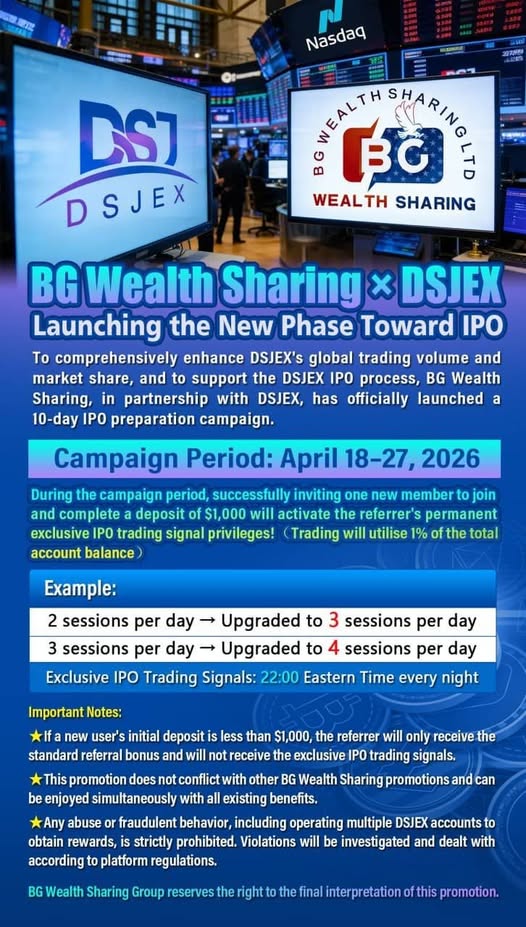
Just before the platform went dark, the operation executed one final attempt to extract money from trapped victims. It was brazen, calculated, and revealed the true nature of the people running this scheme.
A man presenting himself as CEO Stephen Beard appeared in a video address to users over the weekend before the seizure. He told investors that DSJ Exchange was on the verge of an initial public offering (IPO) — a story designed to create excitement and legitimacy at the worst possible moment for victims. But the real ask was what followed: he told users that a 12% tax on account balances was required before anyone could access their funds as part of the IPO process.
Beard Told Users a 12% Tax Was Required to Unlock Withdrawals
This “12% IPO tax” was a textbook advance fee fraud — one of the oldest tricks in the financial scam playbook. Victims who were already unable to withdraw their money were being asked to send even more money for the promise of unlocking what they believed they had already earned. The Washington State Department of Financial Institutions confirmed this framing, identifying the demand as a hallmark advance fee scam tactic. Anyone who paid the 12% simply lost that additional amount on top of everything else already gone.
Washington State DFI Confirmed It Was an Advance Fee Scam
The Washington State Department of Financial Institutions (DFI) was among the regulators that publicly identified BG Wealth Sharing’s final demand as a classic advance fee scam. In this type of fraud, victims are told they must pay an upfront fee — framed as a tax, processing charge, or legal requirement — to unlock funds they are owed. The fee is never the last one, and the money never comes.
What made this particular version especially cruel was the timing. Victims had already watched their accounts freeze, withdrawals get blocked, and customer support go silent. Beard’s video appeared at precisely the moment when people were most desperate, most emotionally invested, and most willing to believe one more payment might fix everything. That is not an accident — it is a deliberate psychological tactic used by scam operators globally.
The DFI’s confirmation matters because it creates an official public record. If you were targeted by this specific demand and paid the 12% fee, that interaction is documented and should be included in any fraud report you file with law enforcement.
Advance Fee Fraud — How to Recognize It:
“Any investment platform that requires you to pay a fee, tax, or charge in order to withdraw your own money is committing advance fee fraud. Legitimate platforms never require payment to release your existing balance. This is true regardless of how the fee is framed — whether called an IPO tax, processing fee, government levy, or verification charge.”
— Washington State Department of Financial Institutions
BonChat “Hack” Exit Into the BG-015 Wealth Sharing Investment Group on Telegram
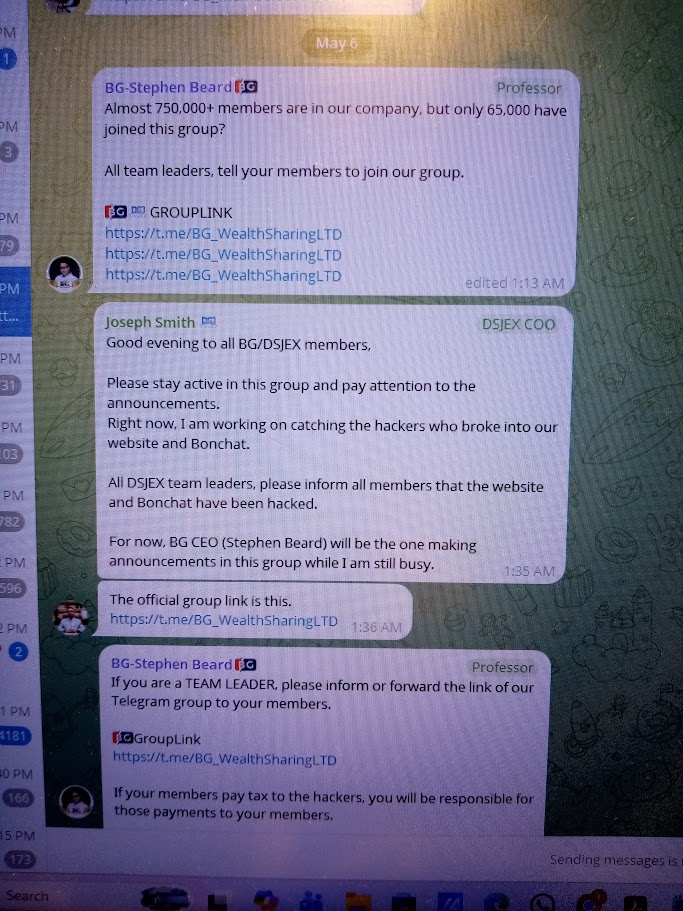
One of the most psychologically confusing phases of the entire BG Wealth situation began when the narrative suddenly shifted toward claims that BonChat had been “hacked” by Chinese hackers.
At the time, many people inside the community genuinely believed this explanation because the communication happened so quickly, emotionally, and with a sense of urgency that made the situation feel chaotic and dangerous in real time.
Almost overnight, leaders from BG Wealth began instructing their teams to immediately leave BonChat and stop trusting the information appearing there. Members were warned not to click on links being shared inside the platform, not to follow the trading codes allegedly being posted by the hackers, and especially not to pay the widely discussed “12% tax” that suddenly started appearing as part of the unfolding situation.
People were told that hackers had taken over BonChat and were now attempting to manipulate users financially.
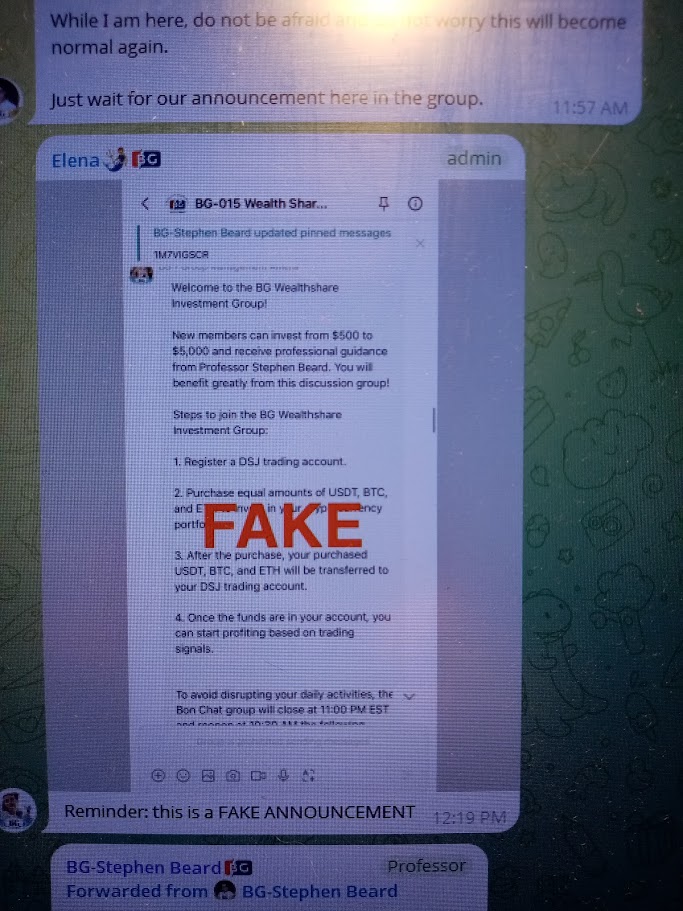
At the same time, members were urgently redirected into Telegram groups that leadership figures claimed were now the “real” communication channels being used by Professor Beard and Elena moving forward.
Looking back now, this moment feels incredibly important psychologically because it created a transition phase where confusion itself became part of the emotional control mechanism surrounding the community.
People were scared.
Confused.
Emotionally overwhelmed.
Desperate for updates.
Desperate for reassurance.
And desperately trying to understand who or what could still be trusted.
In emotional situations like that, people naturally gravitate toward whoever appears calm, organized, and authoritative.
That is exactly why the Telegram migration worked so effectively for many members at the time.
The groups presented themselves as safe spaces away from the alleged hackers. Leaders reassured members that the “real team” was still operating behind the scenes and that communication would now continue safely through Telegram instead.
But when I look back at this phase now with much more emotional distance, several things stand out very differently to me.
One major red flag was the fact that many of these Telegram groups had only been created very recently.
At the time, however, most people did not focus on that detail because emotions were running extremely high and everyone was searching for stability, guidance, and answers. The sudden migration itself created an atmosphere where people stopped critically analyzing the structure of what was happening because they were too emotionally focused on protecting their funds and staying connected to the supposed “real” leadership.
And that is one of the most psychologically fascinating aspects of situations like this.
Confusion can sometimes become an incredibly effective tool for maintaining emotional influence over large groups of people.
Because once fear enters the picture, people become far more willing to follow new instructions quickly without slowing down long enough to analyze the broader situation rationally.
What also made the entire experience feel believable at the time was that the warnings themselves sounded responsible on the surface. Members were repeatedly told:
- not to pay anything,
- not to click suspicious links,
- not to trust random codes,
- and not to interact with the alleged hackers.
- not to watch the bonchat video of Professor Beard claiming a 12% ipo tax fee because the only real professor who is now on Telegram claims that the video of him in bonchat is not the real professor Stephen Beard but it is a fake video of him
Members were told not to watch the BonChat video featuring Professor Beard discussing the controversial 12% IPO tax fee because, according to the “real” Professor Beard who had now supposedly moved over to Telegram, the version of him appearing inside the BonChat video was allegedly fake.
Yes, read that again carefully.
At that stage, the narrative had become so twisted that members were essentially being told that the fake AI professor was now warning everyone about another fake version of the same fake AI professor.
Honestly, if someone had written this storyline into a psychological crypto thriller a few years ago, most people probably would have dismissed it as unrealistic.
And yet this was unfolding in real time inside emotionally invested communities where ordinary people were desperately trying to understand who, if anyone, was actually real anymore.
Ironically, that type of messaging still created the impression for many members that leadership was actively trying to protect the community rather than manipulate it, because the constant warnings, explanations, and emergency updates made the situation feel more like a company under attack than a system potentially collapsing from within.
Sadly enough for many ordinary members, that reinforced the emotional belief that Professor Beard, Elena, and the surrounding leadership structure were still legitimate victims of an external attack rather than participants in a much larger collapse unfolding underneath the surface.
Looking back now, however, this entire phase feels much more like a critical transition point in the emotional unraveling of the scheme itself.
Because once communication systems suddenly shift, narratives rapidly change, urgency escalates, and members are emotionally redirected into newly created channels while being told to distrust previous systems entirely, it becomes extremely difficult for ordinary people to separate truth from manipulation in real time.
Especially inside emotionally charged communities where trust has already been carefully built over many months.
I honestly think this can not get even more twisted than this or can it get even weirder?
My Personal Interpretation of the BonChat “Hack” Narrative
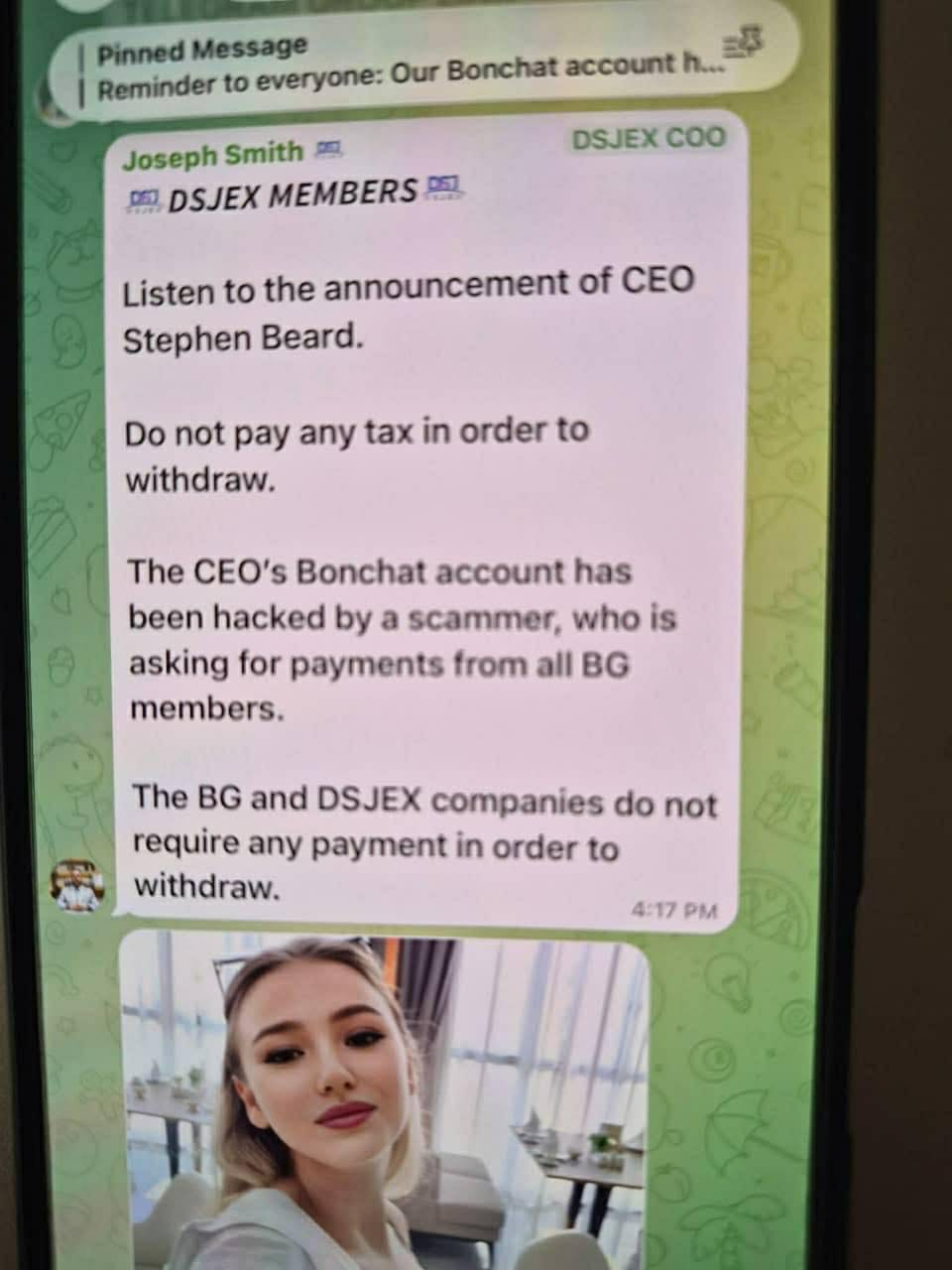
Elena, Professor Beard’s assistant
Looking back now, one of the biggest questions many members still have is whether the BonChat “hack” story itself may have been part of the larger unraveling process surrounding BG Wealth Investing.
At the time, members were told that Chinese hackers had taken over BonChat, were spreading malicious links, promoting fake trading codes, and attempting to convince users to pay a controversial 12% tax. Leaders urgently instructed people to leave BonChat and move into newly created Telegram groups that were presented as the new official communication channels connected to Professor Beard and Elena.
But in hindsight, the situation raises many difficult questions.
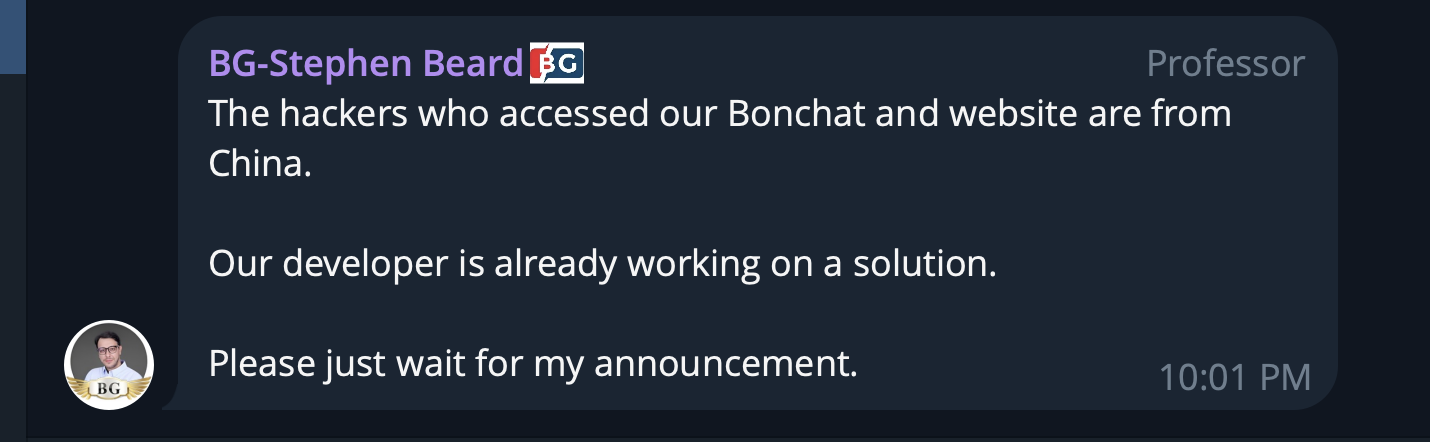
bg wealth sharing bonchat hack
The sudden migration away from BonChat, the emotional urgency, the confusion surrounding withdrawals, the rapidly changing communication structures, and the appearance of freshly created Telegram groups all became significant red flags for many people afterward.
Personally, I cannot definitively prove what happened behind the scenes, and I think it is important to remain responsible and factual when discussing situations like this. However, looking back at the sequence of events as a whole, many members understandably began questioning whether the alleged “hack” narrative itself may have played a role in the broader collapse and confusion surrounding the platform.
And I think that uncertainty is precisely what made the situation so psychologically difficult for many people involved.
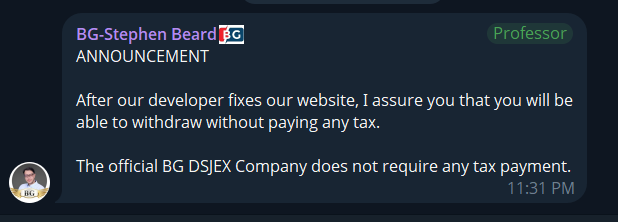
bg wealth sharing scam
Because once communication systems collapse, narratives change rapidly, and trust begins breaking down inside emotionally invested communities, it becomes extremely difficult for ordinary members to separate truth, panic, manipulation, and misinformation in real time. At that stage, many people no longer even knew who the “real” Professor Beard was supposed to be and which communication channels were authentic versus fake.
The situation became even more disturbing once specialized AI analysts later began publicly claiming that the entire Professor Beard persona may itself have been artificially generated or heavily manipulated through AI technology, including the Zoom meetings, AI-generated videos, fake images of Professor Stephen Beard, and the public identity that had been presented to the community for months. Similar concerns were also raised surrounding the identity of his assistant, Elena.

professor Dr. Beard fake Ai zoom meetings
The question that still remains is this: who else, especially among the highest “superstar” leadership levels, may not have been who they appeared to be?
I will continue asking questions, documenting what I find, and releasing a series of related blog posts as more information becomes available in this case. I also encourage everyone who was involved to do the same: ask questions, preserve screenshots and records, report relevant information to the government agencies I mention below, and do not stop seeking answers until more pieces of the puzzle come together.
For me personally, I need to understand the full picture as clearly as possible. If new details emerge, I may update this article and add additional related articles to this series.
I have always believed that staying curious helps us understand life at a much deeper level. Curiosity keeps us grounded, aware, and willing to look beneath the surface instead of simply accepting whatever story is handed to us.
And in the age of AI, that curiosity matters more than ever.
I encourage everyone affected by this situation to stay curious about this entire AI phenomenon and to keep asking who the real people behind these identities were. I sincerely hope law enforcement and investigators uncover the truth piece by piece, so that innocent victims, especially those who lost their life savings, can one day find some measure of peace again.
Warning Signs That Were There From the Start for BG Wealth Sharing
The uncomfortable truth about BG Wealth Sharing is that the warning signs were visible long before the site was seized. Multiple regulatory bodies across different countries raised alarms. Online communities flagged suspicious recruitment tactics. And yet the platform kept growing, kept pulling in new depositors, and kept paying just enough early returns to maintain the illusion. Here is what was there from the beginning — and what to watch for in the future.
Central Bank of Samoa Called It a Scam in April 2025
In April 2025 — a full year before the federal seizure — the Central Bank of Samoa issued a public warning about BG Wealth Sharing. After receiving complaints from investors, the regulator updated its position and explicitly stated that BG Wealth Sharing was likely an investment scam, urging the public to avoid the platform entirely and not send any money.
A central bank warning is not a minor regulatory footnote. It is about as loud an alarm as a financial authority can sound without a court order. The fact that BG Wealth Sharing continued to operate and recruit victims for another year after that warning illustrates how effectively the platform used social media, fake success stories, and community trust networks to overwhelm credible official warnings.
Multiple Regulators Flagged BG Wealth as Unlicensed Since 2025
Beyond Samoa, several other financial regulators identified BG Wealth Sharing as an unlicensed investment entity throughout 2025 and into 2026. Operating without a license is not a technicality — it means the platform had no legal authorization to solicit investments, manage funds, or promise returns in the jurisdictions where it was actively recruiting. No audit trail. No regulatory oversight. No investor protections of any kind.
A licensed investment firm is required to maintain records, submit to audits, and follow strict rules about how client money is handled. BG Wealth Sharing had none of that accountability. When the money disappeared, there was no regulator, no insurance scheme, and no legal framework to protect the people who had trusted it.
Scammers Deployed Bots and Fake Victim Accounts to Silence Critics
One of the most disturbing tactics employed by BG Wealth Sharing was its active effort to suppress public warnings. Operatives behind the scheme monitored Reddit threads, YouTube warning videos, and other online discussions about the platform. When someone posted a credible warning, scam agents — sometimes using fake accounts posing as concerned relatives of victims — would flood the comments with positive testimonials, claims of successful withdrawals, and attempts to discredit the person raising the alarm. For more information, you can read about how the US government seized BG Wealth Sharing.
According to community members on r/Scams who tracked this behavior in real time, BG Wealth Sharing bots were actively deployed against their own warning threads. Fake comments claiming large, successful withdrawals were planted specifically to give hesitant new recruits the confidence to deposit. These were not organic community voices — they were coordinated disinformation planted by the people running the scam.
This is why community warnings alone are never enough. If you see overwhelmingly positive comments on a thread exposing a suspected scam, that uniformity itself is a red flag. Real investment communities have mixed experiences and open debate. Manufactured ones do not.
Why Ponzi Schemes Like This Keep Targeting Expat Communities
There is a reason BG Wealth Sharing concentrated its recruitment in the Philippines, India, Pacific Island nations, and immigrant communities in the US and Canada. Tight-knit diaspora communities share information quickly through trusted networks — WhatsApp groups, church communities, family chat threads. When a trusted person in the group vouches for an opportunity, skepticism drops dramatically. Scammers understand this social architecture perfectly and exploit it with precision. The referral commission structure was not just a growth tool — it was engineered specifically to weaponize community trust.
Add to that the genuine appeal of financial independence in communities where traditional wealth-building pathways feel blocked or slow, and you have an audience that is both highly motivated and, through no fault of their own, more exposed to risk. The path to real financial freedom requires recognizing that the shortcuts being offered in these schemes are not shortcuts at all — they are traps designed to look like doors.
What Victims of BG Wealth Sharing Should Do Right Now
If you lost money to BG Wealth Sharing or know someone who did, the window to act is now. The seizure of the domain is the beginning of an investigation, not the end of it — and what victims do in the coming weeks can directly affect the outcome for everyone involved.
Report the Fraud to the FBI’s Internet Crime Complaint Center (IC3)
File a complaint immediately at ic3.gov. Provide every detail you have: the amount you deposited, dates of transactions, any communications you received from BG Wealth Sharing or DSJ Exchange, wallet addresses you sent funds to, and any names or usernames associated with your account or your recruiter. The more specific your report, the more useful it is to investigators tracking the money trail across blockchain networks.
Contact Your Bank Immediately If You Sent Money
If any portion of your investment was sent via bank transfer, credit card, or payment app like PayPal or Zelle, contact your financial institution the same day you read this. Banks have dispute and fraud recovery processes, but they are time-sensitive. The longer you wait, the lower the chances of reversing a transaction.
Crypto transfers are harder to reverse, but not always impossible. Law enforcement has already partnered with Tether, Binance Security Team, and OKX in this case, which means some frozen or flagged wallets may be subject to asset recovery efforts. Document every wallet address and transaction ID you have access to — this information becomes evidence.
Here is a quick action checklist for BG Wealth Sharing victims:
- File a complaint at ic3.gov (FBI Internet Crime Complaint Center)
- Contact your bank or payment provider immediately to report fraud
- Save all emails, screenshots, chat logs, and transaction records
- Record every wallet address and transaction ID associated with your deposits
- Report to your country’s financial regulator (e.g., FTC in the US, FCA in the UK)
- Warn anyone you referred to the platform so they can also take action
Important: Do not delete any communications from BG Wealth Sharing, DSJ Exchange, or anyone who recruited you. Even messages that seem minor can be critical to investigators building a fraud case. Screenshot everything and store copies in multiple places.
Beware of Recovery Scams Posing as Helpers After the Takedown
This is urgent. Within days of a major scam collapse, a secondary wave of fraud always follows — recovery scams. These are fraudsters who specifically target known victims of collapsed schemes, posing as lawyers, government agents, crypto recovery specialists, or victim advocates. They promise to recover your lost funds for an upfront fee. They are scammers. There is no legitimate private recovery service that guarantees the return of crypto lost to fraud, and any group charging upfront fees to recover your money is running the same advance fee fraud BG Wealth Sharing used at the end. Report any such contact to the IC3 immediately.
Crypto Investment Scams Cost Americans $21 Billion in 2025 Alone
BG Wealth Sharing was not an isolated incident — it was one entry in an accelerating global epidemic of crypto investment fraud. The scale of losses is staggering and growing year over year as scam operations become more technically sophisticated, more psychologically refined, and more globally coordinated.
The $150 million suspected loss figure associated with BG Wealth Sharing alone represents thousands of real people — many of whom were not wealthy investors looking for high-risk plays, but ordinary people chasing financial stability, trying to build something for their families, and placing trust in a platform that was engineered from day one to steal from them. Understanding the true scale of this problem is not meant to discourage you from pursuing financial growth — it is meant to sharpen your instincts so that the next opportunity you evaluate gets the scrutiny it deserves.
How to Spot the Next BG Wealth Sharing Scam Before You Lose Money
The BG Wealth Sharing domain is seized, but the people who built it are not gone. They are regrouping, rebranding, and building the next version of this exact scheme under a different name, a different logo, and a different story. The mechanics will be identical. Your ability to recognize those mechanics is the only reliable protection you have. For more information on similar scams, you can read about how Binance froze $41.5M connected to a Ponzi scheme.
Genuine financial freedom is built on real assets, real returns, and real transparency. The gap between what BG Wealth Sharing promised and what any legitimate investment can actually deliver was so wide that a single question — how is this return being generated? — should have been enough to walk away. The answer they gave was vague by design. That vagueness is always a signal.
Here are the three most reliable red flags that would have identified BG Wealth Sharing as a scam from day one — and that will identify the next one just as clearly.
No Legitimate Investment Guarantees Daily Percentage Returns
BG Wealth Sharing promised a daily yield of 1.3% to 2.6%. At the lower end, that is a 474% annualized return. The S&P 500 averages roughly 10% per year over long periods. Warren Buffett’s Berkshire Hathaway has averaged around 20% annually over decades and is considered one of the greatest investment track records in history. Any platform promising daily percentage returns that compound to multiples of those figures is not offering a superior investment strategy — it is running a fraud. There are no exceptions to this rule.
Any Platform Requiring Fees to Withdraw Your Own Money Is a Scam
The moment BG Wealth Sharing demanded a 12% “IPO tax” before users could access their own balances, the scam was fully exposed. But this tactic had been in place informally long before Stephen Beard’s video — withdrawal delays, processing fees, and verification charges are all versions of the same trap.
A legitimate investment platform — whether a brokerage, a crypto exchange, or a fund — may charge standard trading fees or network gas fees on crypto transactions. What it will never do is require you to deposit additional money in order to withdraw the balance you already hold. If a platform blocks withdrawals and offers any reason why you must pay first, stop immediately. That is advance fee fraud. It does not matter how official the explanation sounds.
Unlicensed Entities With No Verifiable Leadership Are Red Flags
- Search the platform name in your country’s financial regulator database before depositing anything
- In the US, check FINRA BrokerCheck, the SEC’s Investment Adviser Search, and your state’s financial regulator
- Verify that named executives actually exist — search their names, look for a professional history, cross-reference LinkedIn profiles for consistency
- Check whether the platform appears in any regulatory warning lists from bodies like the FCA, ASIC, SEC, or central banks of targeted countries
- Look for a physical address and independently verify it — PO boxes and virtual offices registered in offshore jurisdictions are immediate warning signs
BG Wealth Sharing had no verifiable licensed status in any jurisdiction where it actively recruited victims. The Central Bank of Samoa flagged it. Multiple other regulators flagged it. The name “Stephen Beard” was presented as the CEO, but no verifiable professional history, credential, or legitimate public identity supported that claim.
Real investment firms are built on accountability. Every licensed entity is findable, auditable, and legally obligated to protect client funds. If you cannot independently verify who is holding your money and what legal framework governs it, you are not investing — you are donating to a fraud.
The standard you apply before trusting a platform with your money should be at least as high as the standard you would apply before trusting a stranger with your house keys. Ask hard questions. Demand verifiable answers. Walk away the moment the answers are vague, emotional, or designed to make you feel like the skepticism itself is the problem. For example, authorities recently froze $41M connected to a Ponzi scheme, highlighting the importance of due diligence.
BG Wealth Investing Is Gone, But the Scammers Are Already Using New Domains
Domain seizures end one chapter, not the story. The operators behind BG Wealth Sharing and DSJ Exchange are experienced at this. Sophisticated scam networks typically have contingency infrastructure — alternate domains, mirrored platforms, and new brand names ready to deploy within days of a takedown.
Victims have already been warned to watch for new platforms making contact under different names but using the same referral structures, the same yield promises, and the same recruitment scripts. If anyone who previously promoted BG Wealth Sharing to you contacts you with a “new opportunity,” treat that contact as a continuation of the original fraud.
The best defense is a standing policy: no investment platform gets your money without passing a full verification process. Check the regulator databases. Search the brand name combined with the word “scam” or “warning.” Look for independent reviews that are not on the platform’s own social media channels.
Give yourself at least 48 hours and a conversation with someone you trust before moving any funds. Scammers always create urgency — limited-time offers, special early access, rank bonuses that expire. Legitimate investments do not disappear overnight. If the opportunity cannot survive two days of due diligence, it was never a real opportunity.
🌿Want More Honest Opportunity Reviews?
Join my newsletter for calm reviews, scam awareness, and smarter online income ideas.
If reflections like this resonate with you, you may enjoy the Working With Kirsten newsletter, where I occasionally share deeper thoughts about building a meaningful online lifestyle, navigating digital communities, and creating environments that encourage curiosity and personal growth.
Inside the newsletter, I often expand on many of the themes explored here on the blog — including the evolving culture of the online world, the importance of thoughtful communities, and the small habits that quietly shape how life feels from day to day.
✨ Reflections on building a thoughtful internet lifestyle
🌱 Insights on personal growth and digital communities
☕ Behind-the-scenes perspectives from my own journey online
If these ideas interest you, you’re always welcome to join the conversation.
Join the Newsletter – Click Here!
No noise. Just thoughtful ideas and quiet reflections about building a life that feels genuinely rich.
Mistakes I Learned From BG Wealth Investing Scam
One of the hardest things about experiences like this is that the lessons usually arrive after the emotional attachment has already formed.
When people look at collapsed schemes from the outside, it can all seem obvious in hindsight. The red flags suddenly appear clearer. The inconsistencies become easier to recognize. The emotional manipulation becomes more visible once the entire structure begins falling apart publicly.
But when you are inside it in real time, especially when thousands of other people also appear convinced, hopeful, and emotionally invested, the situation feels very different psychologically.
That is one of the biggest lessons this experience taught me.
I learned that emotional environments can sometimes override critical thinking much more easily than people realize.
The combination of community excitement, constant success stories, AI terminology, charismatic leaders, group chats, professors, assistants, trading screenshots, and emotionally persuasive messaging slowly creates an atmosphere where people begin trusting the emotional momentum of the group more than their own instincts.
Looking back now, there were moments where I personally should have slowed down and questioned things more deeply instead of assuming that the appearance of professionalism automatically meant legitimacy.
I also learned how dangerous it can be when people emotionally depend on a platform succeeding.
Because once hope becomes emotionally attached to an outcome, the mind naturally starts protecting that hope. You begin rationalizing inconsistencies instead of confronting them directly. You tell yourself maybe the delays are temporary. Maybe the communication problems are misunderstandings. Maybe leadership simply needs more time.
And unfortunately, many schemes survive precisely because people want the story to remain true.
Another important lesson I learned is that large communities do not equal safety.
This is something I think many people misunderstand online today.
When thousands of members appear active, excited, and emotionally committed inside Telegram groups, Discord channels, chats, webinars, or livestreams, it creates a psychological sense of legitimacy. Human beings naturally assume that large numbers of people cannot all be wrong at the same time.
But history has repeatedly shown otherwise.
Some of the largest Ponzi schemes in history were surrounded by enormous communities of emotionally invested people right before they collapsed.
I also learned that AI terminology has become one of the most effective modern marketing tools for creating perceived credibility. The moment platforms begin combining artificial intelligence narratives with mysterious professors, exclusive systems, automated trading language, and luxury branding, many people automatically assume there must be advanced technology operating behind the scenes.
But sophisticated vocabulary does not replace transparency.
And finally, I learned something much more personal through this experience:
Peace of mind matters more than chasing emotionally exhausting opportunities that constantly leave you anxious, confused, or uncertain.
Today, I would rather grow slowly inside something transparent and understandable than constantly wonder whether an entire system is quietly unraveling underneath the surface.
That emotional stability matters more than people realize.
Legitimate Alternatives to Make Money Online After the BG Wealth Investing Scam
One of the saddest things I notice after large crypto collapses and online investment scandals is that many people begin losing trust in absolutely everything online afterward.
And honestly, that emotional reaction is understandable.
When people go through experiences involving delayed withdrawals, emotional manipulation, confusing leadership structures, AI narratives, pressure-filled communities, or platforms that slowly unravel in front of their eyes, it can leave behind a deep sense of disappointment and emotional exhaustion.
For some people, it even creates fear around trying anything online ever again.
But despite everything I have personally experienced over the years — including multiple scams, failed opportunities, disappointments, misleading platforms, and emotionally draining situations like BG Wealth Investing — I still do not believe the lesson is to become cynical about every opportunity that exists online.
There are legitimate ways to make money online.
There are ethical business models.
Real trading education communities.
Transparent platforms.
Sustainable income streams.
And genuine opportunities that reward patience, consistency, learning, skill development, and long-term effort.
The difference is that legitimate opportunities usually feel very different emotionally.
They do not rely heavily on secrecy, unrealistic guarantees, emotional pressure, mysterious professors, or constant reassurance to keep people committed.
Real opportunities are generally built on transparency, education, realistic expectations, and gradual progress over time.
That distinction matters enormously.
It is also why I personally take recommendations much more seriously today than I once did in the past.
I no longer believe in promoting random platforms simply because something is trending online or because people inside a group are emotionally excited about it. I also do not feel comfortable recommending opportunities I have never personally explored, tested, researched, or experienced firsthand myself.
My own approach today is much slower and far more grounded in direct experience.
Before I ever seriously recommend something, I prefer to:
- Research the company, structure, and leadership carefully
- Test the platform personally over time
- Observe how communication changes during difficult moments
- Evaluate transparency and consistency
- Study the real user experience beyond the marketing
- Assess whether the opportunity feels emotionally manipulative or educational
- And most importantly, decide whether I genuinely believe it creates real value for people long term
I think that is one of the most responsible ways to approach online opportunities today.
Far too many people online either aggressively promote platforms they barely understand or harshly criticize things they have never personally experienced themselves. Both extremes create confusion, emotional noise, and misinformation.
Personally, I prefer a more balanced approach.
Research first.
Observe carefully.
Test slowly.
And speak honestly afterward — both about the positives and the negatives.
I also believe it is important to take personal responsibility for our own decisions online.
Even when something turns out badly, there is still value in the learning experience itself if we are willing to reflect honestly afterward instead of simply staying emotionally trapped in blame or bitterness.
Every experience teaches something.
Sometimes the lesson is financial.
Sometimes psychological.
Sometimes emotional.
And sometimes it simply teaches us how to recognize dangerous patterns earlier the next time.
That is partly why I am actually grateful for the direction our own small community eventually took after BG Wealth Investing began collapsing.
Instead of remaining emotionally stuck in fear or disappointment, Drew shifted our group toward genuine trading education, emotional discipline, market understanding, and learning how to recognize manipulation tactics before becoming emotionally attached to future schemes.
And honestly, that healthier and more transparent direction has already created far more real momentum than emotionally chasing unrealistic promises ever did.
If you are exploring opportunities online moving forward, my biggest advice is this:
Move slowly.
Research deeply.
Never invest money you cannot afford to lose.
Pay attention to emotional pressure.
And trust your instincts when something no longer feels transparent or grounded in reality.
If you would like to explore more grounded and realistic opportunities for 2026 that I have personally researched, tested, or actively participated in myself, I will continue sharing them here on my blog over time together with honest reflections about my own experiences — both the successes and the mistakes.
You are also always welcome to reach out to me through my contact page or via my social platforms if you would like honest feedback, a second opinion, or simply a more realistic conversation about navigating the online business and crypto world without getting emotionally trapped inside hype-driven environments again.
Sometimes the healthiest thing we can do after disappointment is not to stop believing in ourselves completely.
It is simply to move forward wiser, calmer, more informed, and more emotionally aware than before.
My Final Verdict on BG Wealth Investing & AI Professor Beard and his Assistant Elena
After spending months observing the structure, community behavior, leadership communication, emotional manipulation patterns, withdrawal issues, professor narratives, and the eventual unraveling that began accelerating toward the end of April 2026, my personal conclusion is that BG Wealth Investing displayed many characteristics commonly associated with high-risk Ponzi-style operations and psychologically manipulative investment ecosystems.
What concerns me most is not only the financial damage itself, but the emotional architecture these systems create around people.
Because platforms like this rarely operate purely through logic.
They operate through hope.
They create emotionally immersive environments where people slowly begin building future dreams around the success of the platform itself. Financial relief becomes emotionally tied to the continuation of the system. Communities become emotionally dependent on maintaining optimism. Doubt becomes socially uncomfortable. And over time, people stop evaluating the situation objectively because too much emotional energy has already been invested into believing the narrative.
The AI professor structure itself also deserves much deeper public scrutiny.
After researching multiple schemes involving “professors,” assistants, AI trading education narratives, and emotionally persuasive mentorship systems, I personally believe these patterns are becoming increasingly common online. The names may change. The branding may evolve. The technology buzzwords may become more sophisticated. But the emotional mechanics behind these systems often remain remarkably similar.
That does not mean every trading educator or AI platform is automatically fraudulent. However, I do believe people should approach any platform involving guaranteed emotional certainty, mysterious leadership structures, unrealistic consistency claims, pressured community environments, or vague explanations around trading profits with extreme caution.
Especially when transparency disappears the moment harder questions begin surfacing publicly.
At this point, many people are still waiting for answers, waiting for withdrawals, and trying to understand exactly how deep the situation truly goes. Personally, I believe there is still much more to uncover regarding the leadership structures, promotional systems, and key figures surrounding BG Wealth Investing.
And once additional information becomes available, I plan to continue documenting these patterns in future articles because I think public awareness is one of the few real protections people have left in online financial environments increasingly driven by emotional manipulation and AI-powered marketing narratives.
More Resources & Recommended Reading
1. The Confidence Game
Why I Recommend Reading It
This book explores the emotional psychology behind scams, manipulation, persuasion, and why even highly intelligent people can become vulnerable under the right emotional circumstances. It is one of the best books I have personally read for understanding how trust is psychologically constructed inside schemes like these.
2. Influence: The Psychology of Persuasion
Why I Recommend Reading It
This book helps explain why urgency, authority figures, social proof, exclusivity, and emotionally persuasive environments are so effective online. After experiencing BG Wealth Investing unfold in real time, many of these psychological principles became impossible for me not to notice.
3. Thinking, Fast and Slow
Why I Recommend Reading It
An incredibly valuable book for understanding cognitive bias, emotional decision-making, and why human beings often ignore warning signs when emotionally invested in desired outcomes.
4. Extraordinary Popular Delusions and the Madness of Crowds
Why I Recommend Reading It
Although written long ago, this book remains surprisingly relevant today because it explores how crowd psychology repeatedly influences speculative financial behavior throughout history.
5. The Little Book of Common Sense Investing
Why I Recommend Reading It
This book serves as a powerful reminder that long-term financial stability is usually built slowly, transparently, and patiently rather than through emotionally charged promises of extraordinary returns.
Conclusion
Is BG Wealth Sharing still operating in 2026?
No. BG Wealth Sharing is not operating. The domain bgwealthsharing.com was seized by the FBI, the Department of Justice, and the U.S. Secret Service on May 2, 2026. The site now displays an official government seizure notice. Any platform currently using the BG Wealth Sharing name, branding, or claiming to be a continuation of that service should be treated as a fraud and reported to the IC3 immediately.
Who was behind the BG Wealth Sharing scam?
A man identifying himself as Stephen Beard presented himself as CEO of BG Wealth Sharing and DSJ Exchange, appearing in a video address to users just before the platform collapsed. However, no verified professional identity, regulatory registration, or credible public history has been confirmed for this individual. The use of a named figurehead is a common tactic in large-scale investment fraud — it provides an illusion of accountability while keeping real operators hidden. Investigations by the FBI and DOJ are ongoing, and the full identity of those responsible has not been publicly confirmed as of the seizure date.
Can victims of BG Wealth Sharing get their money back?
Recovery is not guaranteed, but it is not impossible. Law enforcement partners including Tether, Binance Security Team, and OKX cooperated with investigators in tracing laundered funds. Some assets may be recoverable through ongoing legal proceedings depending on how much was successfully frozen before or after the May 2 seizure. Victims should file with the IC3, contact their financial institutions, and monitor official DOJ announcements for updates on asset recovery and victim restitution processes.
What victims should absolutely avoid is paying anyone who promises to recover their funds privately. Recovery scams are already targeting BG Wealth Sharing victims. No private firm can guarantee the return of crypto sent to a fraud scheme, and any group charging upfront fees for that promise is running a second scam against the same victims. Report any such contact to ic3.gov.
What is DSJ Exchange and how does it relate to BG Wealth Sharing?
DSJ Exchange, also referred to as DSJEX, was the crypto trading platform presented as the engine behind BG Wealth Sharing’s daily returns. It was marketed as a legitimate exchange through which user funds were actively traded to generate profits. In reality, DSJ Exchange was part of the same fraudulent operation — a constructed façade designed to add credibility to the Ponzi scheme. Both platforms collapsed simultaneously, and DSJ Exchange domain activity was implicated in the same $92 million laundering operation tracked across blockchain networks between April 27 and May 3, 2026.
How do I report a crypto investment scam like BG Wealth Sharing?
Start with the FBI’s Internet Crime Complaint Center at ic3.gov — this is the primary reporting channel for US-based victims and is actively used by federal investigators working on cases like BG Wealth Sharing. Include every transaction detail, communication record, and wallet address you have. The more specific your report, the more directly it can contribute to the active investigation.
Outside the US, report to your national financial regulator. In the UK, that is the Financial Conduct Authority (FCA) at fca.org.uk/consumers/report-scam. In Australia, report to ASIC via moneysmart.gov.au. In the Philippines, contact the Securities and Exchange Commission (SEC Philippines). In Canada, report to the Canadian Anti-Fraud Centre (CAFC) at antifraudcentre-centreantifraude.ca.
Also file a report with the Federal Trade Commission (FTC) at reportfraud.ftc.gov if you are in the United States. If you sent money via a payment platform like PayPal, Venmo, or Zelle, report the transaction directly to that platform’s fraud team as well. Each report filed across each channel strengthens the overall case and improves the chances that assets connected to BG Wealth Sharing and DSJ Exchange are traced, frozen, and ultimately returned to victims.
Please Share Your Personal Experience With BG Wealth Investing
If you personally experienced issues involving BG Wealth Investing, Professor Beard, Bon Chat, delayed withdrawals, wallet binding, KYC verification problems, AI professor schemes, or related trading groups, feel free to respectfully share your experience in the comments below.
Did you notice warning signs early?
Were withdrawals delayed for you as well?
Did leadership explanations start changing over time?
Were you emotionally affected by the collapse?
Did you lose funds or know someone who did?
I believe open conversations around these experiences matter deeply because public awareness may help other people recognize similar patterns before becoming emotionally or financially trapped inside future schemes.
And as I continue researching this topic further, I also plan to publish additional breakdowns covering the leadership structures, recurring professor narratives, assistant systems, emotional manipulation techniques, and broader scam patterns that appear to connect many of these operations together.
🌿Want More Honest Opportunity Reviews?
Join my newsletter for calm reviews, scam awareness, and smarter online income ideas.
If reflections like this resonate with you, you may enjoy the Working With Kirsten newsletter, where I occasionally share deeper thoughts about building a meaningful online lifestyle, navigating digital communities, and creating environments that encourage curiosity and personal growth.
Inside the newsletter, I often expand on many of the themes explored here on the blog — including the evolving culture of the online world, the importance of thoughtful communities, and the small habits that quietly shape how life feels from day to day.
✨ Reflections on building a thoughtful internet lifestyle
🌱 Insights on personal growth and digital communities
☕ Behind-the-scenes perspectives from my own journey online
If these ideas interest you, you’re always welcome to join the conversation.
Join the Newsletter – Click Here!
No noise. Just thoughtful ideas and quiet reflections about building a life that feels genuinely rich.
Disclosure
Some of the links in this article may be affiliate links. This means that if you choose to make a purchase through one of these links, I may earn a small commission at no additional cost to you.
I only recommend books, services, products, tools, or communities that I genuinely find interesting, useful, or aligned with the ideas discussed on this site and that I am using myself.
My goal with WorkingWithKirsten.com is to explore thoughtful perspectives on online culture, digital entrepreneurship, and building a more intentional internet lifestyle. Any resources mentioned are shared with the intention of helping readers explore these topics further.
Thank you for supporting this work and for being part of the conversation.

Hi, I’m Kirsten!
I started Working with Kirsten to share my journey of rebuilding from burnout, scams, and setbacks — and to help others create purpose-driven income online.
Over the years, I’ve explored nearly every online business model you can think of — eBay, Amazon, Kindle publishing, Etsy, eCommerce — chasing freedom, creativity, and stability. Some of it worked. Some of it didn’t. I eventually burned out hard after losing my Kindle account, and later, I hit rock bottom when I was caught in one of the biggest affiliate scams of 2024, losing over $14,000 in unpaid earnings.
That moment nearly ended everything.
But instead of giving up, I used what I’d learned to rebuild. I found my mentor, tapped back into my creative energy, and started building a business that actually felt good to run — not just profitable, but meaningful.
That’s how Working with Kirsten and my philosophy of Helponomics were born — the idea that by helping others first, success naturally follows.
Today, I’m a digital creator and affiliate marketer focused on ethical partnerships, aligned offers, and creating income that’s both sustainable and soul-led.
Whether you’re just starting out or starting over, I’m here to show you that you don’t need to hustle yourself into exhaustion or fall for the hype. You can build a business with purpose, resilience, and heart — and I’d love to help guide you every step of the way.