
Article At A Glance
- Jordon Schultz’s bankruptcy case turned into a federal legal battle after his former business partner alleged he fraudulently undervalued a customer list worth potentially millions at just $778.60.
- The case — Keyword Rockstar, Inc. v. Jordon Schultz — moved through both the Bankruptcy Appellate Panel of the Ninth Circuit and the Ninth Circuit Court of Appeals.
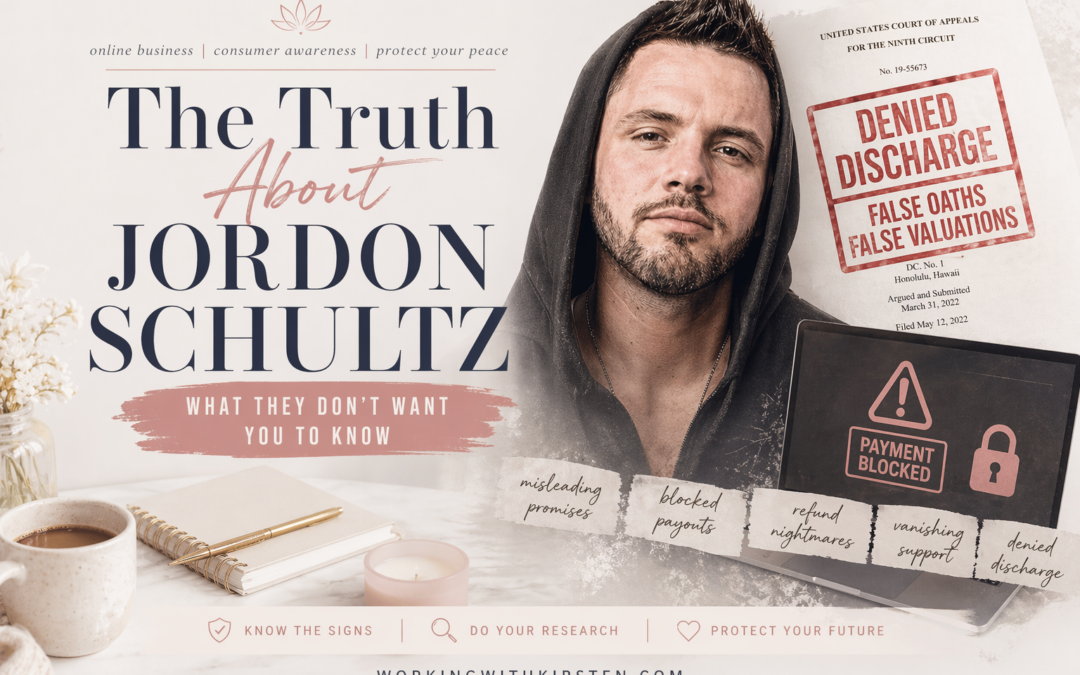
- Schultz’s discharge was denied on one key claim, § 727(a)(7), even though he won on several others.
- A house fire, custody battle, and mounting legal pressure all became part of the court’s analysis of his mental state and credibility.
- The disputed customer list sat at the center of everything: ownership, valuation, and whether the bankruptcy schedules were truthful.
- For anyone researching Jordon Schultz today, this is not just old legal history. It is part of a larger credibility record that should not be ignored.
Sometimes the Real Warning Sign Is Not the Sales Page — It Is the Paper Trail
There is something deeply unsettling about realizing that the truth behind a person can be far more complicated than the version most people encounter at first glance.
In the online world, first impressions are often carefully curated. A webinar may feel polished and persuasive. A mentor may speak with confidence and authority. A program can appear professional, structured, and full of promise. The overall presentation may leave people feeling as though they are standing at the threshold of a meaningful opportunity, one capable of changing their finances, their future, or the direction of their lives.
That is precisely why so many people trust appearances before they trust evidence.
Yet there are moments when curiosity leads someone to look beyond the presentation, and what emerges is something altogether different. Instead of a few scattered complaints or an isolated negative review, they uncover court filings, years of litigation, and a legal history that extends far beyond ordinary business friction. They find a dispute that did not quietly fade away, but instead expanded into a bankruptcy battle serious enough to reach the United States Court of Appeals for the Ninth Circuit.
That is why this case matters.
Because no matter how compelling someone may sound in a webinar, on a landing page, or inside a coaching program, public records often tell a steadier and more revealing story. They are less concerned with image and more concerned with facts, timelines, sworn statements, and consequences.
And in this instance, that story deserves to be taken seriously.
Why This Matters More Today
This is not simply a retrospective look at an old bankruptcy dispute. It remains relevant because people continue searching names like Jordon Schultz while trying to decide whether they should trust him, purchase from him, join something connected to him, or understand experiences they may have had themselves.
That is what makes this more than a technical legal article. It sits at the intersection of consumer trust, online business credibility, and the importance of informed decision-making.
When someone’s history includes serious customer complaints, allegations of misleading business practices, rebranded offers, blocked payouts, support problems, and later a federal bankruptcy case involving a denied discharge tied to false valuation issues, readers deserve access to the broader context. They deserve more than a polished sales narrative or the simplified claim that criticism is merely the result of “haters.”
They deserve the full picture.
And in this case, the fuller picture raises important questions about credibility under pressure, accountability when disputes arise, and what it means when a court concludes that a sworn version of events does not withstand scrutiny.
The Jordon Schultz Lawsuit Explained
This was not one simple lawsuit. It was a layered legal conflict that began as a civil dispute in 2015 and evolved into a bankruptcy fraud battle by 2017.
To understand what the courts actually decided, it helps to follow the timeline carefully.
At the center of it all was Jordon Wallace Schultz, the sole owner of JWS Publishing, Inc., a digital content company that sold instructional video products online. By 2016 and 2017, JWS was generating substantial revenue. That mattered later, because the plaintiffs argued that a business generating that kind of income should not have ended up presenting key assets as nearly worthless.
The case is formally known as Keyword Rockstar, Inc. v. Jordon Schultz, No. 19-60031, decided by the Ninth Circuit on June 25, 2020.
Who Is Jordon Schultz?
Jordon Wallace Schultz was the founder and sole owner of JWS Publishing, Inc. His company sold online instructional products and relied heavily on two business assets that later became the focus of the entire bankruptcy fight: a customer list and a lead list.
Those lists were not minor side assets. They were presented as core drivers of revenue. And once the bankruptcy filings placed a surprisingly low value on them, those numbers became one of the biggest credibility issues in the case.
The Core Dispute With Keyword Rockstar, Inc.
Keyword Rockstar, Inc., along with Jon Shugart and Luke Sample, filed an adversary complaint objecting to Schultz’s discharge under multiple provisions of 11 U.S.C. § 727. Their argument was that Schultz had behaved dishonestly in the bankruptcy process.
The allegation that mattered most was this: he had allegedly undervalued JWS’s customer list on the bankruptcy schedules, listing it at $348.60 when it may have been worth dramatically more.
Asset Valuation at the Center of the Case
| Asset | Schultz’s Scheduled Value | Plaintiffs’ Argued Value |
|---|---|---|
| JWS Customer List | $348.60 ($0.10 per lead) | Up to $1 million |
| JWS Lead List | $430.00 ($0.02 per lead) | Disputed |
| Total Scheduled Value | $778.60 | Argued to be significantly higher |
That gap was not something a court could casually overlook.
And what made it especially difficult for Schultz was that the higher number did not come from nowhere. It came from his own prior public statements.
How the Joint Venture Fell Apart
Before there was a bankruptcy case, there was a business relationship.
Jon Shugart and Jordon Schultz had entered into a 50-50 profit-sharing joint venture. Shugart brought content and expertise. Schultz brought the business infrastructure of JWS Publishing, including access to the customer list.
On paper, that kind of arrangement can look straightforward.
In reality, it unraveled quickly.
What Schultz Discovered in May 2015
In May 2015, Schultz discovered that Shugart had sold copies of JWS video content to contacts on JWS’s customer list without authorization. Shugart described it as testing the strength of the list. Schultz viewed it as an unauthorized use of business assets and a breach of the agreement.
That was the fracture point.
From there, both sides began accusing the other of wrongdoing, and the conflict escalated into litigation.
The Civil Lawsuit Filed in August 2015
In August 2015, Keyword Rockstar, Inc., Jon Shugart, and Luke Sample filed a civil lawsuit against Schultz, JWS Publishing, and others in the U.S. District Court for the Central District of California.
This is important because the story did not begin in bankruptcy. Bankruptcy came later, after the business dispute was already in motion.
And this was not a one-sided case either. Both sides claimed the other owed money. That fact matters because it shows how entangled and contested the business relationship had already become.
The Disputed Ownership of the Customer List
One of the biggest unresolved issues in the civil case was ownership of the customer list itself. Both sides claimed rights to it.
That unresolved ownership issue later became one reason the bankruptcy trustee did not move forward with selling the list during the JWS bankruptcy. If title is under dispute, liquidation becomes far more complicated.
Personal Hardships That Led to Bankruptcy
By the time Schultz filed for bankruptcy in 2017, the lawsuit with Keyword Rockstar had been dragging on for nearly two years.
But the legal dispute was only one layer of pressure.
The 2016 House Fire
In October 2016, Schultz lost his home and its contents in a house fire. That event became part of the court’s understanding of how someone associated with a profitable digital business could still end up in financial collapse.
Child Custody Litigation
At the same time, he was also involved in a child custody battle concerning his infant son. That added another layer of emotional and financial pressure.
Why the Court Considered This
Schultz’s legal team argued that the combination of the house fire, custody battle, medications, and litigation stress affected his mental state and should have weakened any inference of fraudulent intent.
The court considered those arguments.
But in the end, they were not enough to overcome the credibility problems surrounding the valuation issue.
Schultz’s Chapter 7 Filings in 2017
Schultz filed his personal Chapter 7 petition on March 22, 2017.
Seven days later, on March 29, 2017, JWS Publishing filed its own Chapter 7 petition.
That sequence became crucial because the conduct in the JWS case would later be used against him personally under § 727(a)(7).
How the Customer List Was Valued at $778.60
In the JWS bankruptcy schedules, Schultz valued the customer list at $348.60 and the lead list at $430.00, for a combined total of $778.60.
He relied on comparable sales data supplied by his accountant, Benjamin Rucker.
Now, that method itself was not automatically improper. Comparable sales can be a legitimate approach in some contexts.
The problem was the contradiction.
Schultz had also publicly said in a webinar that the customer list was worth $1 million.
That is where the case became especially difficult for him. Courts can tolerate disputes over valuation. What courts struggle to tolerate is a major discrepancy between public claims and sworn filings when the explanation for that discrepancy is not convincing.
Why Plaintiffs Argued the List Was Worth Far More
Keyword Rockstar argued that the list should not be valued using a narrow comparable-sales model when it had allegedly generated millions in revenue.
Their position was that a revenue-generating asset of that size could not credibly be treated as if it were worth less than $800 total.
The court did not have to determine the exact number.
It only had to decide whether the scheduled value was materially false and whether Schultz knew it.
That distinction matters. Bankruptcy courts do not always need a perfect alternate valuation. They need enough evidence to decide whether the number submitted under oath was knowingly misleading.
The Trustee’s Decision to Abandon the Lists
More than a month after JWS filed bankruptcy, the Chapter 7 trustee abandoned the customer list and lead list.
Why?
Because ownership was still being disputed in the ongoing civil litigation, and the trustee did not see a clear path to liquidating assets with unresolved title.
That decision had a ripple effect. Since the lists were not sold, there was no market transaction to establish value. The courts had to rely instead on testimony, public statements, and competing valuation methods.
That left room for argument — but it did not eliminate the core credibility issue.
The Four-Day Bankruptcy Trial
The adversary proceeding went to trial over four days.
Witnesses included:
- Jon Shugart
- Jordon Schultz
- Benjamin Rucker
- Susanne Morgan
- Joanna Morales
Schultz’s Testimony About His Mental State
Schultz described himself as functioning in a severely diminished state, affected by medications, trauma, and ongoing legal stress. His therapist offered supporting testimony.
But the court did not fully credit that explanation where it counted most.
In the end, this was not just about whether someone was going through a difficult season. It was about whether the court believed the explanation for the numbers in the schedules.
And on that issue, the court found his account lacking.
The Court’s Ruling on Each Claim
This case was not a total loss on every issue for Schultz, and that is worth stating clearly.
He prevailed on several claims.
Claims Where Schultz Won
- § 727(a)(3) — failure to keep adequate records: plaintiffs did not prove it.
- § 727(a)(4)(A) in his personal case — false oath: the Bankruptcy Appellate Panel reversed the bankruptcy court’s finding on that issue.
- § 727(a)(5) — failure to explain loss of assets: plaintiffs did not succeed.
So no, this was not a case where every accusation was upheld.
But that does not change what happened next.
The One Claim That Denied Schultz His Discharge: § 727(a)(7)
This was the claim that changed everything.
Section 727(a)(7) allows a court to deny someone’s personal discharge if they committed a disqualifying act in another bankruptcy case involving an insider.
Since Schultz was the sole owner of JWS Publishing, that insider relationship was clear.
The court concluded that he knowingly and fraudulently undervalued JWS’s customer list in the company bankruptcy. That finding then carried over into his personal bankruptcy through § 727(a)(7).
And that is the claim that survived appeal.
In simple terms: Schultz lost his personal discharge because of what the court found he did in the JWS bankruptcy case.
🌿Let’s Stay Connected & Continue the Conversation…
If reflections like this resonate with you, you may enjoy the Working With Kirsten newsletter, where I occasionally share deeper thoughts about building a meaningful online lifestyle, navigating digital communities, and creating environments that encourage curiosity and personal growth.
Inside the newsletter, I often expand on many of the themes explored here on the blog — including the evolving culture of the online world, the importance of thoughtful communities, and the small habits that quietly shape how life feels from day to day.
✨ Reflections on building a thoughtful internet lifestyle
🌱 Insights on personal growth and digital communities
☕ Behind-the-scenes perspectives from my own journey online
If these ideas interest you, you’re always welcome to join the conversation.
Join the Newsletter – Click Here!
No noise. Just thoughtful ideas and quiet reflections about building a life that feels genuinely rich.
Why This Should Concern Anyone Considering His Programs
This is where the legal history meets the present.
People do not usually search for bankruptcy appellate decisions because they are casually interested in federal procedure. They search because they are trying to decide whether they can trust someone now.
And this case gives them a reason to pause.
Credibility Does Not Reset Just Because Time Passes
If someone publicly describes a customer list as worth $1 million and then schedules it at $348.60 in federal bankruptcy papers, that does not become irrelevant simply because years go by.
A credibility problem on the record is still a credibility problem.
The Pattern Is What Readers Need to Notice
When this case is viewed alongside the other complaints you shared — hidden costs, aggressive coaching funnels, blocked payouts, support that disappears, refund problems, pressure tactics, and repeated rebranding — readers are not looking at one isolated issue.
They are looking at a pattern.
And patterns matter far more than polished branding.
Why You Should Run, Not “See for Yourself”
The Red Flags Are Already Enough
- unrealistic promises
- pressure-heavy webinars
- vague transparency
- hidden or escalating costs
- blocked access
- payout issues
- refund struggles
- weak or vanishing support
- business conduct serious enough to produce a published federal appellate case
Trust the Pattern More Than the Pitch
In the online world, polished presentations are easy to create. A smooth website, persuasive webinar, confident language, and carefully chosen testimonials can make almost anything appear credible for a moment. First impressions, especially when professionally packaged, can be remarkably persuasive.
But what matters most is rarely the front-end experience. It is what happens after payment that reveals the true nature of a business.
Does support remain available when questions arise, or does communication suddenly become difficult? Is access delivered as promised, or quietly restricted once the transaction is complete? Are refunds handled fairly and professionally, or turned into a prolonged struggle? Are payouts honored consistently, or delayed, disputed, and withheld when it matters most?
These moments are not minor details. They are often the clearest indicators of integrity. Anyone can design an appealing pitch. Far fewer can sustain trust once money has changed hands.
When support disappears, access is cut, refunds become exhausting battles, or payouts fail to arrive, the original sales message begins to reveal itself for what it may have been: not the truth, but the hook.
That is why wise consumers learn to study patterns rather than promises. A persuasive pitch can last an hour. A business pattern can speak for years.
The most important question is not how impressive something sounds before you join. It is how people are treated after they have paid, when the spotlight is gone and the marketing has done its job.
Trust is not proven in the presentation. It is proven in the follow-through.
Today, that standard is no longer sufficient.
The online world has evolved, and so have the methods used to persuade people. Sophisticated branding, attractive websites, smooth presentations, and carefully crafted testimonials can now be created with remarkable ease. What once appeared to be a sign of credibility may simply be a sign that someone understands marketing well. Those are not always the same thing.
Real due diligence now requires a deeper and more thoughtful approach. It means taking the time to look beyond the presentation and into the substance of what is being offered. It means searching public records when appropriate, reading independent reviews, paying attention to patterns of unresolved complaints, and noticing whether names, brands, or programs seem to change frequently whenever criticism begins to surface. It also means asking an often-overlooked question: what happens to customers after they have paid?
That final question can reveal more than any sales webinar ever could.
How a business treats people once the transaction is complete often tells the real story. Are customers supported when problems arise? Are refund policies honored fairly? Are questions answered respectfully? Do people feel helped, or simply processed and forgotten? These are the details that separate genuine businesses from operations built primarily on acquisition rather than service.
This shift in how we think about due diligence matters because many modern scams no longer look careless or obvious. They often appear polished, upscale, and convincing. They may borrow the language of success, community, mentorship, and opportunity. They may look far more sophisticated than the stereotypes people still imagine when they hear the word scam.
Yet appearance alone has never been evidence.
A beautiful presentation can be designed in a weekend. A compelling pitch can be rehearsed. Testimonials can be curated. Social proof can be manufactured. None of those things automatically confirm integrity.
What tends to matter far more is the paper trail left behind: court records, complaint histories, repeated patterns, broken promises, and the experiences of those who came before you.
In a world where image can be created quickly, substance remains slower, quieter, and infinitely more valuable.
Practical Reminders to Help You Avoid Falling Prey to Scammers Like Jordon Schultz
- Research the people behind the opportunity and its leadership before investing your trust.
A polished brand can be built quickly, but character usually reveals itself over time. Take the time to learn who is leading the company, how they have treated others, and what kind of reputation follows them. - Look beyond the sales page and into the real story.
Search for public records, complaints, past ventures, unresolved disputes, and the experiences of those who came before you. What is hidden in the background often matters more than what is shining in the foreground. - Be cautious whenever urgency replaces clarity.
Pressure to act quickly, limited-time language, or the feeling that you must decide immediately are often signs to slow down rather than speed up. Opportunities built on truth can withstand reflection. - Keep records of what was promised.
Save screenshots, emails, presentations, and written claims before joining anything. Memory fades, but documentation brings clarity when confusion begins. - Pay attention to how people are treated after they join.
Anyone can be warm and persuasive before payment. The real measure of a business is how it responds when questions arise, support is needed, or challenges appear. - Trust patterns more than presentations.
A single charming pitch can be rehearsed. A repeated pattern tells the deeper truth. When similar concerns keep surfacing from different people over time, it is wise to pay attention. - Never hand over your peace of mind for the promise of easy success.
If something feels rushed, murky, overly complicated, or ethically uncomfortable, honor that instinct. Peace, integrity, and self-respect are worth far more than any shiny opportunity.
Final Verdict on Jordon Schultz
After reviewing the federal bankruptcy case, the appellate outcome, the documented valuation dispute, and the broader pattern of complaints that continue to surround his name, my honest view is simple: Jordon Schultz is not someone I would trust with my money, my time, or my future.
This was not just a case of one unhappy customer or a misunderstood business disagreement. It became a published federal appellate matter with serious consequences, including the denial of his bankruptcy discharge under § 727(a)(7). That alone places this situation far beyond ordinary online criticism or casual internet gossip.
Just as importantly, the heart of the case was credibility.
When someone publicly describes an asset as being worth $1 million, then schedules it at $348.60 in sworn bankruptcy filings, reasonable people are entitled to ask serious questions. And when those questions end in a court ruling that survives appeal, those concerns do not simply disappear with time.
When that legal history is viewed alongside repeated complaints involving aggressive sales tactics, hidden costs, blocked payouts, refund problems, disappearing support, and rebranded offers, the overall picture becomes difficult to ignore.
My final verdict: there are far too many warning signs here for anyone to proceed casually. There are too many ethical educators, honest business opportunities, and transparent mentors available online to gamble on a track record like this.
Legitimate Alternatives to Make Money Online
One of the hardest parts after reading about a scammer like Jordon Schultz is that people can begin to doubt everything online. That reaction is understandable, but it is not entirely accurate.
There are legitimate ways to make money online. There are real platforms, ethical business models, and genuine opportunities that reward skill, consistency, patience, and effort. The key difference is that real opportunities do not rely on secrecy, unrealistic guarantees, or pressure tactics. They are built on value creation, transparency, and results that come through action over time.
That is also why I take recommendations seriously.
I do not believe in promoting random platforms I have never touched, nor repeating hype just because something is trending. I only recommend opportunities I have personally researched, signed up for, tested, applied, and gained real experience with myself.
My approach is simple:
- Research the company, model, and leadership
- Join and test the platform firsthand
- Apply the methods consistently
- Evaluate the real user experience
- Review the results honestly — good or bad
- Recommend only what I genuinely stand behind
I believe that is the only responsible way to speak about making money online.
You can also reach out to me via DM on my Facebook profile or through my contact page and send me a message if you would like personal guidance, honest feedback, or to see my experience and results for yourself.
Sometimes the best path forward after disappointment is not to give up, but it is simply to choose wiser, do your own research first, get facts and proof, and pick more transparent opportunities next time.
Resources and Recommended Reading
When stories like this surface, it is easy to focus only on one person or one program. But the wiser path is to use situations like this as an opportunity to become stronger, sharper, and more informed for the future.
That is why I always recommend combining practical consumer resources with books that improve judgment, discernment, and decision-making. Protecting yourself is not only about reacting after something goes wrong — it is about learning how to spot warning signs earlier next time.
Consumer Protection Resources
The FTC is one of the best places to learn how scams operate, how to report deceptive business practices, and how to recognize common fraud tactics before they cost you money.
Internet Crime Complaint Center
If something happened online, this is an important place to understand reporting options for internet-based fraud, misleading digital offers, and online financial deception.
It can help you review complaint patterns, customer experiences, and unresolved disputes before doing business with a company.
Your State Attorney General Consumer Protection Division
Many people forget this resource exists. State consumer protection offices often provide useful guidance and complaint channels for misleading business conduct.
Ripoff Report is a long-running consumer platform where individuals can publish complaints, reviews, and warnings involving scams, fraud, lawsuits, deceptive business practices, and unethical schemes. It also allows consumers to file their own reports and share firsthand experiences to help inform others.
Its broader purpose is consumers educating consumers. By making complaints and patterns publicly visible, the platform aims to help people avoid costly mistakes before they happen.
According to figures published by the platform, it estimates that consumers have avoided more than $15.7 billion in losses since 1997, and that over 2.6 million reports have been filed involving scammers, fraudsters, illegal operations, Ponzi schemes, and other harmful business conduct.
I also filed my complaint about Jordon Schulz and his March & April Traffic Sellers Club Coaching by Jordon Schultz – Encinitas CA with the ripoff report.and you can read it right here!
Recommended Reading
1. Thinking, Fast and Slow by Daniel Kahneman
Why I recommend reading it:
This book helps you understand why people make rushed emotional decisions under pressure. It is powerful for anyone who wants to become less vulnerable to urgency-based marketing and polished promises.
2. Influence: The Psychology of Persuasion by Robert Cialdini
Why I recommend reading it:
This is one of the most practical books ever written on persuasion. It teaches how scarcity, authority, social proof, and urgency are used to influence buying behavior.
3. The Confidence Game by Maria Konnikova
Why I recommend reading it:
It explains how trust is built and then exploited. A valuable read for anyone who wants to understand why intelligent people can still be deceived.
4. Duped: Why Innocent People Believe Lies by Abby Ellin
Why I recommend reading it:
This book is excellent for understanding the emotional side of deception — why hope, trust, and wanting something to be true can cloud judgment.
5. Scam Me If You Can by Frank Abagnale
Why I recommend reading it:
It offers practical modern scam awareness and teaches how fraud has evolved in the digital world.
6. The Laws of Human Nature by Robert Greene
Why I recommend reading it:
This book helps readers understand ego, manipulation, charm, hidden motives, and recurring human behavior patterns.
Finally, please check out the other article “Jordon Schultz Mobile CPA & Traffic Sellers Club Coaching Scam” I wrote about my personal experience with
I also recommend to check out the other article I wrote about him: “Jordon Schultz Mobile CPA & Traffic Sellers Club Coaching Scam,” where I share my personal experience, what I encountered firsthand, and the lessons I believe others can learn before making the same mistake.
Conclusion
In the end, this story is about far more than one individual, one lawsuit, or one disputed business venture. It is about the modern world many people now navigate every day, where confidence is often mistaken for competence, where polished branding can create the illusion of credibility, and where persuasive marketing can sometimes hide problems that only become visible after money has already changed hands.
It involved both a civil lawsuit over a failed business relationship and a later adversary bankruptcy proceeding. The bankruptcy fight became the most legally significant part because it resulted in denial of Schultz’s discharge.
Why was Schultz’s bankruptcy discharge denied?
His discharge was denied under § 727(a)(7) because the courts found that he knowingly and fraudulently undervalued JWS Publishing’s customer list in the company bankruptcy case.
Did Schultz lose every claim?
No. He prevailed on several claims, and one false oath finding in his personal case was reversed. But the discharge denial tied to the company case still stood.
Why does this matter now?
Because public legal history is part of a person’s credibility record. Anyone considering a program, coaching offer, or business relationship tied to Jordon Schultz has the right to consider that history before spending money.
What is the bigger lesson here?
The bigger lesson is that real due diligence goes beyond sales pages and testimonials. It includes lawsuits, court records, complaints, and patterns in how people are treated after they pay.
Share Your Perspective
Have you had an experience with Jordon Schultz, one of his programs, or another online coaching offer that did not turn out the way it was promised?
You are not alone.
Stories like these matter because they help other people slow down, research more carefully, and avoid learning expensive lessons the hard way.
Feel free to share your experience in the comments. The more people speak honestly, the harder it becomes for harmful patterns to stay hidden.
🌿Let’s Stay Connected & Continue the Conversation…
If reflections like this resonate with you, you may enjoy the Working With Kirsten newsletter, where I occasionally share deeper thoughts about building a meaningful online lifestyle, navigating digital communities, and creating environments that encourage curiosity and personal growth.
Inside the newsletter, I often expand on many of the themes explored here on the blog — including the evolving culture of the online world, the importance of thoughtful communities, and the small habits that quietly shape how life feels from day to day.
✨ Reflections on building a thoughtful internet lifestyle
🌱 Insights on personal growth and digital communities
☕ Behind-the-scenes perspectives from my own journey online
If these ideas interest you, you’re always welcome to join the conversation.
Join the Newsletter – Click Here!
No noise. Just thoughtful ideas and quiet reflections about building a life that feels genuinely rich.
Disclosure
Some of the links in this article may be affiliate links. This means that if you choose to make a purchase through one of these links, I may earn a small commission at no additional cost to you.
I only recommend books, services, products, tools, or communities that I genuinely find interesting, useful, or aligned with the ideas discussed on this site and that I am using myself.
My goal with WorkingWithKirsten.com is to explore thoughtful perspectives on online culture, digital entrepreneurship, and building a more intentional internet lifestyle. Any resources mentioned are shared with the intention of helping readers explore these topics further.
Thank you for supporting this work and for being part of the conversation.

Hi, I’m Kirsten!
I started Working with Kirsten to share my journey of rebuilding from burnout, scams, and setbacks — and to help others create purpose-driven income online.
Over the years, I’ve explored nearly every online business model you can think of — eBay, Amazon, Kindle publishing, Etsy, eCommerce — chasing freedom, creativity, and stability. Some of it worked. Some of it didn’t. I eventually burned out hard after losing my Kindle account, and later, I hit rock bottom when I was caught in one of the biggest affiliate scams of 2024, losing over $14,000 in unpaid earnings.
That moment nearly ended everything.
But instead of giving up, I used what I’d learned to rebuild. I found my mentor, tapped back into my creative energy, and started building a business that actually felt good to run — not just profitable, but meaningful.
That’s how Working with Kirsten and my philosophy of Helponomics were born — the idea that by helping others first, success naturally follows.
Today, I’m a digital creator and affiliate marketer focused on ethical partnerships, aligned offers, and creating income that’s both sustainable and soul-led.
Whether you’re just starting out or starting over, I’m here to show you that you don’t need to hustle yourself into exhaustion or fall for the hype. You can build a business with purpose, resilience, and heart — and I’d love to help guide you every step of the way.