
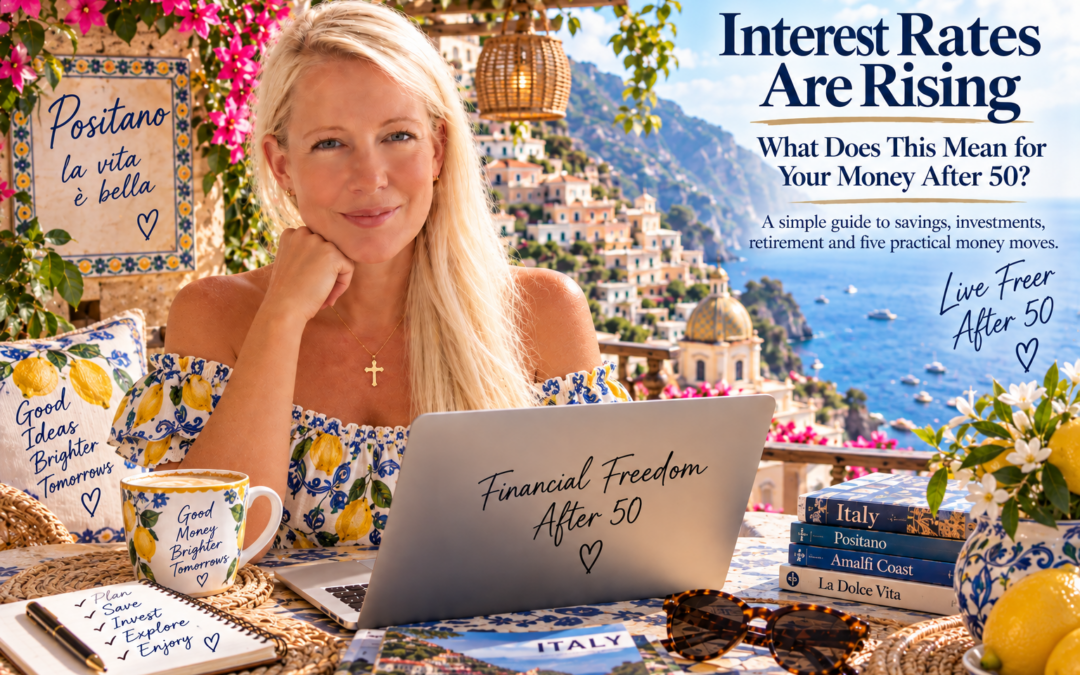
Back from vacation and worried about the financial headlines? Let’s make sense of what rising interest rates mean for our savings, investments, and retirement—without becoming Wall Street economists. 😂💰
Article at a Glance 💡
What happened? In September 2026, both the US Federal Reserve and the European Central Bank raised key interest rates by 0.25 percentage points—making rising rates relevant on both sides of the Atlantic.
Why does it matter? Interest rates influence borrowing costs, savings returns, and financial markets.
Is this bad news for investors? Not automatically. The effects depend on what you own, your financial situation, and how markets respond.
Should you change your plans? One headline isn’t enough reason to overhaul your finances. Your goals, risks, and timeline matter more.
My biggest takeaway: We can’t control interest rates, but we can understand our money and make more thoughtful decisions. ❤️
Back From Italy… and Straight Into Financial Reality! 🇮🇹😂
Well, I’m finally back home after a wonderful Italian adventure!
Naples, the Amalfi Coast, Rome, Florence…
Beautiful places, unforgettable memories, delicious food, and that wonderful feeling of stepping away from everyday life for a little while.
You know that feeling when you’re on vacation and the rest of the world seems to disappear?
For a few beautiful days, you’re simply enjoying life.
And then you come home.
You unpack your suitcase, catch up on your emails, check the news…
And suddenly, there it is.
Interest rates. Inflation. Stock market uncertainty.
Oh, wonderful. Welcome back to reality! 😂
As I started catching up on the financial headlines, I found myself asking:
What does this actually mean for my money?
Should I be worried about my investments?
What about my savings and retirement plans?
And do I need to do anything differently?
Because here’s the thing.
I’m not interested in becoming a Wall Street economist.
I’m interested in understanding how financial decisions affect ordinary people like you and me.
Especially when we’re over 50, working toward financial freedom, or thinking more seriously about the years ahead.
We work too hard for our money to make decisions based on headlines we don’t fully understand.
So I decided to break everything down into simple language.
No complicated financial jargon.
No dramatic predictions.
And definitely no pretending that anyone knows exactly what the stock market will do tomorrow.
Just a practical look at what’s happening and five useful things we can review.
Because enjoying life today and preparing for tomorrow shouldn’t be competing goals.
We can do both.
Join my newsletter and let’s continue building your future together.

What Actually Happened With Interest Rates? 💰
On September 16, 2026, the US Federal Reserve raised its benchmark interest-rate target by a quarter of a percentage point, bringing it to 3.75%–4.00%.
The Federal Reserve—often called the Fed—is America’s central bank.
One of its responsibilities is to help keep inflation under control while supporting employment.
And interest rates are one of the tools it uses.
Think of interest as the price of borrowing money.
When rates rise, borrowing can become more expensive for households and businesses.
That may encourage people to spend less and businesses to reconsider some investments, helping reduce pressure on prices.
But there’s a trade-off.
Higher borrowing costs can also slow economic activity.
Here’s a Simple Example
Imagine you borrow $10,000 and the full balance remains outstanding for one year.
At 5% annual interest, the interest would be approximately $500.
At 7%, it would be approximately $700.
That’s an extra $200 for borrowing the same amount.
Now imagine you’re saving $10,000 instead.
At 2% annual interest, you could earn approximately $200.
At 4%, you could earn approximately $400.
Suddenly, higher rates sound a little more attractive—at least if you’re the saver! 😂
These are simplified examples, excluding taxes, fees, compounding, and loan repayments. Your bank won’t necessarily change its rates by the same amount as the Fed.
The important lesson: Higher interest rates can be challenging for borrowers while potentially creating opportunities for savers.
What About Those of Us Living in Europe? 🇪🇺
The Fed makes monetary-policy decisions for the United States.
In the euro area, that responsibility belongs to the European Central Bank, or ECB.
And this time, the story isn’t only happening in America.
On September 10, 2026, the European Central Bank also decided to raise its three key interest rates by 0.25 percentage points (25 basis points). The new rates took effect on September 16—the same day the Federal Reserve announced its own quarter-point increase.
The ECB’s deposit facility rate is now 2.50%, its main refinancing rate 2.65%, and its marginal lending rate 2.90%.
So for those of us living in France and elsewhere in the euro area, rising interest rates aren’t simply an American financial headline. They are part of our financial picture too.
That doesn’t mean every French mortgage, savings account, or investment suddenly changes by 0.25%. Banks set their own product rates, and the effect depends on the type of account, loan, or investment you have.
A US rate increase doesn’t automatically raise the interest on your French mortgage or savings account either.
However, US decisions can still influence global markets, currencies, and international investments.
If you own American shares or global investment funds, developments across the Atlantic may affect your portfolio.
So it’s worth paying attention to what’s happening on both sides of the Atlantic—without assuming that every American headline applies directly to our lives here in Europe.
My takeaway: Understand the bigger financial picture, but pay closest attention to the interest rates, financial products, and policies that actually affect your own money where you live. ❤️
What Does This Mean for YOUR Money?
Let’s move away from central banks and talk about what actually matters around the kitchen table.
Our savings.
Our investments.
Our homes.
And our retirement plans.
1. Savings: Could Your Money Earn More? 🐷
Higher interest rates can encourage banks to offer better returns on certain savings accounts and fixed-term deposits.
Imagine having $10,000 in savings.
At 1%, you’d earn approximately $100 in a year.
At 4%, you’d earn approximately $400.
That’s a meaningful difference.
But don’t forget inflation.
If your savings earn 3% while prices rise by 4%, your balance may be growing while its purchasing power is shrinking.
And higher central-bank rates don’t guarantee that your particular savings account will pay more.
My takeaway: Check what your savings actually earn, whether you can access the money when needed, and how fees, taxes, and inflation affect the result.
Sometimes, improving our finances starts with understanding the money we already have. ❤️
2. Stocks: Should We Be Worried? 📈
Higher rates can make borrowing more expensive for businesses.
They can also make savings and some bonds more attractive relative to shares.
That may put pressure on certain stock prices.
But here’s something important:
A rate increase does not automatically mean a stock market crash.
Stock prices also depend on company profits, economic conditions, investor expectations, and the price investors are willing to pay.
A financially strong company with manageable debt may face different challenges from a business that relies heavily on borrowing.
And owning a diversified investment fund is different from relying on the fortunes of one company.
Diversification can reduce some risks, although it cannot prevent market losses.
My takeaway: Instead of reacting to a frightening headline, review what you own and whether your investments still match your goals.
3. Mortgages: Why Borrowing Costs Matter 🏡
Imagine finding a beautiful home with a terrace overlooking the Mediterranean.
You can already picture yourself sitting outside with your morning coffee. ☕🌊
Then you look at the mortgage payment.
And suddenly, that dream feels a little more expensive.
For example, a $200,000 fixed-rate repayment mortgage over 25 years would cost approximately:
- $1,056 per month at 4%
- $1,289 per month at 6%
That’s roughly $233 more each month, excluding insurance, taxes, and other costs.
Actual mortgage offers depend on the country, lender, borrower, and loan terms.
If you already have a fixed-rate mortgage, your contractual rate generally won’t change simply because a central bank raises rates.
Variable-rate borrowers may be affected differently.
My takeaway: If you’re considering buying property or refinancing, focus on the total borrowing cost and whether the payments comfortably fit your budget.
A beautiful home should support your lifestyle—not make every monthly bill a source of stress. ❤️
4. Retirement: Why Timing Matters After 50
This is the part that really caught my attention.
When we’re younger, we may have decades before we need our investments.
As retirement approaches, some of that money may be needed much sooner.
Imagine having $100,000 invested in the stock market.
If your portfolio falls by 20%, its value becomes $80,000.
If you don’t need that money for many years, you may have time to wait for a recovery—although recovery is never guaranteed.
But what if you need $20,000 next year?
You might have to sell investments while their value is down.
That’s why it can be important to distinguish money needed soon from money intended for long-term growth.
My takeaway: Review when you’ll need your savings, how much investment risk you can afford, and whether you have enough accessible money for near-term expenses.
Financial freedom isn’t just about growing our money.
It’s also about protecting our choices and peace of mind. ❤️
Should We Stop Investing When Interest Rates Are Rising? 📈
Now for the question I found myself asking:
Should I keep investing, or wait until everything calms down?
Waiting might feel safer.
But nobody knows exactly when the perfect moment to invest will arrive.
Markets can recover before the news improves. They can also continue falling.
One approach worth understanding is dollar-cost averaging.
Despite its fancy name, the idea is simple.
You invest a fixed amount at regular intervals rather than trying to predict the perfect purchase date.
Let’s Imagine You Invest $100 a Month
| Month | Share price | Amount invested | Shares purchased |
|---|---|---|---|
| January | $20 | $100 | 5 |
| February | $10 | $100 | 10 |
| March | $25 | $100 | 4 |
| Total | $300 | 19 |
When the price fell in February, your $100 bought more shares.
When the price rose in March, it bought fewer.
You followed a schedule rather than trying to guess the market.
If the share price finished at $25, your 19 shares would be worth $475.
But if it fell to $10, they would be worth only $190.
This is a hypothetical teaching example, not a typical return or a prediction. It excludes fees and taxes.
Dollar-cost averaging can make investing more systematic, but it doesn’t guarantee profits or eliminate losses. It also isn’t automatically better than investing a lump sum.
And there’s a difference between investing consistently and investing blindly.
Money needed for an emergency or a near-term expense may not belong in a volatile investment.
Regularly buying into a poor-quality or fraudulent opportunity doesn’t turn it into a good one, either. 😂
My takeaway: Before deciding how or when to invest, understand what you’re buying, when you’ll need the money, and how much you can afford to lose.
Five Smart Money Moves to Consider Right Now 💚
After catching up on the financial news, I realized something.
I can’t control interest rates.
I can’t control inflation.
And I certainly can’t control what the stock market decides to do tomorrow!
But there ARE things I can control.
So here’s my little post-vacation financial checkup.
Nothing dramatic.
No panic selling.
No rushing into an opportunity because somebody online says we’ll all be rich by Friday. 😂
Just five practical things worth reviewing.
1. Check Your Emergency Fund
Imagine returning from a wonderful holiday and discovering that your car needs repairing or your washing machine has broken down.
Welcome home! 😂
That’s exactly why accessible emergency savings matter.
A commonly suggested starting point is three to six months of essential expenses, although the right amount depends on your income stability, responsibilities, and circumstances.
Ask yourself: Could I handle an unexpected €2,000 expense without taking on expensive debt or selling investments at a loss?
If not, strengthening your emergency fund may deserve attention.
2. Review Your Debt
Expensive debt can quietly undermine our financial progress.
Imagine owing €5,000 on a credit card charging 20% annual interest.
If the entire balance remained outstanding for a year, the interest would be approximately €1,000 before fees.
That’s money you can’t use for savings, investments, or your next Italian adventure!
Review your interest rates, repayment terms, and any variable-rate borrowing.
Keep an appropriate emergency cushion, and check for penalties or other costs before refinancing or repaying a loan early.
Ask yourself: Am I paying unnecessary interest, and do I understand the total cost of my debts?
3. Give Your Savings a Checkup
Perhaps you’ve had the same savings account for years.
It’s sitting there quietly.
Not complaining.
Not doing anything particularly exciting. 😂
But when did you last check its interest rate?
Compare suitable accounts and products, including fees, taxes, withdrawal conditions, and applicable deposit protection.
For readers in France, regulated savings products such as the Livret A have their own rate-setting rules; they don’t automatically follow US Federal Reserve decisions.
Ask yourself: Is my money in an appropriate place for when I’ll need it?
4. Review Your Investments—and Your Ability to Withdraw
Our financial goals change over time.
An investment approach that made sense 20 years before retirement may need reviewing when retirement is much closer.
Check your diversification, costs, risks, and investment timeline.
And please don’t overlook something I’ve learned to take very seriously:
Can you actually access your money?
An impressive profit displayed on a screen is not the same as money safely available in your bank account.
Even one successful small withdrawal doesn’t establish that a platform is legitimate or that future withdrawals will work.
Before trusting an investment opportunity, investigate the provider, understand how returns are generated, check its regulatory status where applicable, and examine the withdrawal conditions.
Ask yourself: Do I understand what I own, what could go wrong, and how I would access my money?
5. Don’t Let Headlines Make Your Decisions
One day, someone predicts a crash.
The next day, someone else announces the greatest investment opportunity of our lifetime.
By Friday, apparently, we’re all supposed to be millionaires. 😂
No wonder financial news can feel exhausting!
Before making a decision, ask:
- Is this information from a reliable source?
- Do I understand the risks?
- Does this fit my financial goals?
- Am I acting because the decision makes sense—or because I’m frightened of missing out?
Sometimes, the most useful decision is to gather more information before doing anything.
My takeaway: We don’t need to react to every headline. We need to understand our own financial situation.
Kirsten’s Reflection: Why This Matters More Than Ever After 50
Coming home from Italy reminded me of something important.
Life is meant to be lived.
Walking through beautiful Italian streets, discovering new places, enjoying wonderful meals, and making memories with my husband…
Those are the moments I want more of.
Not more hours worrying about the stock market.
Not more sleepless nights wondering what interest rates might do next.
And certainly not more time chasing opportunities that promise the world but leave us with more questions than answers.
I want money to give us freedom, not take away our peace of mind.
But ignoring financial news doesn’t make its consequences disappear.
Inflation can still affect our grocery bills.
Interest rates can influence savings and borrowing costs.
And market downturns can affect the investments we may be counting on for retirement.
Over the years, I’ve explored different ways to build additional income online.
Some experiences have been encouraging.
Others have taught me lessons I would much rather have learned without spending money on them! 😂
One of the biggest?
An impressive number on a screen is not the same thing as financial security.
These days, I’m increasingly interested in understanding the risks, protecting my capital, and asking better questions.
And as I think about the years ahead, financial freedom means more than reaching a particular number.
It means having choices.
The choice to travel.
To spend time with the people I love.
To work on projects that interest me.
Or simply to handle an unexpected expense without unnecessary stress.
Your version of financial freedom might look completely different.
And that’s the point.
Our financial decisions should support the lives WE want to live.
My Italian vacation reminded me why I care about financial freedom in the first place.
I want more beautiful experiences, not more financial anxiety.
I can’t control central banks or predict markets.
But I can keep learning, review my finances, and make thoughtful decisions.
Financial freedom isn’t about predicting tomorrow.
It’s about making better decisions with what we know today—so we can keep enjoying the life we’re building. ❤️
Frequently Asked Questions 💬
Are higher interest rates good or bad for investors?
It depends on the investment. Higher rates can put pressure on some stocks while making certain savings products and newly issued bonds more attractive. The effect also depends on inflation, economic conditions, and market expectations.
Should I stop investing when rates rise?
Not automatically. Consider your financial goals, emergency savings, investment timeline, and tolerance for losses. A rate announcement alone doesn’t tell you whether a particular investment is suitable.
Will my savings earn more interest?
Possibly, but your bank may not pass on rate increases. Check the actual rate, fees, taxes, access conditions, and inflation.
Does a Fed rate increase mean the stock market will crash?
No. Interest rates are one of many factors influencing share prices. A rate increase doesn’t guarantee a particular market outcome.
Why should European investors care about US rates?
US monetary policy can influence international markets, currencies, and US investments held by European investors. But euro-area borrowing and savings conditions are more directly connected to European financial conditions and ECB policy.
Recommended Reading for Your Financial Freedom After 50 📚
You don’t need to follow financial news all day.
But a few reliable resources can help you understand the facts behind the headlines.
The Federal Reserve: Visit https://www.federalreserve.gov for official US interest-rate announcements.
The European Central Bank: Visit https://www.ecb.europa.eu for euro-area monetary-policy information.
Investor.gov: Visit https://www.investor.gov for beginner-friendly explanations of investing, diversification, and risk. Its account and regulatory guidance is US-specific.
If you prefer books, consider exploring:
- The Psychology of Money by Morgan Housel — understanding how behavior influences financial decisions.
- The Little Book of Common Sense Investing by John C. Bogle — an introduction to low-cost index investing.
- The Simple Path to Wealth by JL Collins — long-term investing and financial independence, with US-specific account guidance.
Choose the resources that answer the questions you’re actually asking.
You don’t need to become a financial expert.
You just need to become more confident about understanding your own money.
Tools & Resources for Exploring More Financial Flexibility 💚
One thought kept coming back to me as I settled home after Italy.
I can’t control the economy, but I can continue learning and exploring ways to create more flexibility in my life.
Sometimes that means improving our money-management skills.
Sometimes it means developing a new skill, starting a small project, or exploring an additional income opportunity.
Especially after 50, our experience can be valuable.
We understand people, recognize problems, and have skills that may help us create something useful.
But not every online opportunity is legitimate, suitable, or profitable.
Always investigate the business model, costs, risks, and income claims before getting involved.
If you’re curious about online business education and additional income opportunities, you can explore my Picked With Love recommendations right here.
You’ll find the resources and opportunities I believe are worth exploring for building financial freedom, developing useful skills, creating additional income streams and designing a life with more choice and purpose.
My philosophy is simple:
Quality over quantity.
Ownership over unnecessary dependency.
Skills you can take with you.
Income streams that support your life.
And assets you can actually keep.
Because protecting your future isn’t only about knowing who holds the keys to what you’ve already built.
It’s also about being much more careful about who gets the keys to what you build next.

Please note: An online income program is not a savings account, an investment, or a guaranteed source of income. A free starting option does not necessarily mean every feature or subsequent activity is free. Review the full terms of every program before joining.
Affiliate disclosure: Some recommendations on my website may contain affiliate links. I may earn a commission if you sign up or purchase through them, at no additional cost to you. Please research any opportunity independently and decide whether it suits your circumstances.
Continue Your Journey As An Entrepreneur Over 50
If you’re building financial freedom after 50, I’d love to continue encouraging you on your journey.
Every week, I share practical ideas about personal finance, wealth building, ethical online business, entrepreneurship after 50, mindset, intentional living, and creating a lifestyle with greater freedom and purpose. I also take you behind the scenes as I continue building Working With Kirsten from our home in the South of France—including the successes, the mistakes, and lessons like the one I’ve shared in this article.
Because ultimately, financial freedom isn’t just about having more money.
It’s also about having more control over what you’ve worked so hard to build.
More confidence knowing where your digital assets live.
More freedom to change providers, platforms or direction when something no longer works for you.
More independence from any one person or company.
More control over your time, income and future.
And more peace of mind knowing that the business you’re building is actually supporting the life you want to live.
Whether you’re just beginning your entrepreneurial journey or you’ve been building online for years, my goal is simple: to help you create greater financial freedom while learning from both my successes and my mistakes.
Because after everything this experience taught me, one principle will stay with me:
Build your income. Protect your assets. Keep your keys. And create a life with more choices. 💗
Join my newsletter and let’s continue building your future together.
Join the Conversation: What’s on Your Mind?
Now I’d love to hear from you.
When you see headlines about interest rates and inflation, what concerns you most?
Your savings?
Your investments?
Retirement?
Or simply making your money go a little further?
Please share your thoughts in the comments below.
You don’t need to be a financial expert to join the conversation.
Sometimes, the most valuable discussions begin with a simple question.
We’re all learning, and we can learn from one another.
Related Articles You May Enjoy
If this article has encouraged you to look more closely at your finances, explore these topics next on Working With Kirsten:
Retirement & Wealth Planning After 50: Building a plan that supports your next chapter.
Financial Freedom: Managing money, developing skills, and exploring realistic income opportunities.
Scams & Red Flags: Recognizing warning signs and protecting your hard-earned money.
One Last Thought From Me ❤️
I came home from Italy with wonderful memories and a renewed appreciation for the freedom to enjoy life’s beautiful moments.
Then I opened my emails and found myself thinking about interest rates. 😂
But perhaps that’s the balance we’re all trying to find.
Enjoy today. Understand your money. Prepare thoughtfully for tomorrow.
We can’t predict every financial headline.
But we can keep learning, protect our choices, and take one sensible step at a time.
With love,
Kirsten ❤️
Let’s Stay Connected
If you enjoyed this article and would like more inspiration on creating financial freedom, building an intentional business, protecting your time, and designing a life you love after 50, I’d love to connect with you beyond the blog.
You can find me here:
💗 Website: Working With Kirsten
📧 Newsletter: Working With Kirsten Newsletter
📺 YouTube: Working With Kirsten on YouTube
📘 Facebook: Kirsten on Facebook
📸 Instagram: Working With Kirsten on Instagram
📌 Pinterest: Working With Kirsten on Pinterest
𝕏 X (Twitter): Working With Kirsten on X
Thank you for being part of the Working With Kirsten community. I truly appreciate every visit, every comment, and every conversation we share. 💗
Disclaimer
This article is for general educational purposes and reflects my personal perspective. It is not individualized financial, investment, tax, or legal advice. Financial products and rules differ by country. Consider consulting an appropriately qualified professional for guidance specific to your circumstances.
Some links on Working With Kirsten may be affiliate links. If you choose to purchase through one of these links, I may receive a commission at no additional cost to you. I only share resources and opportunities that I believe may be useful to my readers, but no business opportunity or income method can guarantee results. Always conduct your own research and due diligence before spending money or making a business decision.

Hi, I’m Kirsten!
I started Working with Kirsten to share my journey of rebuilding from burnout, scams, and setbacks — and to help others create purpose-driven income online.
Over the years, I’ve explored nearly every online business model you can think of — eBay, Amazon, Kindle publishing, Etsy, eCommerce — chasing freedom, creativity, and stability. Some of it worked. Some of it didn’t. I eventually burned out hard after losing my Kindle account, and later, I hit rock bottom when I was caught in one of the biggest affiliate scams of 2024, losing over $14,000 in unpaid earnings.
That moment nearly ended everything.
But instead of giving up, I used what I’d learned to rebuild. I found my mentor, tapped back into my creative energy, and started building a business that actually felt good to run — not just profitable, but meaningful.
That’s how Working with Kirsten and my philosophy of Helponomics were born — the idea that by helping others first, success naturally follows.
Today, I’m a digital creator and affiliate marketer focused on ethical partnerships, aligned offers, and creating income that’s both sustainable and soul-led.
Whether you’re just starting out or starting over, I’m here to show you that you don’t need to hustle yourself into exhaustion or fall for the hype. You can build a business with purpose, resilience, and heart — and I’d love to help guide you every step of the way.