
by Kirsten Baum | Jul 27, 2026 | Lifestyle
Article At a Glance
- A consistent bedtime—not just the total number of hours you sleep—can be an important and often overlooked habit for adults over 50 who want to protect their energy, focus, and productivity.
- Irregular sleep schedules can disrupt your circadian rhythm, potentially affecting concentration, memory, decision-making, mood, and how well you handle stress.
- Research has linked irregular sleep patterns with poorer cardiovascular and metabolic health, making sleep consistency about much more than simply feeling rested in the morning.
- Small, practical changes—such as managing evening light exposure, creating a consistent wind-down routine, and setting a sensible cutoff time for caffeine—can help support a healthier sleep schedule.
- Later in this article, we’ll look at why sleeping much later on weekends may disrupt the rhythm you’ve established during the week—and what you can do instead.
Most high performers obsess over their morning routine, but I’ve started paying much more attention to what happens the night before.
What if one of the most underrated success habits is simply going to bed at a regular time?
After 50, sleep patterns can change, and maintaining a healthy sleep routine may become increasingly important. But this isn’t only about waking up feeling rested.
The quality and consistency of your sleep can influence how clearly you think, how well you manage stress, how much energy you bring to your work, and how effectively you navigate everyday life.
And if you’re building a business, preparing for retirement, creating additional income streams, or simply trying to make the most of your next chapter, those things matter.
At Working With Kirsten, I believe success after 50 isn’t about squeezing more and more work into every available hour.
It’s about learning how to use your time, money, health, and energy more intentionally so you can build a life that is not only financially secure—but one you actually have the energy and freedom to enjoy.
Because sustainable success isn’t about working against ourselves.
It’s about creating habits that allow us to keep showing up at our best for years to come.
A Regular Bedtime Is One of the Most Underrated Success Habits For Entrepreneurs After 50
We tend to treat sleep as a passive recovery tool — something that just happens when we’re done with our day. But for adults over 50, sleep is an active neurological process that either sharpens or dulls every skill that matters: focus, memory, creativity, and emotional resilience.
What makes a regular bedtime uniquely powerful isn’t just the sleep itself. It’s the consistency signal it sends to your brain and body. When you go to bed at the same time every night, your internal clock — your circadian rhythm — can anticipate that schedule and prepare your body for optimal sleep architecture. You fall asleep faster, spend more time in deep slow-wave sleep, and wake up with genuine cognitive clarity rather than just the absence of exhaustion.
Why Sleep Changes Dramatically After 50
After 50, several biological shifts converge to make sleep both more important and more fragile. Melatonin production decreases, meaning your natural sleep onset signal weakens. Slow-wave (deep) sleep — the stage most responsible for physical recovery and memory consolidation — decreases significantly with age. You also become more sensitive to sleep disruptors like light, noise, alcohol, and stress hormones.
These changes don’t mean poor sleep is inevitable. They mean that the habits surrounding sleep matter far more than they did two decades ago. Consistency becomes your primary tool for compensating for what biology naturally reduces.
What “Sleep Consistency” Actually Means
Sleep consistency means going to bed and waking up at the same time every day — including weekends. It’s distinct from sleep duration (how many hours you sleep) and sleep quality (how deep or restorative your sleep is), though it influences both significantly. Researchers sometimes measure this as “sleep regularity index” or SRI, a scoring system that quantifies how predictable your sleep-wake timing is across days. A high SRI score has been independently linked to better health outcomes, separate from total sleep time.
The Physical Health Payoff of Sleeping at the Same Time Every Night
The cognitive benefits of consistent sleep get most of the attention, but the physical health returns after 50 are just as significant — and in some cases, more urgent.
- Consistent sleep timing helps regulate blood pressure and reduce arterial inflammation
- Regular sleep-wake cycles improve insulin sensitivity and glucose metabolism
- Sleep consistency directly supports immune function, which weakens with age
- Stable sleep timing reduces nighttime cortisol spikes that accelerate cellular aging
- People with high sleep regularity show lower rates of obesity, diabetes, and cardiovascular disease
These aren’t minor quality-of-life perks. For adults over 50, these outcomes map directly onto your ability to stay active, think clearly, and sustain energy across long, demanding days.
The connection between sleep and physical health operates through multiple biological systems simultaneously. Your cardiovascular system, endocrine system, and immune system all follow circadian patterns — and when your sleep timing is erratic, all three systems take the hit at once.
Reduced Risk of Heart Disease and Metabolic Disorders
A study published in the Journal of the American College of Cardiology found that irregular sleepers had significantly higher rates of atherosclerosis, obesity, and metabolic syndrome compared to those with consistent sleep schedules — even when total sleep duration was similar. After 50, your cardiovascular system is already operating with less reserve capacity. Irregular sleep removes one of the most powerful free tools you have for protecting it.
How Sleep Consistency Regulates Cortisol and Stress Levels
Cortisol follows a precise 24-hour rhythm. It should peak in the early morning to promote alertness and taper off by evening. When your bedtime shifts by even 90 minutes from night to night, this cortisol curve flattens and distorts. The result is that you feel wired at night, groggy in the morning, and chronically stressed throughout the day — not because your life is more stressful, but because your hormone timing is off.
For professionals over 50 managing high-stakes decisions, teams, or businesses, this dysregulated cortisol pattern quietly degrades leadership capacity. You become more reactive, less patient, and slower to access creative thinking — all without knowing why.
The Link Between Regular Sleep and Longevity After 50
What the research shows: A large-scale study tracking over 60,000 adults found that those with consistent sleep schedules had a significantly lower all-cause mortality risk compared to irregular sleepers — independent of sleep duration, physical activity, or diet. Sleep regularity, researchers concluded, may be a more powerful longevity predictor than how many hours you sleep.
Longevity research consistently points to sleep consistency as a key lifestyle variable — sitting alongside diet and exercise in terms of measurable health impact. What’s striking is that the benefit appears to be specific to timing, not just totaling up hours across the week.
For adults over 50, this matters enormously. You may already be eating well and staying active. Adding sleep consistency to that foundation compounds the benefits of everything else you’re doing. Think of it as the multiplier habit.
There’s also a strong connection between regular sleep and preserved brain volume. Research from the University of California, Berkeley shows that deep sleep facilitates the glymphatic system — the brain’s waste-clearance process — which flushes out amyloid beta proteins linked to Alzheimer’s disease. Consistency in sleep timing maximizes the time spent in this critical deep-sleep stage.
Here Are 6 Practical Steps to Build a Consistent Bedtime Routine for Entrepreneurs After 50
Knowing why consistent sleep matters is step one. Actually building the habit is where most people stall. These six steps are sequenced intentionally — start with the first two and add the rest over two to three weeks rather than overhauling everything at once.
1. Set a Non-Negotiable Bedtime That Fits Your Chronotype
Your chronotype is your biological preference for sleep timing — whether you’re naturally a morning person (lark) or a night person (owl). Fighting your chronotype creates unnecessary friction. Instead, identify your natural sleep window and build your bedtime within 30 minutes of it. Most adults over 50 shift toward earlier chronotypes, with an optimal sleep window falling between 9:30 PM and 11:00 PM.
Once you pick your bedtime, treat it like a meeting you cannot reschedule. The consistency signal to your circadian rhythm requires repetition across at least 21 days before it becomes self-reinforcing. Put it in your calendar if needed — that level of intentionality is exactly what distinguishes people who build the habit from those who keep meaning to.
2. Cut Off Screens 60 Minutes Before Bed
Why screens are uniquely disruptive after 50: Blue light emitted by phones, tablets, and televisions suppresses melatonin production by up to 50%, according to research from Harvard Medical School. After 50, when melatonin production is already declining, this suppression has an outsized effect on your ability to fall asleep and stay in deep sleep.
The 60-minute screen cutoff isn’t an arbitrary wellness cliché — it’s the minimum buffer needed for melatonin levels to begin recovering after blue light exposure. For adults over 50 with already-reduced melatonin output, 90 minutes is even more effective.
Replace screen time with low-stimulation alternatives that actively support sleep onset. Reading physical books, light stretching, journaling, or listening to calm audio are all effective. The goal is to lower your neurological arousal level, not just remove the screen.
If eliminating screens entirely isn’t realistic, use blue light filtering glasses like the Swanwick Sleep Blue Light Blocking Glasses or enable Night Shift mode on Apple devices and Night Mode on Android. These reduce — but don’t eliminate — the melatonin suppression effect.
3. Use Light Exposure to Reset Your Circadian Clock
Morning light is one of the most powerful free tools for anchoring your circadian rhythm. Within 30 minutes of waking, expose yourself to bright natural light for at least 10 minutes. This sends a strong timing signal to your suprachiasmatic nucleus — the brain’s master clock — that sets the countdown timer for your evening melatonin release approximately 14 to 16 hours later.
On overcast days or if you wake before sunrise, a 10,000-lux light therapy lamp like the Verilux HappyLight Luxe replicates this effect effectively. Use it while drinking your morning coffee rather than adding it as a separate task — the habit stacks easily and takes zero extra time.
4. Limit Alcohol and Caffeine After 2PM
Caffeine has a half-life of approximately five to seven hours — meaning a 3 PM coffee still has half its stimulant load in your system at 8 PM or 9 PM. After 50, caffeine metabolism slows further, extending this window. The practical rule is simple: nothing caffeinated after 2 PM, and move that cutoff to noon if you’re particularly sensitive.
Alcohol is more deceptive. It helps you fall asleep but suppresses REM sleep in the second half of the night, causing you to wake at 2 AM or 3 AM with your mind racing. Even two drinks with dinner measurably reduces sleep quality. If you drink, finishing alcohol consumption by 7 PM gives your liver enough time to metabolize it before your sleep window.
Both adjustments feel like minor inconveniences until you experience a full week of uninterrupted, consistent sleep. At that point, the trade-off becomes obvious.
5. Keep Your Bedroom Cool and Dark
Core body temperature needs to drop by approximately 2 to 3 degrees Fahrenheit to initiate and sustain deep sleep. A cool bedroom directly supports this process. The optimal sleep temperature range is 65 to 68 degrees Fahrenheit (18 to 20 degrees Celsius) for most adults. Even sleeping one or two degrees warmer than this measurably reduces slow-wave sleep time.
Darkness matters equally. Even small amounts of light — from a streetlight through curtains or a blinking device LED — can disrupt melatonin production and lighten your sleep stages without fully waking you. Blackout curtains like the AmazonBasics Room Darkening Blackout Curtains and covering all LED lights in the room are low-cost, high-return investments in sleep quality.
6. Track Your Sleep With a Wearable Like the Fitbit Sense 2
What gets measured gets managed. A consumer-grade sleep tracker won’t give you clinical-level accuracy, but it will give you consistent, comparative data across nights and weeks — which is exactly what you need to identify patterns and make adjustments.
The Fitbit Sense 2 tracks sleep stages (light, deep, and REM), heart rate variability, skin temperature variation, and provides a daily Sleep Score that synthesizes these metrics into a single number. Its Sleep Profile feature, available with a Fitbit Premium subscription, compares your monthly sleep patterns against benchmarks and identifies your dominant sleep animal archetype — a practical tool for understanding your personal rhythm rather than chasing generic advice.
Other strong options include the Oura Ring Generation 3, which excels at readiness scoring and circadian alignment tracking, and the Garmin Venu 3, which offers detailed sleep coaching features within its Health Snapshot tool. Any of these devices turns sleep from a vague nightly guess into an actionable data stream.
Common Sleep Mistakes Entrepreneurs Over 50 Make Without Realizing It
The Invisible Sleep Saboteurs: Most adults over 50 who struggle with energy, focus, or mood assume the problem is aging. In most cases, it’s one of these four correctable habits quietly dismantling their sleep architecture night after night.
You can have the perfect bedroom setup, the right mattress, and a reasonable bedtime — and still wake up feeling like you didn’t sleep at all. After 50, the mistakes that hurt your sleep the most aren’t the obvious ones. They’re the subtle behavioral patterns that feel harmless but systematically disrupt the sleep consistency your brain and body now depend on.
Two of the most damaging habits are ones most people over 50 defend passionately — sleeping in on weekends and taking afternoon naps. Both feel restorative in the moment. Both quietly erode the consistency that makes every other sleep habit work.
Sleeping In on Weekends Undoes Your Progress
Sleeping in on Saturday and Sunday by even 60 to 90 minutes shifts your circadian rhythm in the same way flying across time zones does. Researchers call this social jetlag — the internal clock misalignment caused by inconsistent sleep timing between weekdays and weekends. For adults over 50, whose circadian rhythm is already less robust than it was at 30, this weekly disruption is enough to keep you perpetually in a state of mild jet lag.
The fix isn’t complicated, but it does require letting go of the idea that weekends are for “catching up” on sleep. You cannot bank sleep in advance or repay a sleep debt by sleeping longer — that’s not how sleep architecture works. Instead, allow yourself a maximum of 30 extra minutes on weekend mornings. That small buffer preserves your circadian consistency while still feeling like a gentle concession to the slower weekend pace.
Napping Too Late in the Day Disrupts Nighttime Sleep
A well-timed nap is genuinely beneficial after 50 — but timing is everything. Napping after 3 PM reduces sleep pressure, the biological drive to sleep that builds throughout the day. With less sleep pressure at bedtime, you’ll take longer to fall asleep, spend less time in deep sleep, and likely wake earlier than intended. Done repeatedly, late napping creates a feedback loop of light nighttime sleep followed by daytime tiredness that makes napping feel necessary again the next afternoon.
If you nap, keep it to 20 to 25 minutes maximum and schedule it no later than 1 PM to 2 PM. This window captures the natural post-lunch dip in alertness without cutting into your evening sleep drive. A short nap in this window improves afternoon cognitive performance without compromising nighttime sleep architecture — which is the result you’re actually after.
Start Tonight: Your Bedtime Is a Success Decision
Every night, the time you go to bed is a choice — and after 50, it’s one of the highest-leverage choices you make. The research is clear, the biology is specific, and the practical steps are simple enough to start tonight. Pick your bedtime, honor it tonight, and repeat it tomorrow. That’s the entire foundation. Everything else builds on that single consistent act.
Frequently Asked Questions
These are the questions adults over 50 ask most often once they take sleep seriously as a performance and health tool — answered directly, without oversimplification.
How Many Hours of Sleep Do Adults Over 50 Actually Need?
The National Sleep Foundation recommends seven to nine hours per night for adults over 50, with most people in this age group functioning optimally at seven to eight hours. Total sleep need doesn’t dramatically decrease with age — but the ability to achieve deep, consolidated sleep does, which is why consistent sleep timing becomes the primary lever for maximizing sleep quality within your natural sleep window.
Can a Consistent Bedtime Reverse Age-Related Cognitive Decline?
A consistent bedtime cannot reverse structural neurological changes, but the evidence is compelling that it significantly slows decline and protects existing cognitive function. Deep sleep facilitates the glymphatic system’s clearance of amyloid beta and tau proteins — the waste products most associated with Alzheimer’s progression. Adults who maintain consistent sleep schedules show better memory consolidation, faster processing speed, and greater executive function compared to irregular sleepers of the same age. Prevention and protection, rather than reversal, are the more accurate expectations — but those outcomes are enormously valuable on their own.
What Is the Best Bedtime for Adults Over 50?
There is no universally “best” bedtime — it depends entirely on your chronotype and your required wake time. What matters far more than the specific hour is consistency and alignment with your natural biology. That said, most adults over 50 experience a circadian phase advance, meaning their biological clock shifts earlier with age.
For a 6:30 AM wake time with seven to eight hours of sleep, a bedtime between 10 PM and 11 PM is the practical target range for most people in this age group. If you naturally feel sleepy at 9:30 PM, lean into that rather than fighting it to stay up later for social reasons.
The most reliable method is to work backward from your wake time, subtract your target sleep hours, and add 15 to 20 minutes for sleep onset. That gives you your ideal “lights out” time — not the time you start winding down, but the time you’re actually in bed ready to sleep.
How Long Does It Take to See Benefits From a Regular Sleep Schedule?
Most people report noticeable improvements in morning alertness and daytime energy within seven to fourteen days of maintaining a consistent sleep schedule. Deeper hormonal benefits — improved cortisol regulation, better insulin sensitivity, and more stable mood — typically take three to four weeks to fully express. Cognitive improvements in memory retention and decision-making quality are often measurable within two to three weeks of consistent sleep timing, making this one of the fastest-acting habit changes available to adults over 50.
Does Menopause or Andropause Affect Sleep Consistency for Female Entrepreneurs After 50?
Hormonal Shifts and Sleep After 50: Both menopause and andropause introduce specific sleep challenges that interact directly with circadian rhythm and sleep architecture — but consistent sleep timing remains effective and important despite these changes.
Menopause is one of the most significant sleep disruptors women face after 50. Declining estrogen and progesterone levels destabilize thermoregulation, leading to night sweats and hot flashes that fragment sleep — often pulling women out of deep sleep stages multiple times per night. Progesterone, which has a natural sedative quality, also decreases, making it harder to fall and stay asleep independently of hot flashes.
For women navigating menopause, consistent sleep timing remains the most important behavioral foundation — but it needs to be combined with strategies that reduce thermal disruption. Keeping the bedroom at 65 degrees Fahrenheit or lower, using moisture-wicking bedding, and speaking with a physician about evidence-based options like menopausal hormone therapy or low-dose sleep support can meaningfully reduce the frequency and severity of nighttime awakenings.
Andropause — the gradual decline of testosterone in men after 50 — affects sleep through a different mechanism. Lower testosterone is associated with reduced slow-wave sleep, increased nighttime awakenings, and greater susceptibility to sleep apnea, which itself accelerates testosterone decline in a self-reinforcing loop. Men over 50 who snore heavily, wake frequently, or feel unrested despite adequate sleep hours should be evaluated for obstructive sleep apnea before assuming the issue is purely behavioral.
In both cases, hormonal changes don’t make sleep consistency less important — they make it more important as the stabilizing anchor around which other interventions can work. A consistent sleep schedule minimizes the additional circadian disruption layered on top of what hormones are already doing to the sleep system.
If you’re navigating either transition and want evidence-based strategies tailored to life after 50, The Successful Midlifer covers the intersection of hormonal health, cognitive performance, and lifestyle habits specifically for high-achieving adults in this stage of life.

by Kirsten Baum | Jul 19, 2026 | Newsletter
Every week, a new program promises you can earn real money from your phone with little effort and almost no experience. Some of these opportunities teach valuable skills. Others rely more on clever marketing than realistic expectations. Knowing the difference can save you both money and disappointment.
Article at a Glance
Before you decide whether the Easy Phone Money System is worth exploring, here are the key points you should know:
- The Easy Phone Money System is a digital training program created by Bob Howsden that claims to help people earn money online using only their smartphone.
- The program is based on affiliate marketing, a legitimate online business model—but success depends on building real skills, attracting consistent traffic, and putting in ongoing effort.
- The income claims used in the promotional material are ambitious and should be viewed with realistic expectations before investing your time or money.
- Beginners may find some of the training helpful as an introduction to affiliate marketing, but sustainable online income rarely happens as quickly as sales pages suggest.
- Throughout this review, I’ll explain what I like, what makes me cautious, and what I would personally do instead—or alongside this program—to build long-term financial freedom.
Over the past several years, I’ve researched and reviewed countless online income opportunities. I’ve seen programs that genuinely teach valuable skills, and I’ve also seen others that promise far more than they deliver. Those experiences have taught me one important lesson: always look beyond the sales page before making a decision.
Online income programs have become increasingly popular, especially those claiming you can build a business using nothing more than the phone already in your pocket. The idea is certainly appealing—no office, no special qualifications, and the freedom to work from almost anywhere. But before you reach for your credit card, it’s worth taking a closer look at what you’re actually buying and whether it fits your long-term financial goals.
Every Week There’s Another “Easy Money” Program—But Is This One Any Different?
If you’ve spent any time on social media recently, you’ve probably seen countless advertisements promising that you can earn hundreds or even thousands of dollars a week using nothing more than your phone. These opportunities often feature impressive income screenshots, enthusiastic testimonials, countdown timers, and claims that anyone can succeed with little or no experience.
The Easy Phone Money System follows a very similar marketing approach. That doesn’t automatically mean it’s a bad program—or even a scam. After all, affiliate marketing itself is a legitimate business model that has helped many people build successful online businesses. The real question isn’t whether the business model is legitimate. It’s whether this particular program delivers enough value to justify your investment of time and money.
One thing I’ve learned over the years is that successful online businesses are rarely built overnight. They are built by developing valuable skills, consistently helping people, and continuing to learn as the online world evolves. Whenever I evaluate a new opportunity, I try to look beyond the exciting headlines and ask a few simple questions.
- Who created the program, and how transparent are they about their experience?
- Are the income claims realistic for the average beginner?
- Does the training teach skills that will still be valuable years from now?
- Could this become part of a long-term financial freedom strategy, or is it simply another short-term trend?
Throughout this review, we’ll evaluate the Easy Phone Money System against those standards. My goal isn’t to convince you to buy it or discourage you from trying it. Instead, I want to give you a balanced, honest review so you can decide whether it fits your own goals, budget, and vision for building lasting financial freedom.
What Is the Easy Phone Money System?

The Easy Phone Money System is a digital training program created by Bob Howsden and marketed as a beginner-friendly way to earn money online using nothing more than a smartphone. The idea is simple: instead of needing expensive software, advanced technical skills, or years of online experience, the program claims you can build an online income by following a straightforward step-by-step system from your phone.
It is primarily aimed at beginners and people who are curious about affiliate marketing, looking for a flexible side income, or hoping to start earning online without the steep learning curve that often comes with building a traditional online business.
The Core Promise Behind the Program
Like many online income opportunities, the Easy Phone Money System is built around a very appealing promise: follow the training, complete the recommended steps, and begin earning commissions without needing previous experience or specialist knowledge.
The sales page presents the process as simple and accessible, suggesting that almost anyone can get started quickly. It also highlights attractive income examples and emphasizes how convenient it is to work directly from your smartphone.
While that message is certainly appealing, it’s important to separate the marketing from the reality. Affiliate marketing is a genuine business model, but like any business, it still requires learning new skills, creating value, attracting visitors, and remaining consistent over time. There are no shortcuts around those fundamentals.
How the System Claims to Work
According to the promotional material, the Easy Phone Money System teaches you how to create a simple online income stream using affiliate marketing. In practical terms, that means promoting products or services through your own affiliate links and earning a commission whenever someone makes a purchase through your recommendation.
The “phone” aspect is really what makes this program stand out from many others. Rather than focusing on websites, complex software, or desktop computers, the training emphasizes using a smartphone to complete much of the work. While that’s certainly possible today, the underlying business model isn’t new. At its core, this is still affiliate marketing presented in a more mobile-friendly format.
Personally, I don’t see the smartphone element as the real value of the program. The more important question is whether the training teaches skills that can continue generating income long after you’ve completed the course. That’s what I’ll be evaluating throughout this review.
Who Created the Easy Phone Money System?
The Easy Phone Money System was created by Bob Howsden, who presents himself as someone who has successfully built an online business using affiliate marketing and now wants to teach others how to do the same.
One thing I always look for when researching any online opportunity is transparency. Can I verify the creator’s background? Do they have a long-term track record? Is there independent information available beyond their own marketing?
In Bob Howsden’s case, publicly available information is relatively limited. Most of what you’ll find comes directly from his own websites and promotional material rather than independent sources. That doesn’t automatically mean the program lacks value, but it does mean I prefer to evaluate the training itself rather than relying solely on the creator’s personal story.
Over the years, I’ve learned that the best online programs don’t need extraordinary claims or polished sales videos to prove their worth. They stand on the quality of their education and on the real skills they help people develop. That’s the standard I’ll continue using throughout this review as we take a closer look inside the Easy Phone Money System.
How Does the Easy Phone Money System Actually Work?
Once you look beyond the marketing, the Easy Phone Money System is essentially an affiliate marketing training program presented in a mobile-friendly format. The concept itself isn’t particularly new. What makes it different is its emphasis on using a smartphone to complete much of the work rather than relying on a desktop computer.
The overall process is straightforward, which is one of the program’s biggest strengths. Even if you’ve never explored affiliate marketing before, the step-by-step approach is easy to understand. Of course, understanding the process and successfully building an income are two very different things. Like any online business, your results will ultimately depend on your willingness to learn, stay consistent, and keep improving over time.
| Step |
What Happens |
What Is Required From You |
| Sign Up |
Purchase access and receive your login details |
Payment and account creation |
| Training |
Work through the video lessons and resources |
Time, focus, and a willingness to learn |
| Apply |
Put the training into practice using your phone |
Consistent action, content creation, and traffic generation |
| Scale |
Build on what works and improve your results |
Patience, testing, and continuous learning |
Step 1: Sign Up and Access the Members Area
After purchasing the program, you’ll receive access to a members area where the training, resources, and supporting materials are located. This is standard practice for most online courses.
One thing I’ve noticed over the years is that a well-organized members area can make a significant difference, especially for beginners. When lessons are presented clearly and in a logical order, it’s much easier to stay motivated and actually complete the training instead of feeling overwhelmed.
It’s also worth mentioning that many programs in this industry include additional offers after you’ve joined. These upsells aren’t necessarily a bad thing, but they do mean the initial purchase price may not reflect the total amount you could eventually spend. I always recommend setting a budget before you join any online program and sticking to it.
Step 2: Work Through the Training
The training itself is divided into video modules that introduce the fundamentals of affiliate marketing. Depending on the program, you’ll typically learn how affiliate commissions work, how to choose products to promote, and how to begin attracting potential customers using your smartphone.
This is where I encourage readers to look beyond the quantity of lessons and focus on the quality of the education. A course with twenty hours of videos isn’t automatically better than one with five. What really matters is whether the training helps you develop practical skills that you can continue using long after you’ve finished the course.
Step 3: Put the System Into Practice
This is where theory becomes reality.
Like every affiliate marketing program, the Easy Phone Money System eventually asks you to take action. You’ll need to create content, share affiliate links, attract visitors, and learn how to connect the right offers with the right audience.
Although the program emphasizes using a smartphone, success still depends on the same core principles that drive every successful online business: providing value, earning trust, and consistently showing up. The phone is simply the tool you use. It isn’t the reason people succeed.
From my own experience reviewing online businesses, this is also where many beginners become discouraged. Learning is exciting. Applying what you’ve learned every day is much harder—but that’s where real progress happens.
Step 4: Improve, Test, and Grow
Once you begin generating results, the next objective is to improve what is already working. In affiliate marketing, this process is often called scaling.
Scaling doesn’t necessarily mean spending large amounts of money on advertising. Sometimes it’s as simple as creating more helpful content, improving your marketing skills, testing different approaches, or expanding into additional traffic sources.
One lesson I’ve learned is that sustainable online businesses aren’t built by chasing the next “secret system.” They’re built by continuously improving the skills you already have. That’s why I always encourage readers to think long-term rather than focusing only on quick wins.
What Do You Receive Inside the Program?
Before buying any online course, I always ask one simple question:
What am I actually paying for?
A polished sales page can make almost any program sound impressive, but the real value lies in the quality of the training you’ll receive after logging in.
While the exact content may evolve over time, programs in this category generally include the following.
Training Videos
The heart of the Easy Phone Money System is its collection of training videos. These lessons are designed to introduce beginners to affiliate marketing through short, easy-to-follow modules that can be completed from a smartphone.
This approach makes learning more accessible for people with busy schedules. However, shorter lessons sometimes come at the expense of depth. As your skills develop, you’ll almost certainly need to expand your knowledge beyond the introductory material.
Tools and Templates
Like many beginner-friendly programs, the Easy Phone Money System appears to provide templates and ready-made resources designed to help members get started more quickly.
These might include marketing examples, promotional materials, or other done-for-you resources that reduce the initial learning curve.
Personally, I see templates as training wheels rather than a complete solution. They can help you take your first steps, but lasting success comes from understanding why something works—not simply copying someone else’s approach.
Member Support and Community
Many online training programs also provide customer support or access to a private community where members can ask questions and share experiences.
A supportive community can be extremely valuable, especially when you’re just starting out. Having experienced members to learn from often shortens the learning curve and provides encouragement during the inevitable challenges every new online entrepreneur faces.
That said, no community can replace your own commitment to learning. The people who achieve the best long-term results are usually the ones who stay curious, continue improving their skills, and take consistent action long after the initial excitement has faded.
What I Like About the Easy Phone Money System
Every honest review should acknowledge both the strengths and the weaknesses of a program. No opportunity is perfect, but very few are entirely without value either. Even when I decide that a program isn’t the right fit for everyone, I always ask myself whether there are elements that could genuinely help someone who is just getting started.
Here are the aspects of the Easy Phone Money System that I believe deserve credit.
It Lowers the Barrier to Entry
One of the biggest advantages of this program is its simplicity. For many people, the idea of starting an online business feels overwhelming. Websites, hosting, funnels, email marketing, SEO—it can all sound incredibly complicated.
By focusing on a smartphone-based approach, the Easy Phone Money System makes the first step feel much more approachable. If that encourages someone to finally take action and begin learning, that’s a positive.
It Introduces Beginners to Affiliate Marketing
Affiliate marketing is a legitimate business model that has helped countless people create additional income streams. While this program doesn’t reinvent affiliate marketing, it does introduce the basic concepts in a format that beginners can follow.
Everyone starts somewhere, and having a structured roadmap is often far less intimidating than trying to piece everything together from dozens of random YouTube videos.
It Encourages Action
One thing I appreciate about many beginner-focused programs is that they encourage people to stop endlessly researching and actually begin.
I’ve seen far too many people spend months searching for the “perfect” opportunity instead of learning by doing. Experience remains one of the greatest teachers in business, and taking imperfect action often teaches you far more than consuming another twenty hours of videos.
My Perspective
If there’s one thing I’ve learned over the years, it’s that no course, mentor, or online system will ever replace your own willingness to learn and stay consistent.
A program can provide direction, but it cannot build your business for you. Ultimately, your results will depend far more on your commitment than on the course itself.
What Makes Me Cautious
While there are aspects of the Easy Phone Money System that I appreciate, there are also several areas where I believe prospective buyers should slow down and ask a few important questions.
These concerns aren’t unique to this program. In fact, they’re common across much of the online income industry. Learning to recognize them now will help you evaluate every future opportunity more confidently.
Unrealistic Income Claims
This is probably my biggest concern.
The promotional material presents income figures and lifestyle examples that can easily create unrealistic expectations for beginners. While it’s certainly possible to build a profitable affiliate marketing business, it’s highly unlikely that someone with no experience will begin earning hundreds or thousands of dollars in a matter of days or weeks.
Whenever I see dramatic earnings claims, I immediately look for the income disclosure. That’s usually where the real story begins.
Real businesses require time, patience, experimentation, and consistent effort. There’s simply no way around that.
Depending Too Much on One Platform
Another concern is the heavy emphasis on generating traffic from a limited number of platforms.
Algorithms change constantly.
What’s working today on TikTok, Instagram, Facebook, or YouTube may stop working next month.
That’s one reason I always encourage building assets that you own—such as your website, your email list, and your personal brand. Those continue working for you regardless of what happens to a social media algorithm.
Limited Transparency
As I mentioned earlier, there is relatively little independently verifiable information available about Bob Howsden.
That doesn’t automatically mean the program lacks value, but I always prefer to see creators with a long history of teaching, supporting students, and demonstrating consistent results over many years.
Transparency builds trust.
When information is difficult to verify, I become naturally more cautious.
Does It Help You Build Something That Lasts?
This is perhaps the most important question I ask whenever I review any opportunity.
Does this program simply help you earn your first commission—or does it teach skills that can continue serving you for years?
Personally, I believe lasting financial freedom comes from building assets you own, developing valuable skills, and creating multiple income streams that don’t rely entirely on one company or one platform.
That’s the lens through which I evaluate every opportunity I review.
Questions I Always Ask Before Joining Any Program
Before I invest in any online opportunity, I ask myself a few simple questions.
- Will I learn a skill that I can use for years to come?
- Am I building something I actually own?
- Are the income expectations realistic?
- Would I feel comfortable recommending this to my family or closest friends?
- Does this fit into my long-term financial freedom plan?
I’ve found these questions help remove emotion from the decision and replace it with careful thinking.
Is the Easy Phone Money System Legitimate?
One question I hear frequently is:
“Is it a scam?”
Personally, I think that’s too simplistic.
A much better question is:
“Is it worth your time, money, and energy?”
Those are three resources you can never fully recover once they’re gone.
Affiliate Marketing Is a Legitimate Business Model
Affiliate marketing itself is absolutely legitimate.
Companies such as Amazon, Shopify, Booking.com, Canva, and thousands of other businesses use affiliate programs every single day. Millions of people around the world earn genuine commissions by recommending products and services they believe in.
The business model isn’t the issue.
The issue is how some programs choose to market that opportunity.
When marketing focuses more on effortless wealth than on learning valuable skills, I become cautious. Sustainable affiliate businesses are built on trust, helpful content, and consistency—not on shortcuts or exaggerated promises.
That’s why I always encourage readers to focus less on finding the “next big opportunity” and more on becoming the kind of person who can build a successful online business regardless of which program they choose.
What the Income Disclosure Really Tells You
One of the first things I look for whenever I review an online income opportunity is the income disclosure.
Why?
Because while the sales page is designed to inspire excitement, the income disclosure is where you’ll usually find the most realistic picture of what buyers actually experience.
Programs that make earnings claims are generally expected to provide some form of earnings disclaimer or income disclosure. In almost every case, you’ll find similar language stating that most participants earn little or no income, and that individual results depend on factors such as experience, effort, consistency, marketing skills, and market conditions.
This isn’t unique to the Easy Phone Money System. It’s true for virtually every affiliate marketing course, coaching program, or online business opportunity I’ve researched.
That’s why I always encourage readers to pay far more attention to the average outcome than to the exceptional success stories featured on a sales page. Testimonials can be inspiring, but they’re rarely representative of what most people achieve.
Whenever possible, read the income disclosure before you buy. It will usually give you a much clearer picture of what you can realistically expect than the marketing itself.
My Perspective
One thing I’ve learned over the years is that there are no guarantees in online business.
What you can control is how much you’re willing to learn, how consistently you take action, and whether you’re building skills that continue to serve you long after you’ve finished a course.
That’s where lasting financial freedom begins.
Real Risks Every Buyer Should Consider
Every online business opportunity carries some level of risk, and I believe it’s important to understand those risks before investing your time or money.
Here are the ones I think matter most.
Additional Upsells
The advertised price is often just the starting point.
Many digital programs offer optional upgrades, premium training, coaching packages, or additional tools after you’ve purchased the entry-level product. These offers aren’t necessarily a problem, but they can increase your total investment considerably.
Before joining any program, decide in advance how much you’re comfortable spending and avoid making emotional purchasing decisions in the moment.
The Time Commitment
Affiliate marketing is not a “set it and forget it” business.
Creating helpful content, attracting visitors, learning new skills, and earning people’s trust all take time. While it’s possible to build meaningful income, it rarely happens within days or even weeks.
The people who succeed are usually the ones who stay consistent long after the initial excitement wears off.
The Challenge of Getting Traffic
This is one of the biggest realities that many beginner programs don’t emphasize enough.
You can have an excellent product, great training, and well-designed affiliate links—but without people actually seeing your content, you won’t generate sales.
Traffic is the engine of every online business.
Whether it comes from Google, YouTube, Pinterest, Facebook, email marketing, or another source, learning how to attract the right audience is one of the most valuable skills you can develop.
Understanding the Refund Policy
Before purchasing any online course, always take a few minutes to read the refund policy.
Many digital products sold through platforms such as ClickBank include a money-back guarantee, which can provide additional peace of mind if the program doesn’t meet your expectations. Even so, it’s always better to understand the refund process before buying rather than needing to figure it out later.
Platform Dependency
If an income strategy relies heavily on one specific social media platform, remember that platform rules can change at any time.
Algorithms evolve.
Features disappear.
Accounts can be suspended.
That’s one reason I encourage building assets you truly own—such as your own website, email list, and personal brand. Those assets continue working for you regardless of changes made by social media companies.
Every opportunity involves some level of uncertainty.
The goal isn’t to eliminate every risk—that’s impossible.
The goal is to understand the risks well enough to make thoughtful decisions instead of emotional ones. I’ve found that people who build lasting wealth aren’t necessarily the ones who take the biggest risks. They’re the ones who consistently make informed decisions, continue learning, and focus on building assets that grow stronger over time.
Can Beginners Really Succeed With This Program?
The short answer is yes—but probably not in the way the sales page suggests.
I genuinely believe beginners can build a successful affiliate marketing business. In fact, every experienced online entrepreneur started as a complete beginner. The difference isn’t talent or luck—it’s having realistic expectations and being willing to keep learning when progress feels slow.
A program like the Easy Phone Money System may provide a useful introduction to affiliate marketing, but no course can replace the work required to build a real business. The more important question isn’t simply, “Can this program make me money?” It’s “Will it teach me skills that continue creating opportunities long after I’ve finished the course?”
That’s the question I always encourage readers to ask before investing in any online opportunity.
Success Comes From Building Skills
One of the biggest misconceptions about affiliate marketing is that it’s all about finding the right product.
It isn’t.
The real business is learning how to solve problems for people, create helpful content, build trust, and consistently attract the right audience. Those are skills that become more valuable every year, regardless of which products you choose to promote.
The wonderful thing about developing those skills is that nobody can take them away from you.
Algorithms may change.
Companies may close.
Programs may disappear.
But the knowledge you’ve gained stays with you for life.
The Role of Traffic and Helpful Content
If there’s one lesson I wish every beginner understood from day one, it’s this:
Traffic is the lifeblood of every online business.
You can have an excellent product, a beautifully designed website, and the best affiliate links available—but without visitors, nothing happens.
That’s why I always pay close attention to how much time a training program spends teaching traffic generation.
Does it explain how to attract people through Google?
Does it teach YouTube, Pinterest, Facebook, or email marketing?
Does it help you create content that genuinely serves your audience?
These are the questions that matter far more than flashy income screenshots.
Personally, I believe the strongest online businesses are built by helping people first and selling second. When your content solves real problems, the income becomes a natural by-product of the value you provide.
My Perspective
One lesson I’ve learned after building online businesses over many years is that content keeps working long after you’ve created it.
A helpful blog article, YouTube video, Pinterest pin, or email newsletter can continue bringing visitors for months or even years.
That’s one reason I encourage people to spend less time chasing the latest shortcut and more time creating valuable content that becomes an asset for the future.
How Long Does It Realistically Take to See Results?
This is probably one of the most important questions you can ask before joining any online business program.
The honest answer is:
It depends.
Your background, available time, willingness to learn, and consistency all play a role. However, based on both industry experience and the experiences of many successful affiliate marketers, most beginners should expect a gradual journey rather than overnight success.
For many people, earning their first commissions may take three to six months of consistent effort.
Building a dependable income often takes twelve months or longer, especially if you’re creating original content, growing an audience, and learning new marketing skills along the way.
That timeline isn’t meant to discourage you.
Quite the opposite.
I believe having realistic expectations is one of the greatest advantages you can give yourself. When you understand that building an online business is a marathon rather than a sprint, you’re much less likely to become discouraged after a few weeks.
Programs that suggest significant income can be achieved within days often create unrealistic expectations that leave beginners feeling like they’ve failed—when in reality, they’re simply experiencing the normal learning process that every successful entrepreneur goes through.
If We Were Having Coffee…
If we were sitting together over coffee here in the South of France, this is exactly what I’d tell you:
Don’t look for the fastest way to make your first dollar online.
Look for the skills that can help you earn your hundredth, your thousandth, and eventually your ten-thousandth dollar.
Those skills become assets that stay with you for life, and in my experience, they’re worth far more than any promise of quick money ever could be.
Who Is the Easy Phone Money System Best Suited For?
No online program is the right fit for everyone, and I think it’s important to be honest about who is most likely to benefit from it.
From everything I’ve researched, the Easy Phone Money System is best suited for people who are completely new to affiliate marketing and simply want an affordable introduction to how the business model works.
It may be a reasonable starting point if you:
- Are completely new to affiliate marketing.
- Want an inexpensive introduction before investing in more advanced training.
- Enjoy learning at your own pace through video lessons.
- Understand that building an online business takes time and consistent effort.
- Are willing to continue learning beyond the course itself.
If you approach the program with realistic expectations, it could provide a helpful foundation. Just remember that no beginner course can replace experience, and you’ll almost certainly need to expand your knowledge as your business grows.
My Perspective
One of the biggest mistakes I see beginners make is believing they need to find the perfect course before taking action.
In reality, your first course is rarely your last.
Every program teaches you something. The important thing is to keep building your knowledge, developing your skills, and moving forward one step at a time.
Who Should Probably Skip This Program?
Just as important as knowing who a program is for is knowing who it probably isn’t for.
You may want to look elsewhere if you:
- Already understand the fundamentals of affiliate marketing.
- Have completed similar beginner courses in the past.
- Are looking for advanced marketing or business-building strategies.
- Need to replace your income quickly or are under immediate financial pressure.
- Prefer complete transparency about a program creator’s background and track record.
If you’re already familiar with affiliate marketing, there’s a good chance you’ll encounter concepts you’ve seen before. Likewise, if you’re hoping to generate significant income within a few weeks, this probably isn’t the right expectation for any affiliate marketing course.
Building a reliable online income takes patience, continuous learning, and consistent action. Those realities don’t change simply because a sales page promises faster results.
If Your Goal Is Long-Term Financial Freedom…
Whenever I evaluate an opportunity, I ask myself one simple question:
Will this help me build a business that still serves me five or ten years from now?
That’s the standard I encourage you to use as well.
If your goal is simply to make a few quick commissions, there are countless programs promising exactly that.
But if your goal is to build lasting financial freedom, create multiple income streams, and own assets that continue working for you over time, then focus on learning transferable skills, building your own audience, and creating something that isn’t dependent on a single course or platform.
Those are the foundations that have stood the test of time, and they’re the principles I continue to build my own business around.
Pros and Cons of the Easy Phone Money System
Every online program has strengths and weaknesses, and the Easy Phone Money System is no exception.
Rather than focusing only on the marketing claims, I believe it’s more helpful to step back and look at the bigger picture. The best decision isn’t based on hype or criticism alone—it’s based on understanding whether a program aligns with your goals, your experience level, and the kind of business you want to build.
Here’s my balanced assessment after researching the Easy Phone Money System.
Pros
- Beginner-friendly approach
The training is presented in a simple, step-by-step format that makes it accessible for people with little or no previous experience.
- Introduces affiliate marketing fundamentals
If you’re completely new to online business, the program can help you understand the basic concepts behind affiliate marketing and how commissions are earned.
- Affordable entry price
Compared with many online business courses, the initial investment is relatively low, making it easier for beginners to explore affiliate marketing without a large financial commitment.
- Mobile-friendly learning
The focus on using a smartphone makes the program more accessible for people who don’t always have access to a desktop computer.
- Encourages taking action
One positive aspect is that the program motivates beginners to move beyond endless research and begin applying what they’re learning.
Cons
- Income expectations may be unrealistic
The promotional material highlights impressive earning potential that is unlikely to reflect the experience of the average beginner.
- Limited information about the creator
Independently verified information about Bob Howsden is relatively limited, making it difficult to fully evaluate his long-term track record.
- Traffic generation receives limited attention
Generating targeted traffic is the foundation of affiliate marketing. If this skill isn’t developed properly, even the best products are unlikely to generate consistent commissions.
- Additional costs may arise
Like many online programs, there may be optional upsells or additional tools that increase the overall investment beyond the advertised purchase price.
- Not a complete long-term business strategy
While the program may provide a useful starting point, most people will eventually need more advanced training to build a sustainable online business and multiple income streams.
My Overall Assessment
Looking at both the positives and the negatives, I don’t see the Easy Phone Money System as either a miracle opportunity or something that should automatically be dismissed.
Instead, I see it as an introductory affiliate marketing course that may help complete beginners understand the basics. Its greatest strength is making online business feel less intimidating. Its biggest weakness is that, on its own, it is unlikely to provide everything needed to build lasting financial freedom.
As with every opportunity I review, I encourage you to think beyond your first commission and focus instead on building valuable skills, creating assets you own, and developing multiple income streams that can continue serving you for years to come.
My Experience With Programs Like This
One of the reasons I created WorkingWithKirsten.com was to help people make better decisions before spending their hard-earned money on online opportunities.
Over the years, I’ve built online businesses, invested in training, tested different business models, and researched countless income opportunities. Some have genuinely helped me grow my skills and expand my business. Others taught me valuable lessons about marketing, expectations, and the importance of looking beyond an impressive sales page.
Those experiences have changed the way I evaluate every new program I come across.
Today, I’m far less interested in the promises being made than in the education that’s actually being delivered.
What I’ve Learned
One pattern appears again and again.
The sales page is often the most polished part of the entire experience.
The copy is persuasive.
The testimonials are inspiring.
The income examples make success look almost inevitable.
Then you log into the members’ area and discover that the training doesn’t always match the expectations created by the marketing.
That’s certainly not true of every course. I’ve invested in programs that completely transformed how I think about online business, marketing, and financial freedom. Those courses were worth every euro because they focused on teaching real skills rather than selling unrealistic dreams.
Unfortunately, I’ve also purchased programs that offered little more than information you could have found for free with enough time and research.
That experience has taught me something important:
The value of a course isn’t determined by how exciting the sales page is. It’s determined by what you’re able to do after you’ve completed the training.
What Beginner Programs Usually Get Right
To be fair, beginner programs like the Easy Phone Money System often do something very well.
They remove the fear of getting started.
For someone who’s completely new to affiliate marketing, having a structured roadmap can make the entire process feel much less overwhelming. Instead of wondering where to begin, you have a sequence of lessons that introduces the basic concepts step by step.
That confidence has value.
Sometimes all someone needs is enough guidance to take their first step.
Where Many Beginner Programs Fall Short
The challenge usually comes later.
Most beginner courses explain how affiliate marketing works.
Many show you how to create affiliate links.
Some even provide templates and promotional materials.
But the biggest challenge isn’t creating a link.
It’s finding people who actually want to click on it.
That’s where traffic becomes everything.
Whether you’re writing blog articles, creating YouTube videos, posting on Pinterest, building an email list, or growing a social media audience, learning how to consistently attract the right people is what separates a hobby from a real business.
In my experience, this is also the area where many beginner programs don’t go deep enough.
My Philosophy: Why I Evaluate Programs Like Easy Phone Money System Differently Today
Over the years, my perspective on online business opportunities has changed considerably.
Like many people, I was once drawn to the excitement of finding the “next big opportunity.” I believed the right program might be the missing piece that would finally unlock financial freedom.
Experience has taught me something different.
Today, whenever I review an online business, affiliate marketing course, or income opportunity, I ask myself a few simple questions:
- Would this training still be valuable if the company disappeared tomorrow?
- Am I learning skills I can use throughout my career?
- Will this help me build assets that I actually own, such as a website, an email list, valuable content, or lasting expertise?
- Is this helping me build a sustainable business—or simply teaching me how to promote one specific offer?
If I can answer “yes” to most of those questions, I know the program is probably worth a closer look.
If the value depends entirely on one company, one platform, or one short-lived strategy, I become much more cautious.
I’ve also learned to pay far more attention to income disclosures than to income promises.
A sales page is designed to show what’s possible.
An income disclosure often provides a more realistic picture of what the average participant achieves.
Both have their place, but one is usually a better guide when you’re making an important financial decision.
What I’m Really Looking For
Perhaps the biggest lesson I’ve learned is this:
I no longer search for programs that promise to change my life overnight.
Instead, I look for opportunities that help me become a little more knowledgeable, a little more confident, and a little more capable every single day.
Because that’s how meaningful success is built.
Knowledge compounds.
Skills compound.
Confidence compounds.
Relationships compound.
Trust compounds.
And over time, those small daily improvements become far more valuable than any single commission or quick win.
They become the foundation of lasting financial freedom.
That’s the philosophy behind every review I write.
My goal isn’t to convince you to join a particular program.
It’s to help you think critically, make informed decisions, and build a future that doesn’t depend on chasing the next opportunity—but on becoming the kind of person who can create opportunities wherever you go.
What I Would Do Instead—or Alongside Easy Phone Money System
Whether you decide to purchase the Easy Phone Money System or not, I believe the most important question is this:
What will still be creating opportunities for you five or ten years from now?
Courses come and go.
Platforms change.
Algorithms evolve.
But the skills you develop and the assets you build can continue paying you for decades.
If I were starting again today, these are the areas I would focus on first.
Build Skills That Nobody Can Take Away
One of the greatest investments you’ll ever make isn’t in another online course—it’s in yourself.
The people who consistently build long-term online businesses usually become very good at one or more valuable skills.
Some of the most useful include:
- Writing content that helps people and ranks in search engines (SEO).
- Copywriting that inspires people to take action.
- Email marketing that builds trust over time.
- Creating videos that educate and solve problems.
- Understanding your audience and communicating with authenticity.
The wonderful thing about skills is that they compound.
Once you’ve learned them, they become part of who you are.
No company can take them away.
No algorithm update can erase them.
No course creator owns them.
They belong to you.
That’s why I believe learning valuable skills will always produce a better long-term return than chasing the latest online opportunity.
Start Building an Email List From Day One
If I could give every beginner just one piece of advice, it would be this:
Start your email list as early as possible.
Your email list is one of the very few assets you truly own online.
Unlike social media followers, nobody can suddenly reduce your reach because of an algorithm change.
Every subscriber has chosen to hear from you.
That’s incredibly valuable.
You don’t need thousands of subscribers to make an impact.
I’d much rather have 500 people who genuinely trust my recommendations than 50,000 followers who never read what I share.
Relationships build businesses.
Not follower counts.
Begin simply.
Offer something genuinely helpful—a checklist, a guide, a resource, or a free newsletter—and focus on serving your readers consistently.
Trust grows one email at a time.
Build Multiple Income Streams
One lesson life has taught me is never to depend entirely on one source of income.
Jobs change.
Companies close.
Markets fluctuate.
Technology evolves.
That’s why I believe in creating multiple income streams that support one another over time.
For example:
- Affiliate marketing
- Blogging
- YouTube
- Digital products
- Newsletters
- Consulting or coaching
- Sponsored partnerships
- Investments that generate passive income
You don’t need to build everything at once.
Start with one.
Learn it well.
Then gradually add the next.
Financial freedom is rarely built through one opportunity.
It’s built by patiently creating several streams that work together.
Connect Your Online Income to Your Retirement Plan
This is probably where my philosophy differs most from many online marketers.
My goal has never been to make money simply for the sake of making money.
My goal is freedom.
Freedom to choose how I spend my time.
Freedom to enjoy life with my family.
Freedom to help other people.
Freedom to retire with confidence instead of worry.
That’s why I encourage people to connect every online income stream to a much bigger financial plan.
Ask yourself:
- How much monthly income would make retirement feel comfortable?
- Which income streams could continue generating revenue years from now?
- How much of today’s online income can I invest for my future?
Even modest monthly earnings invested consistently over many years can become surprisingly powerful thanks to compound growth.
Your online business shouldn’t simply pay today’s bills.
It should also help create tomorrow’s security.
Think Bigger Than the Next Commission
One of the biggest mindset shifts I ever made was realizing that every piece of helpful content I create is an asset.
A blog article.
A YouTube video.
A Pinterest pin.
A newsletter.
They continue working long after I’ve finished creating them.
Those assets quietly build trust, attract new readers, and create opportunities month after month.
That’s why I encourage people to stop asking:
“How can I make money today?”
And start asking:
“What can I build today that will still create value five years from now?”
That single question has changed how I approach every business decision.
If We Were Having Coffee…
If we were sitting together over coffee here in the South of France, I probably wouldn’t spend much time talking about the Easy Phone Money System at all.
Instead, I’d encourage you to think about the life you’re trying to build.
What does financial freedom actually look like for you?
Is it retiring earlier?
Travelling more?
Spending more time with your family?
Reducing financial stress?
Helping your children or grandchildren?
Those are the goals that matter.
An online business is simply one possible vehicle to help you get there.
Never fall in love with a single program.
Fall in love with building a life that gives you more freedom, more choices, and more peace of mind.
That’s the kind of wealth that lasts.
Before You Decide to Buy Easy Phone Money System, Ask Yourself These Three Questions
Before you invest your time or money in the Easy Phone Money System—or any online income opportunity—I encourage you to pause for just a moment and ask yourself these three questions.
1. Am I Learning a Skill or Chasing a Shortcut?
The most valuable online businesses are built on skills that continue serving you for years. If a program helps you become a better writer, marketer, educator, or entrepreneur, that’s an investment in yourself. If it simply promises fast money without meaningful learning, I’d be much more cautious.
2. Will What I Learn Still Be Valuable Five Years From Now?
Technology changes.
Platforms change.
Algorithms change.
But valuable skills remain valuable.
I always ask whether the knowledge I’m gaining would still help me build an online business even if the course disappeared tomorrow.
3. Does This Fit the Life I’m Trying to Build?
Perhaps the most important question of all.
Every opportunity should move you a little closer to your bigger goals—whether that’s retiring with greater confidence, creating multiple income streams, spending more time with your family, or simply enjoying greater peace of mind.
If a program doesn’t support that bigger vision, it may not be the right investment.
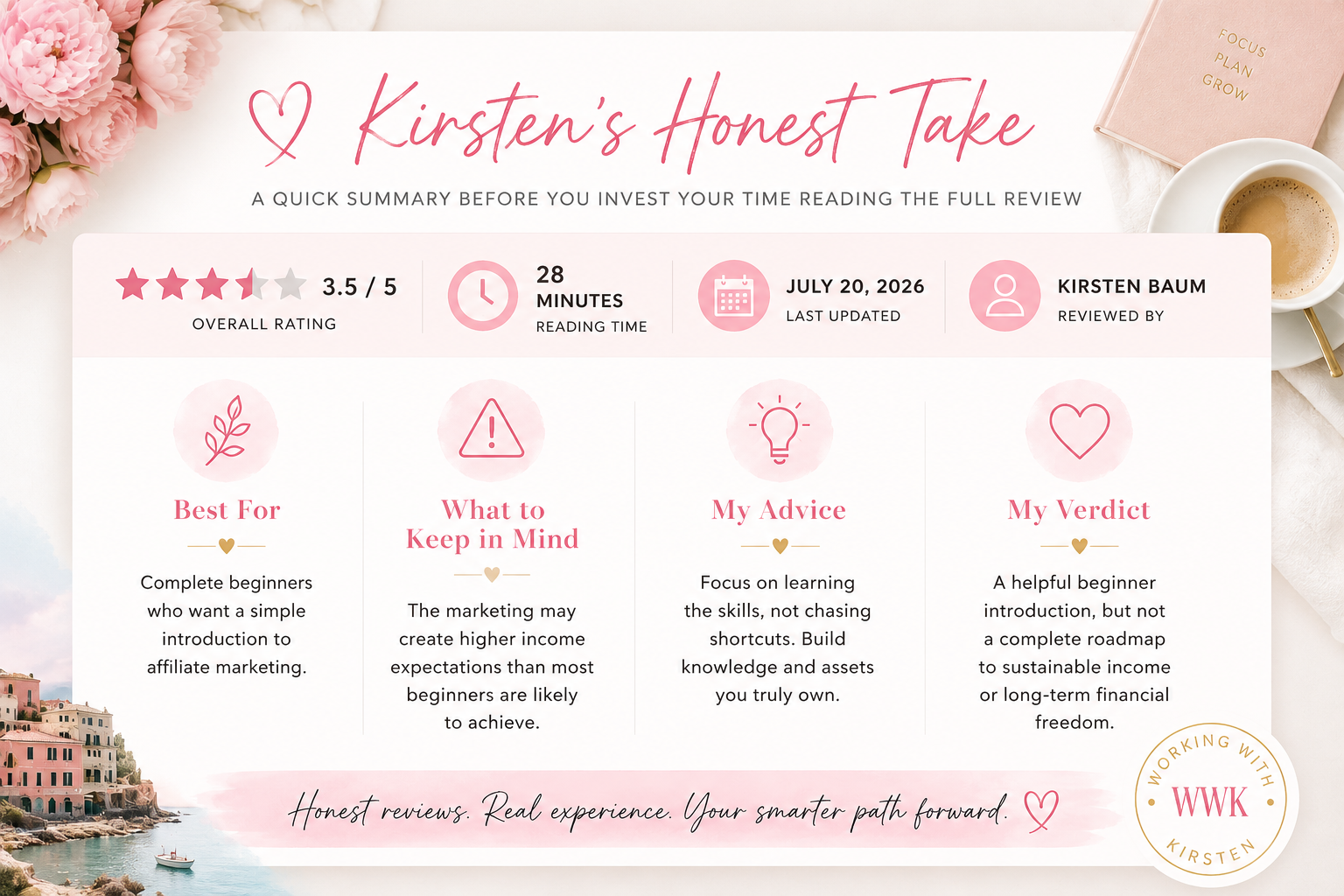
My Final Verdict for Easy Phone Money System ⭐⭐⭐
After taking a close look at the Easy Phone Money System, here’s my honest conclusion.
I don’t believe this is a scam, nor do I believe it’s the life-changing opportunity the sales page suggests.
Instead, I see it for what it is: a beginner-level introduction to affiliate marketing that may help some people take their first steps into online business—but it should not be mistaken for a complete blueprint for long-term financial freedom.
If you’ve never explored affiliate marketing before and you’re simply looking for an affordable way to understand the basics, the Easy Phone Money System may provide a reasonable starting point. Just be prepared to continue learning beyond the course itself.
If, however, your goal is to build a sustainable online business that can support your retirement, create multiple income streams, or provide lasting financial security, you’ll almost certainly need to develop additional skills in areas such as content creation, search engine optimization (SEO), email marketing, audience building, and personal branding.
One thing I’ve learned over the years is that real online businesses aren’t built by finding the perfect program. They’re built by becoming the kind of person who can succeed regardless of the program.
That’s a very different mindset.
Programs come and go.
Marketing trends change.
Algorithms evolve.
But valuable skills continue creating opportunities for the rest of your life.
My Final Thought
I’ve learned that hesitation isn’t always something to ignore.
Sometimes it’s your experience telling you to slow down, ask better questions, and gather a little more information before making a decision.
The best investments I’ve ever made weren’t driven by urgency or hype.
They were built on learning valuable skills, making thoughtful decisions, and thinking long term.
My Rating
⭐⭐⭐☆☆ Overall Rating: 3.5 / 5
| Category |
Rating |
| Beginner Friendliness |
⭐⭐⭐⭐☆ |
| Value for Money |
⭐⭐⭐☆☆ |
| Training Quality |
⭐⭐⭐☆☆ |
| Transparency |
⭐⭐☆☆☆ |
| Long-Term Potential |
⭐⭐⭐☆☆ |
| Overall Recommendation |
⭐⭐⭐⭐☆ for beginners, ⭐⭐☆☆☆ for experienced marketers |
If This Were My Money…
If I were starting from scratch today with a limited budget, I wouldn’t ask myself,
“Will this program make me money?”
I’d ask,
“Will this help me become more valuable five years from now?”
That’s a question worth answering before every investment you make—whether it’s a course, a business opportunity, or even a book.
Because financial freedom isn’t built by buying the next shiny object.
It’s built by developing valuable skills, creating assets you own, earning people’s trust, and making small, consistent improvements over time.
That’s the approach I’ve chosen to build my own business, and it’s the same approach I hope this website inspires you to take.
If the Easy Phone Money System helps you begin that journey, wonderful.
If another path feels like a better fit, that’s perfectly okay too.
The important thing is that you keep moving forward.
Your future self will thank you for every skill you build today.
Frequently Asked Questions
Here are some of the questions readers ask most often about the Easy Phone Money System.
Is the Easy Phone Money System a Scam?
Based on my research, I wouldn’t describe the Easy Phone Money System as a scam in the traditional sense. It teaches affiliate marketing, which is a legitimate online business model used by thousands of companies around the world.
That said, I do believe the promotional material creates expectations that many beginners may struggle to achieve. That’s why I encourage readers to evaluate the program based on the quality of its training rather than the excitement of its sales page.
How Much Does the Easy Phone Money System Cost?
The advertised entry price is generally quite affordable, often under $30, making it accessible for beginners.
However, remember that many online programs include optional upsells after your initial purchase. Before joining, decide how much you’re willing to invest overall and stick to that budget regardless of any additional offers you see.
Do You Need Experience?
No.
The Easy Phone Money System is designed for beginners and assumes little or no previous knowledge of affiliate marketing.
However, beginner-friendly doesn’t mean effortless.
Like any online business, success depends on learning new skills, applying them consistently, and continuing to improve over time.
How Long Before You Can Earn Money?
This is one of the questions that deserves the most honest answer.
While everyone’s journey is different, I believe most beginners should expect several months of consistent learning and implementation before earning meaningful commissions.
Building a dependable online income often takes six to twelve months or longer, especially if you’re creating original content and growing your own audience.
That timeline isn’t a weakness.
It’s simply how real businesses are built.
Are There Better Alternatives?
That depends on your goals.
If you’re simply looking for a basic introduction to affiliate marketing, the Easy Phone Money System may provide a reasonable starting point.
If your goal is to build a long-term online business, however, I’d encourage you to explore more comprehensive training that focuses on content creation, search engine optimization, email marketing, audience building, and sustainable business growth.
Some well-respected options include:
- Wealthy Affiliate for beginners who want an all-in-one learning platform.
- Authority Hacker for people interested in building authority websites with long-term SEO strategies.
- Project 24 by Income School for those who prefer a realistic, content-first approach to building an online business.
- Free educational YouTube channels from experienced marketers who consistently publish high-quality tutorials and case studies.
Whichever path you choose, remember that no course is a substitute for consistent action.
Further Resources to Explore
Building a successful online business isn’t about finding one perfect program—it’s about continuously learning, improving your skills, and making informed financial decisions.
If you’d like to explore affiliate marketing, online business, and long-term financial freedom in more depth, these resources are an excellent place to continue your journey.
Learn More About Affiliate Marketing
If you’re completely new to affiliate marketing, take time to understand how the business model works before investing in any course. The more you understand the fundamentals, the easier it becomes to recognize quality training and avoid unrealistic promises.
Topics worth researching include:
- What affiliate marketing really is
- How affiliate commissions work
- Choosing profitable niches
- Building trust with your audience
- Creating content that attracts visitors
- Search Engine Optimization (SEO)
- Email marketing
- Content marketing
- Website analytics
- Conversion optimization
Learn About Long-Term Financial Freedom
Affiliate marketing is only one possible income stream.
I also encourage readers to learn about:
- Retirement planning
- Investing for long-term wealth
- Dividend investing
- Index funds and ETFs
- Passive income strategies
- Personal finance
- Multiple income streams
- Financial independence
- Entrepreneurship
- Building digital assets
The more diverse your financial knowledge becomes, the stronger your overall financial foundation will be.
Helpful Free Resources
Before spending money on another course, take advantage of the incredible amount of free education available online.
Some of the best places to continue learning include:
- YouTube tutorials from experienced affiliate marketers
- Google Search Central SEO documentation
- HubSpot’s free marketing resources
- Blogging and content marketing podcasts
- Personal finance websites
- Free webinars and online workshops
Never underestimate what consistent self-education can do for your future.
My Book Recommendations
Books have played a huge role in shaping how I think about business, money, and building a meaningful life. These are some of the books I regularly recommend because they teach timeless principles rather than short-lived tactics.
The Psychology of Money — Morgan Housel
If I could recommend just one book to someone starting their journey toward financial freedom, this would be it.
At first glance, it may seem like an unusual recommendation for an affiliate marketing review because it isn’t about building an online business or making money on the internet.
But that’s exactly why it’s so valuable.
One of the biggest mistakes people make is believing that financial success comes from finding the perfect program, investment, or business opportunity. In reality, lasting wealth is built through the decisions we make every day—how we think about money, how patient we are, how we manage risk, and how consistently we invest in ourselves.
The Psychology of Money explores these timeless principles through engaging stories and practical lessons that apply whether you’re building an online business, planning for retirement, investing in the stock market, or simply trying to create a more secure future.
Why I Recommend It
This book will help you:
- Develop a healthier and more realistic relationship with money.
- Understand why patience often beats chasing quick wins.
- Learn how small, consistent decisions create lasting wealth.
- Think long term instead of being distracted by hype and unrealistic promises.
- Build financial confidence based on knowledge rather than emotion.
These are the same principles I try to share throughout WorkingWithKirsten.com.
My Takeaway
The biggest lesson I learned from this book is that wealth isn’t created by one lucky decision.
It’s created by making good decisions consistently over many years.
That’s true whether you’re investing in index funds, building an affiliate marketing business, starting a blog, or creating multiple income streams.
Programs will come and go.
Markets will rise and fall.
Technology will continue to evolve.
But good financial habits, valuable skills, and thoughtful decision-making never go out of style.
If you read one book this year to strengthen your financial mindset, I hope it will be The Psychology of Money. I believe it’s one of the best investments you can make—not just in your finances, but in the way you think about your future.
The Simple Path to Wealth — JL Collins
Why I recommend it
This book explains investing and financial independence in an incredibly clear and practical way. It’s especially valuable if your goal is to build long-term wealth rather than chase quick wins.
Atomic Habits — James Clear
Why I recommend it
Successful online businesses aren’t built through one brilliant idea—they’re built through consistent daily action.
This book perfectly complements my own philosophy that small improvements, repeated consistently, create extraordinary long-term results.
Building a StoryBrand — Donald Miller
Why I recommend it
Whether you’re promoting affiliate products, creating content, or starting your own business, learning how to communicate clearly is one of the most valuable skills you can develop.
This book will completely change the way you think about marketing.
The Millionaire Fastlane — MJ DeMarco
Why I recommend it
Despite its controversial title, this book challenges many traditional assumptions about wealth and explains why building scalable businesses often creates greater financial opportunities than simply trading time for money.
I don’t agree with every idea in the book, but it encourages readers to think differently about income and entrepreneurship.
Rich Dad Poor Dad — Robert T. Kiyosaki
Why I recommend it
While some of the stories have been debated over the years, the mindset lessons remain incredibly valuable.
The book introduces one of the most important financial concepts you’ll ever learn:
Build assets that generate income instead of continually accumulating liabilities.
That idea alone can completely change how you think about money.
One Final Recommendation
Don’t feel like you need to read every book or buy every course.
Choose one book, apply what you learn, and then move on to the next.
Knowledge only changes your life when you put it into practice.
One good idea, consistently applied, is often worth far more than reading twenty books and taking no action.
Continue Your Financial Freedom Journey
Thank you for taking the time to read this review.
Whether you decide to join the Easy Phone Money System, choose a different opportunity, or simply continue researching, I hope you’ve come away with something even more valuable than a product recommendation—a clearer understanding of how to evaluate online income opportunities with confidence.
Financial freedom isn’t built through one perfect program.
It’s built one skill, one smart decision, and one consistent step at a time.
If you’d like to continue learning, here are a few resources you may find helpful.
🌿 Explore More Honest Reviews
Before investing in any online business opportunity, take time to research it carefully.
Throughout WorkingWithKirsten.com, you’ll find independent reviews designed to help you separate genuine opportunities from unrealistic promises, so you can make informed decisions with confidence.
💰 Learn How to Build Multiple Income Streams
One of the biggest lessons I’ve learned is that relying on a single source of income creates unnecessary risk.
Discover practical strategies for building multiple income streams through blogging, affiliate marketing, digital products, investing, and other ethical online business models designed to support long-term financial freedom.
📈 Plan for Retirement With Confidence
Making money is only one part of the journey.
Learning how to protect it, grow it, and create lasting financial security is equally important.
Explore my articles on retirement planning, investing, wealth building after 50, and creating a future that gives you greater peace of mind and more choices.
🌱 Build an Intentional Life, Not Just an Income
Financial freedom is about far more than money.
It’s about having the freedom to spend time with the people you love, pursue meaningful work, care for your health, travel, give back, and design a life that reflects your values.
That’s the journey I hope this website encourages.
Let’s Stay Connected & Continue the Conversation
If you enjoy honest reviews, practical financial guidance, and thoughtful conversations about building a meaningful life after 50, I’d love to invite you to stay connected.
Subscribe to my newsletter for new articles, personal insights, retirement strategies, online business ideas, book recommendations, and practical resources to help you continue building lasting wealth—one step at a time.
Thank you for being here, and I genuinely wish you every success on your journey toward financial freedom.
Join the Conversation
I’d genuinely love to hear your thoughts.
Have you tried the Easy Phone Money System or another affiliate marketing program?
What was your experience?
Did it meet your expectations, or did you learn something valuable along the way?
Please share your thoughts in the comments below. Your experience could help someone else make a more informed decision, and that’s exactly the kind of supportive community I hope to build here at WorkingWithKirsten.com.
Here are a few questions to get the conversation started:
- Have you ever purchased an online income program? What was your biggest takeaway?
- What’s the best business or marketing course you’ve ever taken?
- If you could give one piece of advice to someone starting affiliate marketing today, what would it be?
- What’s your biggest challenge when it comes to building financial freedom or creating additional income streams?
- Are there any online business opportunities or programs you’d like me to review next?
Every comment adds another perspective, and I truly enjoy learning from the experiences of this community.
If this review helped you, please consider sharing it with a friend or family member who’s exploring ways to earn income online. A thoughtful recommendation can sometimes save someone from making an expensive mistake—or help them discover an opportunity that’s genuinely worth pursuing.
Thank you again for spending part of your day here. I appreciate your trust, your time, and your willingness to learn alongside me.
I look forward to hearing your thoughts in the comments!
My Final Thoughts ❤️
If there’s one thing I hope you take away from this review, it’s this:
There is no single program that will magically change your financial future.
Real, lasting wealth is rarely built through one opportunity, one course, or one lucky decision.
It’s built through hundreds of small decisions that move you forward—learning a new skill, asking better questions, making thoughtful financial choices, and continuing even when progress feels slower than you’d hoped.
That’s how meaningful change happens.
Over the years, I’ve learned that financial freedom isn’t just about earning more money. It’s about creating more choices.
The choice to spend more time with the people you love.
The choice to travel.
The choice to retire with greater confidence.
The choice to wake up each morning knowing you’re building something that truly belongs to you.
Whether that’s a blog, an online business, an investment portfolio, or simply a more secure financial future, every small step matters.
That’s why I encourage you to look beyond the marketing and focus on building something that lasts.
Learn skills that nobody can take away.
Create assets that continue working for you.
Build relationships based on trust.
And never stop investing in yourself.
You don’t need to have everything figured out today.
You simply need to keep moving in the right direction.
Thank you for spending part of your day here with me. It truly means a great deal that you’ve chosen to visit WorkingWithKirsten.com, and I hope you’ll continue exploring the many resources I’ve created to help you build financial freedom, retirement security, and a life filled with purpose.
Remember, your future isn’t determined by one program.
It’s shaped by the decisions you make consistently over time.
So take that next step.
Keep learning.
Keep growing.
And keep believing that it’s never too late to build a life you genuinely love.
Until next time…
Here’s to building lasting wealth, creating more freedom, and designing a life you truly love. ❤️🌿
— Kirsten
Disclaimer
The information shared in this review is based on my independent research, personal experience, and opinion at the time of writing. My goal is to provide honest, balanced, and educational content to help you make informed financial and business decisions.
I am not a financial advisor, investment advisor, attorney, accountant, or tax professional. Nothing in this article should be considered financial, legal, investment, or tax advice. Always do your own research and, where appropriate, consult a qualified professional before making important financial decisions or purchasing any online program.
Some links on WorkingWithKirsten.com may be affiliate links. This means I may earn a small commission if you choose to make a purchase through those links, at no additional cost to you. I only recommend products, services, and resources that I believe may provide value to my readers, and any compensation I receive never influences my opinions or the content of my reviews.
Please remember that every person’s experience is different. Online business results, affiliate marketing income, investment performance, and financial outcomes depend on many factors, including your experience, skills, effort, consistency, market conditions, and individual circumstances. Past results do not guarantee future success, and no earnings or income claims should be interpreted as typical or guaranteed.
My mission is simple: to help women and men—especially those over 50—build financial freedom, retirement security, and lasting wealth through honest information, ethical online business, and thoughtful financial planning.
Thank you for trusting WorkingWithKirsten.com as part of your journey.

by Kirsten Baum | Jul 16, 2026 | Lifestyle
What if one simple “yes” could change the entire course of your life?
My journey from Germany to New York and eventually to the South of France taught me that life’s greatest blessings often begin with the smallest decisions. This is the story of how one unexpected invitation led to love, personal growth, and a life I never could have imagined.
What You’ll Discover in This Article
- One unexpected “yes” can change the direction of your entire life—not through one giant leap, but through a series of small, courageous decisions.
- Growth rarely happens inside your comfort zone. Moving to New York on my own and later starting over in France taught me that discomfort is often a sign you’re growing into the person you’re meant to become.
- The right partner doesn’t complete you—they help you become more fully yourself. François showed me that the strongest relationships are built on kindness, trust, encouragement, and actions that speak louder than words.
- Life-changing moments rarely announce themselves. The evening I almost skipped a singles event in the South of France became the beginning of the greatest adventure of my life.
- It’s never too late to start over. The lessons woven through twenty-eight years of unexpected twists have taught me that adaptability isn’t just a valuable skill—it’s one of life’s greatest strengths.
If you’ve ever stood at a crossroads that looked more like a dead end than a new beginning, I have a feeling you’ll recognize a little of your own story in mine. Because sometimes the smallest “yes” becomes the beginning of the life you never knew was waiting for you.
One Photograph Stopped Me in My Tracks
The photograph was taken in Corsica. I am laughing at something just out of frame, completely unaware that I was already living the answer to every question I had been asking myself for years. When I look at it now, I do not see a vacation snapshot. I see the exact moment my real life began — the one built on curiosity, courage, and a willingness to say yes when every cautious instinct told me to stay home.
Growing Up in Germany With Eyes on the World
I grew up in Germany in a household that never made smallness feel like an option. My parents were entrepreneurs — not in the polished, LinkedIn sense of the word, but in the deeply practical, roll-up-your-sleeves way that shapes how you see problems and possibilities for the rest of your life. They worked hard, they took risks, and they never once suggested that the world beyond our town was something to be afraid of.
Entrepreneurial Parents Who Showed Me What Was Possible
Watching my parents build something from nothing gave me a template I didn’t know I was absorbing. They showed me that uncertainty is not a stop sign — it’s just the terrain. When they encouraged me to study abroad, it didn’t feel like a radical idea. It felt like the next logical step for someone who had always been quietly restless inside a life that fit everyone else perfectly.
The Curiosity That Never Felt at Home in One Place
I loved Germany. I want to be clear about that. But I also felt a persistent pull toward something larger — more languages, more cultures, more of the world rubbing up against my assumptions and changing them. That curiosity was not dissatisfaction. It was direction. And it pointed, unmistakably, toward New York.
Moving to New York Alone Changed Everything I Thought I Knew About Myself
I landed in New York to study Fashion Merchandising, and the city introduced itself the way it introduces itself to everyone — loudly, without apology, and completely indifferent to whether you are ready. I was not ready. That turned out to be exactly the point.
Nobody tells you that moving somewhere alone means you will have to build a version of yourself that can actually function without the scaffolding of familiarity. No shared language of inside jokes, no friends who already know your backstory, no shortcuts. Just you, figuring out how to become someone competent and confident in a place that has no time for hesitation.
What Fashion Merchandising Taught Me Beyond the Classroom
The degree taught me about trends, textiles, and the business of beauty. But New York taught me something the curriculum never listed: how to read a room, negotiate your presence in a space that wasn’t designed for you, and find your footing when the ground keeps shifting. Those skills have served me in every country and every season of life since.
Culture Shock, Independence, and the Confidence I Built From Scratch
Culture shock is not just jet lag for your personality. It is a full dismantling. The things that used to define you — your language, your humor, your social fluency — suddenly stop working, and you have to decide whether to collapse inward or build something stronger. I chose to build. Slowly, imperfectly, and with more than a few humbling moments along the way.
- I learned to ask for help without interpreting it as weakness.
- I discovered that confidence is not something you wait to feel — it’s something you practice until it becomes real.
- I stopped apologizing for my accent and started using it as an opening.
- I built friendships that had no history behind them, which meant they were built entirely on choice.
The Lesson New York Burned Into Me: Growth Lives Outside Familiarity
By the time I left New York, I was not the same person who had arrived. That is not a cliché — it is a fact. The city had stripped away the version of me that needed everything to feel safe before she would move forward. What replaced her was someone who had learned, at a cellular level, that growth does not live inside comfort. It never did.
The Life I Planned Disappeared Overnight
I had a plan. Most of us do. Mine involved finishing my studies, returning to Germany, and building a life that made logical sense given everything that had come before it. Life, as it turns out, is spectacularly uninterested in logical sense.
When My Parents Retired to France and My Road Home Vanished
While I was in New York becoming someone new, my parents made a decision of their own. They retired — and they did not retire to the Germany I had been mentally mapping my return to. They moved to the South of France. Just like that, the home I had been planning to go back to no longer existed in the form I remembered. The road I thought I was on simply ended, and a completely different one appeared in its place.
How I Stopped Fighting Life’s Rewrites and Started Reading Them
There is a particular grief that comes with watching your plan evaporate — not because something terrible happened, but because life simply moved in a direction you did not authorize. I felt it. And then, eventually, I did the only thing that made any sense: I followed. Not reluctantly, not with defeat, but with the growing suspicion that maybe life was not rewriting my story. Maybe it was finally writing the real one.
Starting Over in the South of France
France was stunning and disorienting in equal measure. The light in the South is different — golden in a way that makes everything look like a painting and nothing look quite real. I arrived carrying New York confidence and German practicality, and I quickly discovered that neither prepared me for the particular art of becoming French-adjacent.
The Loneliness Nobody Talks About When You Move Abroad
There is a loneliness specific to expat life that does not get enough honest airtime. It is not the loneliness of isolation — you are surrounded by people. It is the loneliness of not yet belonging, of being permanently one cultural beat behind the room, of laughing a half-second after everyone else because you are still translating. It passes. But first, it sits with you, and you have to let it.
Building a Life in a Place That Was Never Part of the Plan
Building a life in France meant starting from scratch in ways that went far beyond language. New routines, new rhythms, a new understanding of what community looks like when it unfolds differently than anything you have known. I was not unhappy. I was just unfinished — and slowly, with time and stubbornness, the pieces began to settle into something that felt surprisingly like home.
School French Is Not Real French
Let me save you the illusion: whatever French you learned in a classroom bears approximately the same relationship to actual spoken French as a map bears to a road trip. The accents vary wildly by region, the pace is merciless, and native speakers do not slow down simply because you are visibly drowning. In the South of France particularly, the language has its own music — and learning to hear it, let alone speak it, took far longer than any textbook suggested it should.
What it did teach me, though, was humility. Real humility — the kind that comes from being an intelligent, capable adult who cannot order lunch without pointing at the menu. That humility became one of the most useful things I have ever carried. It made me patient with others who were struggling, and it made me genuinely curious about the effort it takes to build a life in a language that is not your own.
The Evening I Almost Did Not Go
Here is where the story turns. On an ordinary evening in the South of France, I came very close to staying home. I was tired. I was still finding my footing. The invitation had arrived through a friend — a soirée célibataire, which translates loosely to a singles’ evening — and everything in me wanted to decline politely and spend the night doing something that required considerably less courage.
I almost did not go. I want you to hold that thought, because the distance between that almost and what actually happened is the entire point of this story.
The Friend Who Would Not Take No for an Answer
There are people in your life who appear at precisely the right moment and refuse, gently but firmly, to let you disappear into your own hesitation. My friend was one of them. She did not lecture me or catastrophize what I might be missing. She simply showed up, made it clear she was not going without me, and made declining feel like more effort than just getting dressed and going. I owe her more than she knows.
What a Soirée Célibataire Taught Me About Saying Yes
Walking into that evening, I had no expectations. That, as it turns out, is the ideal condition for a life-changing moment to occur. When you arrive somewhere without a script, without an agenda, without the weight of what you think should happen — you are actually present. And presence, I have learned, is where everything real begins.
The Moment I Met François and Did Not Know My Life Was Changing
He was not what I was looking for, mostly because I was not looking for anything. François appeared in that evening the way important things often do — quietly, without fanfare, in the middle of an ordinary conversation that did not feel ordinary for very long. We talked. Not the performance of talking that happens at parties, where everyone is half-listening and half-scanning the room, but real talking — the kind where you forget to check the time.
One Simple “Yes” to Corsica
Some time after that first evening, François invited me to Corsica. On paper, it was a straightforward invitation. In practice, it was a moment that required me to make a decision about what kind of person I wanted to be — someone who waited until everything felt safe, or someone who moved toward things that felt right even when they also felt uncertain. I had already moved to New York alone. I had already followed my family to France. By this point, I was beginning to understand that the most important moments of my life had never arrived with guarantees attached.
Why It Felt Risky and Why I Said Yes Anyway
Saying yes to Corsica was not reckless. That distinction matters. It was not the yes of someone ignoring her instincts — it was the yes of someone finally learning to trust them. There is a difference between a risk that comes from fear and a risk that comes from intuition, and by then I had enough self-knowledge to tell them apart. My instincts said: this person is worth knowing better. My courage said: go find out.
The island was extraordinary. But what I remember most is not the landscape — it is the feeling of being completely at ease with another person in a place neither of us called home. That ease told me something important. Not every relationship requires you to shrink yourself to fit. Some expand you simply by existing.
Life-Changing Moments Rarely Announce Themselves
That trip to Corsica did not arrive with a sign that said your life is about to change direction. It looked like a holiday. It felt like an adventure. It turned out to be the beginning of twenty-eight years of a life I could not have imagined from the vantage point of any earlier version of myself. This is the part I most want you to understand: the moments that matter most almost never look like the moments that matter most when they are happening.
What François Taught Me About Love, Trust, and Character
Twenty-eight years teaches you things about a person that no holiday, no conversation, and no first impression ever could. What I know about François now — and what I suspected then, which is why I said yes — is that his character has always been more consistent than his circumstances. That consistency is rarer than people realize, and it is worth far more than grand romantic gestures.
Actions Speak So Much Louder Than Words Ever Could
François never told me who he was. He showed me, repeatedly, in the smallest and least theatrical ways possible. He showed up when he said he would. He remembered things I had mentioned once and never repeated. He treated people — waitstaff, strangers, people who could do nothing for him — with the same respect he gave everyone else. These are not dramatic declarations of character. They are the quiet, daily proof of it. And they are the things I watched most carefully before I decided to trust him with my life.
What It Feels Like to Be Accepted Exactly as You Are
I came to France carrying an accent, a background, and a set of cultural references that were entirely my own. François never once made me feel like those things were problems to be solved. Being accepted exactly as you are — not in spite of your differences but including them — is one of the most profoundly stabilizing experiences a human being can have. It does not make you complacent. It makes you brave, because you finally have a place safe enough to grow from.
How the Right Partner Helps You Become More Yourself
There is a version of love that asks you to become smaller — quieter, less opinionated, more accommodating of someone else’s vision of who you should be. That is not love. That is renovation. What François offered was something entirely different: a relationship in which I became progressively more myself over time, not less. More curious, more confident, more willing to take up space in my own life.
The right partner does not complete you. That framing has always bothered me, because it implies you were incomplete to begin with. The right partner accompanies you — through the versions of yourself you are still figuring out, through the countries you did not plan to live in, through the evenings you almost did not attend. They make the journey more interesting without needing to control the destination.
Small Decisions Shape Your Entire Life
We have a tendency, when we look back at our lives, to identify the big moments — the moves, the marriages, the career pivots — as the things that defined us. But I have come to believe that this is a comforting simplification. The truth is more granular and more empowering: your life is not shaped by a handful of enormous decisions. It is shaped by the accumulation of hundreds of small ones, made daily, made quietly, made in moments that felt utterly unremarkable at the time.
The decision to get on the plane to New York was significant. But so was the decision to talk to the person next to me instead of keeping my head down. So was saying yes to one party. So was choosing, when François invited me to Corsica, to trust what I felt rather than what I feared. None of those smaller choices announced themselves as pivotal. Together, they built everything.
Germany, New York, France: Every Step Led Somewhere Meaningful
When I trace the geography of my life — Germany to New York to the South of France — it looks, in retrospect, like a deliberate itinerary. It was not. Each move was a response to something: curiosity, circumstance, family, love. None of it was planned in sequence. All of it was connected in ways I could only see looking backward.
This is what I want you to take from the geography of my story: you do not need to see the whole map. You only ever need to be willing to take the next honest step. The pattern reveals itself later, and when it does, it is usually more coherent and more beautiful than anything you could have designed in advance.
“You do not need to see the whole map. You only ever need to take the next honest step — the pattern reveals itself when you look back.”
Every city I lived in asked something different of me. Germany gave me roots and the courage to leave them. New York gave me independence and the confidence to use it. France gave me humility, love, and a life I never would have chosen from a catalog but would choose again without hesitation.
Why Life Is Not Built on One Giant Choice But Hundreds of Small Ones
If you are waiting for the single defining moment that will redirect everything, I want to gently suggest that you may be waiting for something that does not arrive in that form. Life-changing transformation is almost always a series of smaller movements that compound over time — like interest, but for courage.
- Saying yes to a study abroad program when staying home felt safer.
- Walking into a city alone and deciding to figure it out anyway.
- Following your family to a country that was not in your plans.
- Attending an event you almost skipped because you were tired.
- Trusting a feeling over a fear when someone asks you to take a chance.
- Choosing, again and again, to stay curious instead of retreating into certainty.
Each of those decisions, taken alone, looks modest. Together, they construct a life. Not a perfect life — but a real one, fully lived, with a depth that only comes from having actually shown up for it.
The life I am living now was not available to the version of me who stayed home. It only became possible because I kept moving — imperfectly, sometimes reluctantly, but consistently forward. That is all any of us can do. And it turns out, it is enough.
7 Lessons 28 Years of an Unexpected Life Taught Me
Twenty-eight years of a life built on unexpected yeses has taught me more than I could compress into a single article. But there are seven things that rise above the rest — seven truths that have proven themselves across countries, decades, and more versions of myself than I can easily count. These are not motivational platitudes. They are things I have tested in the actual friction of a real, complicated, beautiful life.
1. Growth Rarely Happens Inside Your Comfort Zone
I have never grown significantly while comfortable. Every meaningful expansion of who I am — every new skill, every deepened relationship, every shift in how I understood the world — happened in conditions that felt unfamiliar, uncertain, or actively uncomfortable. New York was uncomfortable. France was uncomfortable. Love was uncomfortable. All three changed me in ways that ease never could have.
Comfort is not the enemy. Rest is necessary. But if comfort becomes your primary goal, growth quietly stops being available to you. The two cannot fully coexist, and the sooner you make peace with that, the sooner you can start choosing discomfort on purpose — which is where all the interesting things happen.
2. Sometimes Life Knows Better Than You Do
The plan I had for my life after New York did not survive contact with reality. My parents moved to France. My road home disappeared. At the time, it felt like disruption. Looking back, it was the most precise redirection I could have received. The life waiting for me in France was not on my map — but it was, without question, the right destination. Sometimes the best thing that can happen to a plan is for it to fall apart.
3. Actions Always Reveal Character
I learned this from François, but I have since confirmed it everywhere I have looked. People reveal who they are not through what they say about themselves but through what they do when nothing is at stake — when there is no audience, no incentive, no reason to perform goodness except that it is simply who they are. Watch how people treat others who can do nothing for them. Watch what they do when they think no one is watching. Character lives in those moments, and it does not lie.
This lesson applies equally to how you evaluate yourself. You are not the person you intend to be on your best days. You are the person revealed by your small, daily, unwitnessed choices. That is worth sitting with.
4. The Right Partner Helps You Grow, Not Shrink
A relationship that requires you to be less — less expressive, less ambitious, less authentically yourself — is not a partnership. It is a negotiated diminishment. The right partner for you is the one in whose presence you feel more capable of being fully yourself, not less. That quality is rare, and it is worth being patient for.
5. Adaptability Is One of Life’s Greatest Strengths
I have lived in three countries, navigated multiple languages, and rebuilt my sense of home more than once. The skill that made all of it possible was not intelligence or talent — it was adaptability. The willingness to let go of how things used to work and figure out how things work here, now, in this new context. Adaptability is not passivity. It is a form of active, engaged problem-solving that keeps you functional when everything around you is changing.
6. Gratitude Deepens the More Perspective You Gain
I am more grateful for my life at this point than I was at any earlier stage of it — not because my life is easier now, but because I have enough perspective to understand what I almost missed. The party I almost skipped. The invitation I almost declined. The country I almost resented instead of embracing. Gratitude is not a feeling you wait for — it is a practice that grows sharper as your understanding of what could have been otherwise deepens with time.
7. One Simple Yes Can Change Absolutely Everything
I do not know what your version of Corsica looks like. I do not know which invitation is sitting in front of you right now, or which evening you are considering skipping because you are tired and it feels like too much effort. But I know this with complete certainty: the moments that changed my life did not look important when they were happening. They looked like ordinary evenings and casual invitations and slightly inconvenient detours.
The yes that changes everything rarely feels monumental in the moment. It feels like a small act of courage in an ordinary life. And then, years later, you find yourself standing in front of a photograph, completely unable to imagine who you would have been if you had stayed home.
Here Is How You Start Saying Yes to Your Own Unexpected Life
Reading someone else’s story of transformation is one thing. Recognizing where your own story is waiting for a different answer is another entirely. You do not need to move to another country or attend a party in the South of France to begin. You need to start noticing the invitations already in front of you — the ones you have been quietly declining because they feel inconvenient, uncertain, or just slightly too far outside what feels familiar.
The Four Questions Worth Asking Yourself Right Now
Before you can start saying yes more deliberately, it helps to understand why you have been saying no. Most of us carry a default setting — a habitual response to uncertainty that was installed so long ago we have stopped noticing it operates. These four questions are designed to surface that pattern and give you something more useful to work with.
The first question: What have you been saying no to out of habit rather than genuine choice? There is a meaningful difference between declining something because it genuinely does not align with your values and declining it because it simply feels uncomfortable. One is wisdom. The other is avoidance wearing wisdom’s clothes.
The second question: What would you do if you already knew you were capable of handling the outcome? Most hesitation is not really about the opportunity itself — it is about our confidence in our ability to manage whatever follows. When you separate the opportunity from the fear of failure, you often find the opportunity looks considerably more interesting on its own.
The third: Which relationships in your life expand you, and which ones have quietly asked you to shrink? The people around you are either evidence that your yeses are working or a reflection of your habitual nos. Both are worth examining honestly.
And the fourth, which is perhaps the most important: What is the smallest possible yes you could say today? Not the enormous, life-restructuring yes. Just the next small one. The phone call you have been putting off. The invitation you have been sitting on. The conversation you have been rehearsing but never starting. Start there.
“You don’t need to overhaul your entire life to start living it differently. You need to say one small, honest yes — and then notice what it opens.”
8 Books That Will Help You Embrace Courage, Change, and Connection
Over twenty-eight years of navigating new countries, new languages, and new versions of myself, I have returned again and again to books that helped me make sense of what I was experiencing. These are not self-help books in the shallow sense — they are books that take the business of being human seriously, and they have each, in their own way, made me more willing to say yes to things that mattered.
I am recommending them not because they are universally praised (though most are), but because they have each said something to me at a moment when I needed to hear exactly that thing. That is the real test of a book worth reading.
The Alchemist by Paulo Coelho
If there is one book that captures the spirit of following your own path even when it makes no obvious sense, it is this one. Coelho’s story of a shepherd boy pursuing a dream across continents is deceptively simple — and profoundly true in the way that simple things often are. The central idea, that the universe conspires to help those who pursue their own legend, is not mysticism. It is a description of what happens when you stop resisting your own direction.
I first read it during a period of deep uncertainty in France, when I was still not sure I had made the right choices. It did not give me answers. It gave me something better: permission to trust the journey I was already on.
The Road Less Traveled by M. Scott Peck
Peck opens with three words — “Life is difficult.” — and then spends the rest of the book explaining why accepting that truth is the beginning of everything useful. This is a book about discipline, love, growth, and grace, written by a psychiatrist who understood that the avoidance of difficulty is the source of most human suffering. It is not a comfortable read. It is an honest one, and honesty is considerably more valuable.
The Gifts of Imperfection by Brené Brown
Brown’s research on vulnerability and shame has changed how millions of people understand courage, and for good reason. The central argument — that wholehearted living requires letting go of who you think you should be in order to become who you actually are — is something I had lived instinctively before I had the language for it. This book gave me the language.
If you have ever felt that your life required you to perform a version of yourself rather than simply be one, this book will feel like someone finally turned the lights on in a room you have been navigating in the dark.
The Five Love Languages by Gary Chapman
Understanding how people give and receive love — and recognizing that those languages are not universal — transformed how I understood my relationship with François and, honestly, most of the important relationships in my life. Chapman’s framework is practical in a way that relationship books rarely are. It does not ask you to feel differently. It asks you to pay different attention, which turns out to produce the same result far more reliably.
Atomic Habits by James Clear
The argument Clear makes is simple and airtight: you do not rise to the level of your goals, you fall to the level of your systems. Every yes you want to make more automatic — every courageous habit you want to build into your daily life — becomes more achievable when you understand the architecture of how habits actually form. This is the book I wish I had read before building a life from scratch in three different countries. It would have made the building considerably more efficient.
Mindset by Carol Dweck
Dweck’s research on fixed versus growth mindsets is one of the most practically useful bodies of work I have encountered. The core distinction — between believing your qualities are fixed and believing they are developable — explains more about why some people grow through difficulty while others are defeated by it than almost anything else I have read.
Moving to New York alone was only possible because I operated, without knowing the term for it, from a growth mindset. I assumed I would figure things out because I believed figuring things out was a learnable skill. Dweck confirmed that assumption and gave it a framework I now use consciously.
Fixed Mindset vs. Growth Mindset at a Glance:
| Fixed Mindset |
Growth Mindset |
| Avoids challenges to protect self-image |
Embraces challenges as opportunities to grow |
| Gives up when obstacles appear |
Persists through setbacks with curiosity |
| Sees effort as a sign of inadequacy |
Sees effort as the path to mastery |
| Ignores feedback that feels threatening |
Uses feedback as information, not judgment |
| Feels threatened by others’ success |
Finds inspiration in others’ achievements |
The shift from one column to the other does not happen overnight. But it does happen — one small, deliberate yes at a time.
The Power of Now by Eckhart Tolle
Tolle’s central premise is that most human suffering is generated not by present circumstances but by the mind’s insistence on living in either the past or the future. When I read this during a particularly disorienting period of adjustment in France, it reframed everything. The loneliness I was experiencing was not a problem to be solved — it was a present-moment experience to be moved through. That distinction changed how I carried it.
This is not a book about positivity. It is a book about presence, and presence — as I learned on the evening I met François — is where everything real happens.
The Mountain Is You by Brianna Wiest
Wiest writes about self-sabotage with a clarity and compassion that makes the topic feel less like an indictment and more like a map. The central idea is that the obstacles we keep encountering in our lives are not external — they are reflections of the internal resistance we have not yet examined. This book asks you to look at what you have been avoiding, and why, and what it would mean to stop.
It is particularly useful if you are the kind of person who knows exactly what they want but keeps finding reasons not to pursue it. Which, honestly, describes most of us more often than we care to admit.
Reading Wiest during a period of reflection helped me understand something I had been circling for years: that the version of me who almost did not go to that party was not being cautious. She was protecting a comfort zone that had already outgrown its usefulness. The mountain was not the party, or France, or François. The mountain was the story I was telling myself about what I was capable of.
And the only way past a mountain, Wiest would say, is through it. Which requires, as everything meaningful does, one simple and slightly terrifying yes.
- The Alchemist — Paulo Coelho: For when you need permission to follow your own direction.
- The Road Less Traveled — M. Scott Peck: For when you need honesty more than comfort.
- The Gifts of Imperfection — Brené Brown: For when you are ready to stop performing and start being.
- The Five Love Languages — Gary Chapman: For understanding how the people you love actually experience love.
- Atomic Habits — James Clear: For building the daily architecture that makes your yeses sustainable.
- Mindset — Carol Dweck: For understanding why some people grow through difficulty and others don’t.
- The Power of Now — Eckhart Tolle: For finding your way back to the present moment when everything feels overwhelming.
- The Mountain Is You — Brianna Wiest: For finally understanding what has been standing between you and the life you keep almost choosing.
One Photograph, Twenty-Eight Years, One Beautiful Life
I keep coming back to that photograph — the one taken in Corsica, where I am laughing at something just out of frame. In it I am somewhere between the life I planned and the life I was given, completely unaware that the two had already merged into something better than either. Twenty-eight years later, I still cannot walk past it without stopping. Not out of nostalgia, but out of something closer to gratitude — the deep, perspective-earned kind that only comes from knowing, in vivid detail, what almost did not happen. The party I almost skipped. The invitation I almost declined. The yes I almost did not say. All of it, in hindsight, was exactly right. Not because life is tidy or guaranteed, but because the willingness to show up — imperfectly, uncertainly, one small brave decision at a time — is the only thing that ever makes a life fully yours.
Frequently Asked Questions
Over the years, the questions I receive most often are not about France or fashion or even François. They are about courage — specifically, how to find it when it feels absent, and how to use it when the stakes feel high. These are the questions I would have wanted answered when I was standing at the beginning of every new chapter of my own story.
I have answered them as honestly as I know how, not from a position of having everything figured out, but from the vantage point of someone who has been in the uncertainty, stayed in it long enough for it to change shape, and come out the other side with something real to show for it.
Is It Ever Too Late to Start Over in a New Country or a New Life?
No. And I say that not as reassurance but as a statement of observed fact. I have watched people build entirely new lives in their forties, fifties, and beyond — new countries, new languages, new relationships, new careers. The timeline our culture assigns to life milestones is a convention, not a law. The only thing that becomes genuinely harder with age is the willingness to feel incompetent again — and that is a psychological obstacle, not a structural one.
What changes as you get older is not your capacity for growth but your tolerance for the discomfort that precedes it. That tolerance is not fixed. It is trainable. Every small yes you say to something unfamiliar builds it incrementally, like a muscle. Start where you are. That has always been the only available option, at any age.
How Do You Actually Adapt When Everything Around You Feels Unfamiliar?
You adapt slowly, imperfectly, and in smaller increments than you expect. There is no shortcut through the disorientation of a genuinely new environment. What helps is refusing to treat that disorientation as evidence that you made the wrong choice. Feeling lost is not the same as being lost — it is simply the accurate experience of being somewhere new, which is, by definition, where you are when you are starting over.
Practically speaking, the things that accelerated my adaptation every time were consistent: finding one community or group with a shared interest, committing to the language at whatever level I had access to, and giving myself permission to be the least competent person in the room for as long as necessary. That last one was harder than moving countries.
What did not help was comparing my current chapter to a previous one in which I already knew how everything worked. That comparison is always unfair and almost always discouraging. Each new beginning deserves to be evaluated on its own terms, in its own time.
How Do You Build Confidence When You Feel Like You Are Starting From Zero?
You build it the same way you build anything — through repeated small actions that produce small results that, over time, accumulate into something substantial. Confidence is not a personality trait. It is an outcome. It is what happens after you do the thing you were not sure you could do, and discover that you could, and then do the next thing. It is sequential and it is earned, and it cannot be shortcut by affirmation alone.
When I arrived in New York, I had none of the social fluency that I had worked my entire life to develop in Germany. I had to rebuild it from scratch — in a different language, at a faster pace, in a city with no patience for people who needed extra time. The confidence I built there did not come from feeling ready. It came from acting before I felt ready, repeatedly, until acting before I felt ready became its own kind of readiness.
The most important reframe I can offer is this: starting from zero is not a deficit. It is a clean surface. Everything you build on it is yours, constructed deliberately, without the weight of who everyone already thinks you are. There is a freedom in that, if you choose to see it that way.
How Confidence Actually Builds (vs. How We Think It Works):
| What We Think |
What Actually Happens |
| Wait until you feel confident, then act |
Act without confidence, then feel it grow |
| Confidence comes from certainty |
Confidence comes from survived uncertainty |
| One big success creates confidence |
Many small actions compound into confidence |
| Confident people don’t feel afraid |
Confident people act despite feeling afraid |
What Is the Biggest Lesson 28 Years of Marriage Has Taught You?
That love is less a feeling and more a daily practice of choosing the same person — not because they are perfect, but because who they are, consistently and without performance, is someone worth choosing. The feeling arrives and recedes the way all feelings do. What remains, and what actually builds a life together, is the repeated, unglamorous, deeply meaningful act of showing up for each other in the ordinary moments that nobody photographs and nobody celebrates but that constitute the actual texture of a shared life. Choose someone whose ordinary is something you can genuinely live inside of. Everything else follows from that.
How Do You Know When to Say Yes to a New Opportunity That Feels Scary?
The question I have learned to ask is not “does this feel safe?” but “does this feel true?” Safe and true are not the same thing, and for most of my life I have found them in tension with each other. The opportunities that changed my life — New York, France, Corsica — did not feel safe. They felt true. There is a difference between fear that is telling you something important about a genuine mismatch and fear that is simply the predictable response to doing something new. Learning to distinguish between those two is one of the most valuable skills I have developed.
Practically, I pay attention to where the fear is located. Fear rooted in concern about what other people will think is almost never a useful guide. Fear rooted in genuine uncertainty about whether you can handle the outcome is worth examining — but it is rarely, in my experience, a reason to decline. You are almost always more capable of handling outcomes than your most cautious inner voice believes.
I also pay attention to what the no would protect. Sometimes a no protects something genuinely valuable — your health, your existing commitments, your actual values. More often, a no protects a comfort zone that has already served its purpose and stopped being useful. When I examine the nos I most regret, almost all of them were protecting something I did not actually need to keep.
And finally: act on the intuition before the analysis talks you out of it. The reasoning mind is extraordinarily skilled at producing arguments for staying where you are. Intuition arrives faster and quieter, and it has, in my experience, a considerably better track record. The evening I almost did not go to that party? My intuition said go. My reasoning mind said you are tired, it is late, it will be awkward. Twenty-eight years of evidence suggests I should have listened to intuition a great deal sooner than I did — and that every time I have, since then, the results have been worth it.
How One Simple “Yes” Changed My Entire Life: From Germany to New York, France, and the Love I Never Expected

by Kirsten Baum | Jul 7, 2026 | Retirement & Wealth Planning After 50
🌸 A Gentle Reminder Before You Begin
Retirement isn’t simply about reaching a certain age. It’s about creating the freedom to live life on your own terms.
Whether you’re just starting to think about retirement or you’re already making plans, remember that it’s never too late to make thoughtful decisions that move you closer to the future you truly want.
This guide is here to help you feel more confident, more informed, and more encouraged—one step at a time.
- 🌿 Build financial freedom with confidence, not fear.
- 🌿 Learn practical strategies you can apply at your own pace.
- 🌿 Discover how small, consistent decisions create lasting wealth.
- 🌿 Create a retirement built around freedom, purpose, and peace of mind.
💗 One Last Thought Before We Begin:
The future isn’t built in a single day. It’s built one thoughtful decision at a time.
Inside This Guide
In this comprehensive guide, you’ll discover:
- Turning 50 unlocks one of the most powerful wealth-building windows of your life — if you know how to use it.
- The biggest retirement mistakes aren’t about saving too little — they’re about planning too late, too narrowly, and without a real income strategy.
- The Five Pillars of Retirement Wealth give you a complete framework: income, savings, investments, protection, and lifestyle — and you’ll need all five.
- Healthcare alone can cost a retired couple over $300,000 out-of-pocket — and most people never account for it in their retirement numbers.
- Keep reading to discover the exact action plan — week by week, month by month, and year by year — that turns retirement from a distant hope into a deliberate choice.
Somewhere around 50, retirement stops feeling like something that’s “years away” and starts becoming much more personal.
Maybe you’ve been saving for years and still wonder whether it will be enough. Maybe you’re only now beginning to take retirement planning seriously and worry that you’ve started too late. If that sounds familiar, you’re not alone.
The good news is this: the years after 50 can become one of the most important wealth-building opportunities of your life. Not because you have unlimited time, but because you now have something just as valuable—life experience, clearer priorities, and the opportunity to make intentional financial decisions that can shape the years ahead.
That’s exactly why I created Working With Kirsten. My goal is to help women and men over 50 stop guessing, build financial confidence, and create a future with greater financial freedom, retirement security, and lasting wealth.
In this guide, I’ll walk you through the same framework I believe every person over 50 should understand—from assessing where you stand today to creating reliable income streams, protecting your wealth, and designing a retirement that’s built around purpose as much as financial security.
A Quick Personal Note
When I turned 50, I realized I wasn’t just planning for retirement—I was rebuilding the future I wanted to create.
Like many people, I had questions about whether I was saving enough, whether I should build additional income streams, and how I could create more financial security without sacrificing the life I wanted to live today.
That journey is one of the reasons I created Working With Kirsten.
Everything you’ll read in this guide comes from countless hours of learning, research, and applying these principles as I continue building my own retirement plan and online business.
My hope is that this guide helps you feel more confident, more informed, and more encouraged to take the next step toward your own financial freedom.
Retirement After 50 Looks Different Than It Used To
Before 50, retirement often feels like something you’ll think about “one day.” After 50, it starts feeling much more real—not because it’s too late, but because the decisions you make during this decade can have a lasting impact on your financial future.
The Retirement Landscape Has Changed
For previous generations, retirement often followed a fairly predictable path: work for 40 years, receive a company pension, collect Social Security, and enjoy retirement with a stable monthly income.
Today, that picture looks very different.
Traditional pensions have become increasingly rare, and many workers now rely primarily on employer-sponsored retirement plans such as 401(k)s or similar investment accounts. That means much of the responsibility—and the investment risk—has shifted from employers to individuals.
While Social Security remains an important part of retirement income for many Americans, it was never designed to replace your entire salary. For the average worker, it typically replaces only a portion of pre-retirement income, making personal savings, investments, and additional income sources more important than ever.
The result is that many people approaching retirement feel uncertain—not because they failed, but because the financial world changed faster than most of us were ever taught to navigate it.
The good news is that understanding these changes gives you the opportunity to take control. Whether you’re just beginning to plan or refining an existing strategy, there are still practical steps you can take to build greater financial security for the years ahead.
What Financial Freedom After 50 Really Looks Like
Financial freedom after 50 doesn’t necessarily mean you never work again. It means work becomes a choice rather than a necessity.
It means your income isn’t entirely dependent on showing up somewhere every day. Instead, you’ve built a combination of savings, investments, and multiple income streams that give you greater flexibility and peace of mind.
It also means being prepared for life’s unexpected moments. A job loss, a health challenge, or a market downturn shouldn’t derail your future because you’ve created a financial foundation designed to withstand change.
Ultimately, financial freedom isn’t about reaching a specific number in a savings account. It’s about creating a life where you have more choices, greater security, and the confidence to spend your time on what matters most.
🌿A Personal Note from Kirsten
For many years, I believed retirement meant reaching a certain age and simply hoping everything would work itself out. Today, I see it very differently.
I don’t want to depend on a single pension or hope that someone else has planned my future for me. Instead, I want to build multiple sources of income, continue learning, keep creating, and stay active doing work I genuinely enjoy.
For me, financial freedom isn’t about stopping work altogether. It’s about having the freedom to choose the work I do, the projects I pursue, and how I spend my days. That kind of freedom has become far more valuable than the idea of simply retiring.
Why the Next 10–15 Years Could Be Your Most Powerful Wealth-Building Window
Your 50s can become one of the most important decades of your financial life. While it’s true that time is more limited than it was in your 20s or 30s, you now have something just as valuable: experience.
Many people reach this stage of life with their highest earning potential. Your children may be grown or becoming more independent, you’ve built valuable skills throughout your career, and you have a much clearer understanding of what truly matters to you financially.
You also have opportunities that weren’t available earlier in life. In the United States, for example, people aged 50 and older can make additional “catch-up” contributions to retirement accounts, allowing them to accelerate their savings. As of 2024, that means contributing an extra $7,500 annually to a 401(k) and an additional $1,000 to an IRA above the standard contribution limits.
Most importantly, your money can still benefit from years of compound growth. Even if retirement is only 10 to 15 years away, those years can make a remarkable difference when combined with consistent investing, thoughtful planning, and intentional financial decisions.
Time hasn’t run out—it has simply become more valuable.
That’s why every decision you make today has the potential to shape the lifestyle, freedom, and peace of mind you’ll enjoy for decades to come.
🌿 A Personal Note from Kirsten
When I turned 50, I stopped focusing on the years I thought I had lost and started focusing on the years I still had ahead of me.
That simple shift changed everything.
Instead of asking, “Is it too late?” I began asking, “What can I build with the time I have?”
Every article I write, every new skill I learn, every investment I make, and every step I take toward financial freedom is my way of investing in the future I want to create—not only for myself, but for my family and the life I love.
Where You Actually Stand Financially Right Now
You can’t build a retirement strategy without knowing your starting point. Most people have a vague sense of their finances — they know roughly what’s in their 401(k) and what comes in each month — but they’ve never sat down and calculated the actual numbers that matter for retirement planning.
Before anything else, you need three figures:
- Your current net worth (everything you own minus everything you owe)
- Your actual monthly expenses (not what you think they are — what they actually are)
- Your retirement income goal (the monthly income you’d need to live the life you want)
Quick Reality Check: If you want $5,000 per month in retirement and plan to withdraw from savings using the widely-referenced 4% rule, you’d need approximately $1.5 million saved. If Social Security covers $1,800/month, you need your savings and other income streams to cover the remaining $3,200 — or about $960,000 in investable assets. That’s your target to reverse-engineer.
How to Calculate Your Real Net Worth Today
Net worth is simple: assets minus liabilities. But people often miscalculate it by forgetting accounts, overvaluing their home, or ignoring debts.
| Assets |
Liabilities |
| 401(k) / IRA balances |
Mortgage balance |
| Home equity (realistic market value) |
Car loans |
| Brokerage accounts |
Credit card debt |
| Rental property value |
Student loans (yours or co-signed) |
| Cash & savings accounts |
Personal loans |
| Business interests |
Any other outstanding obligations |
Add up both columns. Subtract liabilities from assets. That number — whether it excites you or makes you uncomfortable — is your starting line, not your finish line.
The Retirement Income Gap: What It Is and Why It Matters
The retirement income gap is the difference between what your guaranteed income sources (Social Security, pension, annuity) will cover and what you actually need each month. This gap is what your savings, investments, and other income streams must fill. Most people underestimate this gap because they plan based on current expenses without accounting for inflation, healthcare costs, or the fact that spending patterns actually change significantly in retirement — often spiking in early years when people travel and stay active, then shifting heavily toward healthcare costs in later years.
Monthly Expenses vs. Retirement Goal: Closing the Distance
Take your current monthly expenses and run them through a simple retirement filter. Which expenses disappear (commuting costs, work clothing, maybe a mortgage if it’s paid off)? Which ones increase (healthcare, travel, leisure)? Which stay the same? A realistic retirement budget is rarely just your current budget with a few line items removed. Build it fresh, category by category, based on the life you actually intend to live.
The Five Pillars of Retirement & Wealth Planning After 50
Building retirement wealth isn’t about relying on a single savings account or hoping one investment performs well. It’s about creating a strong financial foundation built on five interconnected pillars that work together to provide stability, growth, and long-term financial freedom.
Together, these five pillars form the framework I now use to think about retirement planning. Each pillar supports the others, creating a more resilient financial future regardless of what life—or the financial markets—bring.
🌿 A Personal Note from Kirsten
As I’ve been building Working With Kirsten, I’ve realized that retirement planning isn’t just about investing more money. It’s about creating a stronger foundation.
Every article I write, every YouTube video I publish, every Pinterest pin I design, and every new skill I learn becomes another small asset that can continue serving me long into the future.
That mindset has completely changed the way I think about retirement. Instead of seeing it as the end of my working life, I now see it as the beginning of a new chapter built on freedom, purpose, and flexibility.
Let’s look at each pillar and why it plays such an important role in building a secure and fulfilling retirement.
Pillar 1: Building Multiple Income Streams
Relying on a single income source in retirement is one of the most common—and potentially most costly—planning mistakes. Social Security benefits can change, pensions may not provide enough income, and rental properties can sit vacant. The most financially resilient retirees typically receive income from several different sources, such as Social Security, investment dividends, rental income, part-time consulting, or digital income through blogging, affiliate marketing, or other online businesses.
You don’t need every income stream imaginable. However, having two or three sources of income that operate independently of one another can provide a level of financial security that no single paycheck or investment account can offer.
Pillar 2: Savings Buffers That Actually Protect You
Most retirement advice focuses on investment accounts, but having accessible cash reserves is just as important. Every person over 50 should aim to build three different savings buffers, each with a specific purpose.
Emergency Fund: Keep six to twelve months of essential living expenses in a high-yield savings account, completely separate from your retirement investments. This helps you avoid selling investments during market downturns when unexpected expenses arise.
Cash Reserve: Set aside money for known future expenses such as replacing a car, major home repairs, or special travel plans. Having this fund prevents planned purchases from reducing your long-term investments.
Retirement Bridge Fund: If you plan to retire before age 59½, consider building a taxable investment account that can provide income until you can access retirement accounts without early withdrawal penalties.
Together, these savings buffers provide flexibility, reduce financial stress, and help protect the investments you’ve worked so hard to build.
Pillar 3: Investments That Grow While You Sleep
After 50, your investment strategy should balance long-term growth with appropriate risk management. Even if retirement is only 10 to 15 years away, you may still have another 20 or 30 years of life ahead of you. That means inflation remains one of your biggest long-term risks.
A diversified portfolio of low-cost index funds, dividend-producing ETFs, and, where appropriate, real estate investments can help your money continue growing while managing market volatility. The exact investment mix will depend on your personal goals, timeline, and comfort with risk, but the underlying principle remains the same: stay invested, stay diversified, and keep investment costs low.
Pillar 4: Protection Against the Risks Most People Ignore
Building wealth is only half of retirement planning. Protecting that wealth is equally important.
The greatest threats to a retirement plan are often not stock market crashes but unexpected life events, such as serious illness, disability, lawsuits, or passing away without proper estate planning in place.
Long-term care insurance, an up-to-date estate plan, current beneficiary designations, and appropriate insurance coverage may not be exciting topics, but they can make the difference between a retirement plan that survives life’s challenges and one that doesn’t.
Pillar 5: Designing a Retirement Lifestyle With Purpose
This is the pillar that many financial plans overlook, yet it may be the most important of all.
Retirement without purpose can lead to declining health, loneliness, and a loss of direction. People who thrive during retirement usually have more than financial security—they have meaningful activities, strong relationships, opportunities to contribute, and reasons to look forward to each day.
Whether your ideal retirement includes part-time work, volunteering, travelling, creative projects, spending time with family, or simply enjoying a slower pace of life, your lifestyle deserves as much planning as your investment portfolio.
Your retirement isn’t simply a financial destination—it’s a life you’re intentionally designing. The more purpose you build into that life today, the more meaningful your retirement years can become tomorrow.
Retirement Income: How to Make Sure the Money Keeps Coming
Building a healthy retirement savings account is an important milestone, but it’s only part of the equation. The next challenge is turning those savings into reliable, long-term income that can support the lifestyle you want for years—or even decades—to come.
After all, financial freedom in retirement isn’t measured by how much money you’ve accumulated. It’s measured by whether your income continues to provide confidence, flexibility, and peace of mind throughout your retirement years.
Social Security: When to Claim and How to Maximize It
For many people, Social Security forms the foundation of a retirement income plan. Deciding when to claim your benefits is one of the most important financial decisions you’ll make because it affects your income for the rest of your life.
You can begin claiming benefits as early as age 62, but doing so permanently reduces your monthly payment. Waiting until your Full Retirement Age (FRA)—67 for anyone born in 1960 or later—provides your full benefit. If you delay beyond your FRA, up to age 70, your monthly benefit increases by approximately 8% each year.
For many retirees, that’s one of the few guaranteed, inflation-adjusted increases available, making it an important factor to consider when building a long-term retirement strategy.
The age at which delaying begins to pay off—often called the breakeven point—typically falls around age 80. If you’re in good health and longevity runs in your family, delaying benefits may provide significantly greater lifetime income. On the other hand, if you have health concerns or need the income sooner, claiming earlier may be the right decision.
The most important thing is not to claim benefits simply because you’ve reached age 62. Instead, take the time to understand your options and choose the strategy that best fits your personal circumstances.
Pensions, Annuities, and Other Guaranteed Income Sources
If you’re fortunate enough to have a pension, you belong to a steadily shrinking group of retirees. A pension can provide valuable financial stability, so it’s important to understand all of your options before making any decisions.
One of the biggest choices many pension holders face is whether to accept a lump-sum payment or receive guaranteed monthly income for life.
A lifetime monthly pension offers predictable income and removes much of the investment and longevity risk. A lump-sum payment provides greater flexibility and control but also places the responsibility for investing that money—and ensuring it lasts—entirely on you.
There isn’t one right answer for everyone. Your decision should depend on your financial goals, overall retirement plan, health, and comfort with investing.
For people without a traditional pension, certain types of annuities can serve a similar purpose by converting a portion of retirement savings into guaranteed lifetime income.
Simple products, such as single premium immediate annuities (SPIAs) or deferred income annuities, can be useful tools for covering essential monthly expenses when combined with Social Security and other income sources.
Be cautious, however, with complex annuity products that include high fees or difficult-to-understand features. As a general rule, if an investment product is extremely complicated, take the time to fully understand it—or seek independent financial advice—before committing your retirement savings.
🌿 A Personal Note from Kirsten
One of the biggest shifts I’ve made over the past few years is realizing that retirement isn’t just about reaching a certain savings goal. It’s about creating dependable income that allows you to enjoy life with confidence.
Knowing that money will continue coming in each month—whether through investments, pensions, Social Security, or additional income streams—creates a very different feeling than simply watching a retirement account balance rise and fall with the market.
For me, that’s what financial freedom is really about: building enough stability that I can spend more time doing what I love, continue creating meaningful work through Working With Kirsten, and enjoy life’s simple moments with my husband and our three Persian cats without constantly worrying about money.
Rental Income as a Retirement Strategy
For many people, rental income can become one of the most dependable sources of retirement income. A well-managed rental property that is paid off—or has a relatively small mortgage—can generate consistent monthly cash flow while allowing your investments to remain invested for longer.
For example, a property producing between $1,200 and $2,000 per month in net rental income can significantly reduce the gap between your guaranteed retirement income and your monthly living expenses.
However, it’s important to remember that rental properties are not completely passive investments.
Vacancies happen. Repairs are inevitable. Maintenance costs increase over time, and occasionally you’ll have challenging tenants. Successful real estate investors plan for these realities instead of assuming every month will generate the same income.
Many retirees simplify property ownership by investing in local properties they can easily oversee, hiring a professional property manager, or choosing newer, lower-maintenance homes that typically require fewer repairs.
Before including rental income in your retirement plan, make sure you’ve accounted for all of the ongoing costs, including:
- Mortgage payments (if applicable)
- Property taxes
- Insurance
- Property management fees
- Routine maintenance and repairs
- Vacancy periods
- Unexpected expenses
Planning with realistic numbers—not optimistic ones—will help you build a retirement plan that’s both reliable and sustainable.
Rental Property Reality Check
| Item |
Monthly Amount |
| Gross Rental Income |
$1,800 |
| Mortgage (PITI) |
-$600 |
| Property Management (9%) |
-$162 |
| Maintenance Reserve (10%) |
-$180 |
| Vacancy Reserve (5%) |
-$90 |
| Estimated Net Monthly Income |
≈ $768 |
The difference between gross rent and actual income surprises many first-time landlords. Always build your retirement plan using realistic net income, not the amount of rent collected each month.
🌿 A Personal Note from Kirsten
Although I don’t currently rely on rental income as part of my own retirement strategy, I think it’s a valuable example of why I believe in building multiple income streams instead of depending on just one source of income.
For me, financial freedom has never been about finding one perfect investment. It’s about creating a balanced foundation where different assets and income streams work together. Whether those assets include investments, rental property, an online business, or other sources of income, the goal is the same: to create greater stability, more choices, and peace of mind for the future.
How Digital Income Streams Fit Into Modern Retirement
Investing After 50: Building Growth Without Taking Unnecessary Risks
The conversation around investing changes after 50—but it certainly doesn’t end.
Your money still needs to grow. It still needs to outpace inflation and support you for what could be another 30 years or more. What changes is the balance between pursuing growth and protecting the wealth you’ve already worked so hard to build.
The goal isn’t to avoid risk completely. The goal is to take smart, intentional risks that support your long-term financial future.
How Your Investment Strategy Can Evolve After 50
For years, many people followed the old rule of thumb that suggested subtracting your age from 100 to determine the percentage of your portfolio invested in stocks.
Today, many financial professionals consider that guideline too conservative for modern retirements. People are living longer, staying active well into their 70s and 80s, and often need their investments to continue growing throughout retirement.
Rather than focusing on a single percentage, think about matching your investments to when you’ll actually need the money.
Money you’ll use within the next few years should generally be invested more conservatively than money you won’t need for another 10, 15, or even 20 years.
Many investors find it helpful to organize their portfolio into three simple “buckets”:
- Short-term: Cash and low-risk investments for immediate expenses.
- Medium-term: Balanced investments for expenses over the next several years.
- Long-term: Growth-focused investments designed to continue building wealth over decades.
This approach can help reduce emotional decision-making during market downturns while allowing part of your portfolio to continue growing over the long term.
ETFs, Index Funds, and Dividend Stocks Made Simple
For many investors, these three investment types form the foundation of a well-diversified retirement portfolio.
Broad-market index funds provide instant diversification by investing in hundreds of companies while keeping investment costs remarkably low.
Exchange-Traded Funds (ETFs) offer similar diversification but trade throughout the day like individual stocks, giving investors additional flexibility.
Dividend-paying stocks provide another valuable benefit: regular income. Instead of relying solely on selling investments, dividend payments can generate ongoing cash flow during retirement while allowing your investments to remain invested.
Each serves a different purpose, but together they can create a balanced portfolio that supports both growth and income.
Real Estate Without Becoming a Landlord
Owning rental property isn’t the only way to invest in real estate.
Real Estate Investment Trusts (REITs) allow investors to own shares in professionally managed real estate portfolios without dealing with tenants, maintenance, or property management.
Many REITs invest in office buildings, apartments, healthcare facilities, warehouses, shopping centers, and other commercial properties while distributing a significant portion of their income to shareholders through dividends.
For people who want real estate exposure without the responsibilities of direct property ownership, REITs can be an attractive addition to a diversified retirement portfolio.
The Biggest Investment Mistakes People Make with their Retirement & Wealth Planning After 50
The most expensive investment mistakes after 50 are rarely dramatic.
More often, they’re quiet decisions that slowly reduce long-term wealth.
Common examples include:
- Moving entirely to cash because of fear and allowing inflation to erode purchasing power.
- Chasing unusually high investment returns without fully understanding the risks involved.
- Forgetting to rebalance a portfolio after years of strong stock market performance.
- Paying unnecessarily high investment management fees year after year.
- Delaying investment decisions because the choices feel overwhelming.
The truth is that a good plan followed consistently will almost always outperform a perfect plan that never gets implemented.
🌿 A Personal Note from Kirsten
One of the biggest lessons I’ve learned is that investing isn’t about trying to predict the future—it’s about preparing for it.
There will always be headlines predicting the next market crash, recession, or economic uncertainty. If I waited until everything felt completely certain, I’d probably never invest at all.
Instead, I’ve learned to focus on what I can control: continuing to learn, investing consistently, thinking long term, and building a financial future one thoughtful decision at a time.
That approach doesn’t eliminate uncertainty, but it gives me confidence that I’m moving in the right direction. And for me, that’s what successful investing after 50 is really about.
Healthcare: The Retirement Cost Many People Overlook
When most people think about retirement, they picture travel, hobbies, family time, or finally having the freedom to enjoy life at a slower pace.
What many don’t fully consider is the cost of healthcare.
While housing, food, and everyday living expenses are usually part of a retirement plan, healthcare is often underestimated—even though it can become one of the largest expenses you’ll face during retirement.
The good news is that understanding these costs today allows you to prepare for them with confidence rather than being caught by surprise later.
How Much Healthcare Can Cost in Retirement
Healthcare expenses continue long after your working years end, and they often increase as we grow older.
According to Fidelity’s annual Retiree Health Care Cost Estimate, a single 65-year-old retiring in 2023 may need approximately $157,500 saved to cover healthcare expenses throughout retirement—even with Medicare coverage. For a retired couple, that estimate approaches $315,000. These figures include Medicare premiums, deductibles, copayments, and other out-of-pocket medical expenses, but they do not include long-term care, dental care, vision, or hearing services, which Medicare generally does not fully cover.
If you plan to retire before age 65, healthcare becomes an even more important part of your financial plan.
Until you become eligible for Medicare, you’ll likely need alternative health insurance through a spouse’s employer, COBRA coverage, or a private marketplace plan. Depending on your age, location, and health, those premiums can easily range from $500 to $1,200 per month—or more.
That’s one of the reasons early retirement often requires more savings than many people initially expect.
🌿 A Personal Note from Kirsten
The more I’ve learned about retirement planning, the more I’ve realized that building wealth isn’t only about growing investments—it’s also about preparing for the expenses that many people never see coming.
Healthcare is one of those realities.
Planning for these costs doesn’t mean expecting the worst. It means giving yourself and your family greater peace of mind, knowing you’ve considered one of retirement’s biggest financial challenges before it becomes an emergency.
For me, that’s what good retirement planning is really about. It’s not about living in fear of the future—it’s about preparing wisely so you can enjoy it with greater confidence and freedom.
Medicare Basics: What It Covers—and What It Doesn’t
For many Americans, Medicare becomes an important part of retirement planning beginning at age 65. While it provides valuable healthcare coverage, it’s important to understand that it doesn’t pay for everything.
Medicare is divided into several parts, each covering different aspects of healthcare:
- Part A generally covers hospital stays and is usually premium-free for people who have worked at least 40 quarters.
- Part B covers outpatient medical care and requires a monthly premium. In 2024, the standard premium is $174.70, although higher-income retirees may pay more.
- Part D helps cover prescription medications.
Just as important as understanding what Medicare covers is knowing what it doesn’t cover.
Traditional Medicare generally does not fully cover:
- Routine dental care
- Vision care
- Hearing aids
- Most long-term care services
- Medical care received outside the United States
Many retirees choose to purchase a Medigap (Medicare Supplement) policy or enroll in a Medicare Advantage plan to help cover some of these additional expenses. Both options have advantages and disadvantages, so it’s worth comparing them carefully before making a decision.
Long-Term Care Insurance: Should You Consider It?
Long-term care refers to ongoing assistance with everyday activities such as bathing, dressing, eating, or managing daily life due to illness, disability, or cognitive decline.
One of the biggest surprises for many people is that Medicare provides only very limited coverage for long-term care.
According to the U.S. Department of Health and Human Services, approximately 70% of people turning 65 will need some form of long-term care during their lifetime. In many parts of the United States, the annual cost of a private nursing home room now exceeds $100,000.
Traditional long-term care insurance has become more expensive over the years as insurers have adjusted pricing to reflect increasing healthcare costs and longer life expectancies.
Today, many people also consider hybrid policies, which combine life insurance or annuities with long-term care benefits. These products can provide value even if long-term care is never needed.
If you’re in your early or mid-50s and in good health, this is often one of the best times to evaluate your options. Waiting until your mid-60s may result in significantly higher premiums or make qualifying for coverage more difficult due to health conditions.
🌿 A Personal Note from Kirsten
One thing retirement planning has taught me is that protecting your future is just as important as building your wealth.
It’s easy to focus on growing investments and increasing retirement savings, but a single unexpected healthcare event can quickly change even the best financial plan.
That’s why I believe retirement planning should never focus on just one piece of the puzzle. The goal isn’t simply to accumulate money—it’s to build a life that’s financially prepared for both the opportunities and the uncertainties that the future may bring.
For me, having a thoughtful plan creates something that’s difficult to put a price on: peace of mind. And I believe that’s one of the greatest gifts we can give ourselves and the people we love.
Estate Planning Isn’t Just for the Wealthy
When many people hear the words estate planning, they imagine wealthy families with large estates, complicated trusts, and teams of lawyers.
In reality, estate planning is much simpler than that.
At its core, estate planning is about deciding what happens to your money, your property, and your healthcare decisions if you become unable to make those decisions yourself or after you pass away.
If you don’t make those choices, the law will make many of them for you through a legal process known as probate. Probate can be time-consuming, costly, and public, and it may not reflect your personal wishes.
Estate planning isn’t about how much money you have. It’s about making life easier for the people you love during one of the most difficult times they’ll ever experience.
After 50, having a basic estate plan becomes increasingly important. Life is unpredictable, and unexpected illness, accidents, or sudden changes in health can happen to any of us.
The encouraging news is that creating a solid estate plan doesn’t have to be complicated or expensive. For many families, a few well-prepared legal documents can provide years of clarity, protection, and peace of mind.
What Can Happen Without an Estate Plan?
Without a basic estate plan in place:
- Your estate may go through probate, which can take months—or even years—to complete.
- State laws determine who inherits your assets rather than your personal wishes.
- A court may appoint someone to make important legal or financial decisions on your behalf if you become incapacitated.
- Your family may face unnecessary legal expenses, delays, and emotional stress.
- Medical decisions could be made without clear guidance from you.
- Family disagreements become more likely when your wishes haven’t been clearly documented.
Planning ahead helps reduce uncertainty and allows your loved ones to focus on supporting one another instead of navigating avoidable legal challenges.
The Five Essential Estate Planning Documents for Retirement & Wealth Planning After 50
A complete estate plan doesn’t necessarily require dozens of legal documents. For most people over 50, these five documents provide a strong foundation.
Last Will and Testament
A Last Will and Testament explains how you want your assets distributed after your death and allows you to name guardians for any minor children.
Revocable Living Trust
A Revocable Living Trust allows certain assets to transfer directly to your beneficiaries without going through probate. While not everyone needs a trust, it can be particularly valuable for people who own real estate, have significant assets, own a business, or have blended family situations.
Durable Power of Attorney
A Durable Power of Attorney authorizes someone you trust to manage your financial affairs if you become unable to do so yourself.
Healthcare Proxy
A Healthcare Proxy (also called a Healthcare Power of Attorney) designates the person you want making medical decisions on your behalf if you cannot communicate your wishes.
Advance Directive (Living Will)
An Advance Directive, sometimes called a Living Will, records your preferences regarding medical treatment and end-of-life care. It gives your loved ones clear guidance during difficult situations and helps ensure your wishes are respected.
Review your estate planning documents every three to five years—or sooner after major life events such as marriage, divorce, the birth of a child or grandchild, the death of a loved one, moving to another state or country, or significant changes to your financial situation.
Your estate plan should evolve as your life evolves.
🌿 A Personal Note from Kirsten
One of the biggest lessons I’ve learned is that retirement planning isn’t just about building wealth—it’s also about protecting the people we care about most.
Estate planning isn’t something I think about because I expect the worst. I think about it because I want the people I love to have clarity instead of confusion, guidance instead of uncertainty, and peace of mind instead of unnecessary stress.
To me, that’s one of the greatest gifts we can leave behind.
Building financial freedom isn’t only about creating a better life for ourselves. It’s also about making life a little easier for the people who matter most when they need us most.
How to Protect Your Assets and Pass Them On Efficiently
Building wealth is only part of the journey. Protecting that wealth—and ensuring it passes smoothly to the people you love—is just as important.
The goal of asset protection isn’t simply to shield your assets from potential risks. It’s also about making sure everything you’ve worked so hard to build is transferred according to your wishes, with as little delay, cost, and stress as possible for your family.
For many people over 50, a Revocable Living Trust can be one of the most effective estate planning tools available. Unlike a will alone, a trust allows many assets to pass directly to your beneficiaries without going through probate. That often means your loved ones can access those assets much more quickly and with greater privacy.
A trust can be especially valuable if you own real estate in more than one state, have significant assets, or want to simplify the administration of your estate. Without proper planning, your family could face separate probate proceedings for property located in different states.
It’s also important to review how your assets are titled.
Jointly owned property with rights of survivorship generally transfers automatically to the surviving owner without probate. Likewise, retirement accounts, life insurance policies, annuities, and many bank accounts pass directly to the beneficiaries you’ve named on those accounts.
These details may seem small, but they can have a significant impact on how efficiently your estate is settled.
Beneficiary Designations: The Mistake That Can Override Your Will
One of the most common—and costly—estate planning mistakes has nothing to do with your will.
Imagine someone carefully creates a will leaving everything to their current spouse and children but forgets to update the beneficiary designation on an old 401(k) after a previous marriage.
When that person passes away, the retirement account may legally go to the former spouse because beneficiary designations generally take precedence over the instructions in a will.
The same principle applies to many retirement accounts, life insurance policies, annuities, and payable-on-death bank accounts.
That’s why it’s so important to review your beneficiary designations regularly—not just once, but after every major life event, including marriage, divorce, the birth of a child or grandchild, or the death of a loved one.
Spending just a few minutes reviewing these documents today could save your family months—or even years—of legal complications and unnecessary emotional stress in the future.
🌿 A Personal Note from Kirsten
The more I’ve learned about retirement and estate planning, the more I’ve realized that true financial freedom isn’t just about building wealth during our lifetime—it’s also about leaving behind clarity, not confusion.
I want the people I love to spend their time supporting one another, sharing memories, and healing—not trying to untangle paperwork or navigate complicated legal processes that could have been avoided with a little planning.
To me, that’s one of the greatest reasons to have an estate plan. It’s one final act of love and responsibility that continues caring for your family even when you’re no longer here.
Your Retirement Action Plan: From Today to Financial Freedom
Everything you’ve learned in this guide will only make a difference if you put it into action.
One of the biggest challenges with retirement planning is that it’s easy to feel informed but overwhelmed. You read another article, watch another video, and promise yourself you’ll start “soon.” Before long, months—or even years—have passed without taking meaningful action.
That’s why this section is different.
Instead of giving you more information, it gives you a practical roadmap you can follow step by step. Financial freedom isn’t built overnight. It’s built through consistent decisions made over months and years.
The good news is that you don’t have to do everything at once.
You simply need to focus on the right actions in the right order.
Start by understanding where you are today. Then build a strong financial foundation. From there, continue strengthening your retirement plan one step at a time.
The people who achieve lasting financial freedom after 50 are rarely the ones who make one brilliant financial decision. They’re the ones who consistently make thoughtful, intentional choices—month after month, year after year.
Use the action plan below as your personal roadmap. Adapt the timeline to fit your own circumstances, but try not to skip the sequence. Each step builds upon the one before it, bringing you closer to a retirement that’s not only financially secure but also filled with greater confidence, freedom, and peace of mind.
Week One: Gain Complete Financial Clarity
Nothing changes until you know exactly where you stand.
Your goal this week isn’t to fix everything—it’s simply to gather the facts. Pull together every account balance, list every debt, and review every dollar you spent over the past month. This information becomes the foundation of every financial decision you’ll make moving forward.
During Week One:
- Calculate your complete net worth (all assets minus all liabilities).
- List every source of monthly income.
- Review your estimated Social Security benefit.
- Track your actual monthly expenses.
- Record your retirement account balances and current contribution rates.
- Check whether you already have a will, trust, or other estate planning documents.
Don’t judge the numbers.
The purpose of Week One is awareness—not self-criticism.
Whatever your financial picture looks like today, it simply represents your starting point. Every successful retirement plan begins with an honest understanding of where you are today.
Once you’ve gathered your information, calculate your retirement income gap using the framework from this guide. That number becomes your roadmap for the years ahead.
Month One: Stop the Biggest Financial Leaks
Before you focus on growing your wealth, make sure you’re not losing money unnecessarily.
Many people over 50 are paying for subscriptions they no longer use, carrying insurance policies they’ve never reviewed, or investing in accounts with higher fees than necessary. Small changes made today can free up hundreds of dollars each month for retirement savings.
During your first month:
- Cancel unnecessary subscriptions and recurring expenses.
- Review your insurance policies.
- Increase retirement contributions, especially if you’re not receiving your full employer match.
- Open or strengthen your emergency fund in a high-yield savings account.
- Schedule a retirement review with a fee-only financial planner or your employer’s benefits department.
Sometimes one professional conversation can uncover opportunities that have been hiding in plain sight for years.
Year One: Build the Foundation
With your finances organized and unnecessary spending reduced, it’s time to build a retirement plan designed to last.
This is the year you begin strengthening each of your Five Pillars of Retirement Wealth.
Focus on protecting what you’ve built, increasing your retirement savings, and creating additional opportunities for future income.
During your first year:
- Complete your estate planning documents.
- Review and update all beneficiary designations.
- Maximize retirement contributions, including catch-up contributions if you’re eligible.
- Build an emergency fund covering six to twelve months of living expenses.
- Open a taxable brokerage account if appropriate.
- Research and begin developing one additional income stream.
- Review and consolidate old retirement accounts where appropriate.
- Create a realistic retirement budget based on the lifestyle you want to enjoy.
This isn’t about becoming financially perfect.
It’s about creating a strong foundation that will support every financial decision you make in the years ahead.
Five Years Before Retirement: Accelerate and Protect
If you’ve been consistently following your plan, this stage becomes less about catching up and more about refining what you’ve built.
Your savings should be growing, your investment strategy should be well established, and your retirement income plan should be taking shape.
This is an excellent time to:
- Explore the best Social Security claiming strategy.
- Stress-test your retirement plan for inflation, healthcare costs, and market downturns.
- Pay off or reduce high-interest debt.
- Build a healthcare bridge if you plan to retire before Medicare eligibility.
- Review whether your investment allocation still matches your goals and timeline.
At this stage, protecting your progress becomes just as important as continuing to grow your wealth.
Ten Years Before Retirement: Optimize the Life You’re Creating
As retirement approaches, your focus gradually shifts from building wealth to preparing for the lifestyle you truly want to enjoy.
Financial planning becomes lifestyle planning.
Ask yourself:
- Where do I want to live?
- How do I want to spend my time?
- What will give my life purpose?
- How much income will support the lifestyle I envision?
This is also an excellent time to begin working with a qualified financial planner or tax professional to evaluate strategies such as Roth conversions, tax-efficient withdrawals, and long-term distribution planning.
The goal isn’t simply to retire.
The goal is to retire with confidence, flexibility, and the freedom to enjoy the life you’ve intentionally designed.
| Timeframe |
Primary Focus |
Key Actions |
| Week One |
Financial Clarity |
Calculate your net worth, review expenses, identify your retirement income gap. |
| Month One |
Stop Financial Leaks |
Reduce unnecessary spending, increase savings, review your retirement plan. |
| Year One |
Build Your Foundation |
Estate planning, emergency savings, investments, additional income streams. |
| Five Years Before Retirement |
Accelerate & Protect |
Optimize Social Security, stress-test your plan, reduce debt, prepare for healthcare costs. |
| Ten Years Before Retirement |
Optimize & Design |
Tax planning, Roth conversions, retirement lifestyle planning, legacy planning. |
Remember, retirement planning isn’t a single event.
It’s a series of thoughtful decisions made consistently over time.
Every small step you take today becomes part of the financial freedom you’ll enjoy tomorrow.
🌿A Personal Note from Kirsten
When I started building Working With Kirsten, I didn’t set out to create another website about retirement or personal finance.
I wanted to create the kind of place I wish I had found years ago—a place where retirement planning feels encouraging instead of overwhelming, where building wealth is about creating freedom rather than chasing more, and where people over 50 are reminded that some of their greatest opportunities may still lie ahead.
Whether you’re rebuilding after financial setbacks, preparing for retirement, or simply looking for a more intentional way to design your future, I hope this guide has shown you one thing:
It is never too late to begin.
You don’t have to change everything today.
You simply have to keep taking the next thoughtful step.
I’m so grateful you’re here, and I hope Working With Kirsten becomes a trusted companion on your journey toward greater financial freedom, lasting wealth, and a retirement filled with purpose, peace, and the people—or pets—you love most.
Frequently Asked Questions about Retirement & Wealth Planning After 50
Retirement planning after 50 raises a lot of questions — many of which don’t have simple one-size-fits-all answers. The following are the questions that come up most often, answered directly and practically based on what actually works for real people navigating this stage of life.
If a question you have isn’t answered here, that’s usually a signal that your situation has enough complexity to warrant a direct conversation with a fee-only financial advisor who can look at your complete picture rather than offer general guidance.
Is It Too Late to Start Retirement Planning at 50?
It is absolutely not too late to start retirement planning at 50. In fact, your 50s are when retirement planning arguably matters most. You have higher earning potential than at any earlier point in your career, access to catch-up contribution limits that younger savers don’t have, and — critically — enough time for compound growth and consistent investing to meaningfully impact your outcome. A 50-year-old who invests $2,000 per month for 15 years in a portfolio averaging 7% annual returns would accumulate approximately $620,000 by age 65, without counting any existing savings. Starting now, done consistently, changes everything.
How Much Money Do I Actually Need to Retire Comfortably?
The honest answer is: it depends on the lifestyle you’re designing. But there are reliable frameworks for getting to a personal number rather than guessing.
- Estimate your desired monthly retirement income (be specific — build an actual budget)
- Subtract guaranteed income sources: Social Security + pension + any annuity payments
- The remaining monthly shortfall is what your savings and investments must cover
- Multiply that monthly shortfall by 12 to get the annual draw needed from savings
- Divide by 0.04 (the 4% rule) to estimate the portfolio size needed to sustain that withdrawal
As an example: if you want $6,000 per month and Social Security provides $2,200, you need $3,800/month from savings. That’s $45,600 per year. Divide by 0.04 and you get a target portfolio of $1.14 million.
The 4% rule — based on research showing that a 4% annual withdrawal rate from a diversified portfolio has historically lasted 30+ years — is a useful starting point, but it isn’t perfect. A longer retirement, higher healthcare costs, or lower expected market returns may argue for a more conservative 3% to 3.5% withdrawal rate, which requires a larger starting portfolio.
The bottom line is that your retirement number is personal. Run your own calculation, revisit it annually as your expenses and income picture evolves, and don’t let someone else’s benchmark become a substitute for your own careful planning.
What Are the Best Investments for Someone Over 50?
For most people over 50, the core of a well-constructed portfolio is low-cost, diversified, and tax-efficient. That typically means a combination of broad market index funds like Vanguard’s VTSAX or iShares’ IVV, dividend-focused ETFs such as the Vanguard Dividend Appreciation ETF (VIG) for income, investment-grade bond funds for stability, and REITs for real estate income exposure — all held inside tax-advantaged accounts wherever possible. The specific allocation depends on your timeline and income needs, but the principle is consistent: low fees, broad diversification, and a clear distinction between money you need soon (which should be stable and liquid) and money you won’t touch for 10+ years (which can absorb more short-term volatility in exchange for long-term growth).
When Should I Start Collecting Social Security?
For most people in good health, delaying Social Security to age 70 is the single highest-return financial decision available — a guaranteed 8% annual increase in benefit for each year you delay beyond full retirement age, up to 70. If your full retirement age is 67 and you wait until 70, your monthly benefit increases by 24% permanently, and that higher base is what all future cost-of-living adjustments are applied to. The calculus changes if you have serious health concerns, need the income to survive, or have a spouse whose benefit strategy is interdependent with yours. But for healthy individuals with other income options to bridge the gap, waiting as long as possible to claim Social Security is almost always the mathematically optimal choice.
How Do I Create Passive Income Streams Before I Retire?
Passive income is rarely as passive as the term implies — most streams require meaningful upfront work, capital, or both before they begin generating income independently. The key is to start early enough that the income has time to build before you need to rely on it. The most realistic and accessible passive income streams for people over 50 include dividend investing, rental real estate, REITs, and digital assets like online courses or affiliate-driven content.
Dividend investing is the most straightforward starting point. Buying shares in dividend-paying stocks or ETFs creates a cash flow stream that grows over time as you reinvest dividends and add to positions — and requires no ongoing active management once your portfolio is constructed. A $200,000 dividend portfolio yielding 3% generates $6,000 per year, or $500 per month, completely passively.
Rental real estate requires more capital and active involvement but can generate substantially higher returns. A well-selected single-family rental in a stable market can net $700 to $1,500 per month after expenses — and appreciates in value over time. The key is selecting properties with strong rental demand, managing expenses carefully, and either developing property management skills yourself or budgeting for professional management from day one.
Digital income streams — affiliate marketing through a blog or website, licensing your professional expertise through an online course, or consulting on a retainer — are increasingly viable for people over 50 who have decades of specialized knowledge that others will pay to access. These streams take 12 to 24 months to build meaningfully but can eventually run with minimal weekly time investment. The combination of even two of these income streams alongside Social Security can create a retirement income foundation that’s genuinely resilient — and genuinely freeing.
My Personal Journey
If someone had told me ten years ago that I’d be spending my days building a website about financial freedom, retirement planning, online business, and intentional living, I probably wouldn’t have believed them.
Like many people, I used to think retirement was simply something that happened when you reached a certain age. I believed that if I worked hard, saved what I could, and hoped for the best, everything would somehow work itself out.
Over time, I realized that hope alone isn’t a retirement strategy.
Life has taught me many lessons along the way. I’ve experienced financial setbacks, made mistakes, trusted the wrong opportunities, and questioned whether it was too late to start building something new. Looking back, I now see that every challenge taught me something valuable and pushed me toward creating a different kind of future.
That realization changed everything.
Instead of asking myself when I could retire, I started asking a much better question:
“What kind of life do I want to build?”
That single question completely transformed the way I think about money, retirement, and success.
Today, retirement is no longer my finish line.
It’s my motivation.
Every article I write, every YouTube video I create, every Pinterest pin I design, and every new skill I learn becomes another small asset that can continue serving me for years to come.
I’m building multiple income streams instead of depending on just one.
I’m learning skills I never imagined I’d be learning in my fifties.
I’m creating a business that reflects my values instead of chasing someone else’s definition of success.
Most importantly, I’m intentionally designing a life with more freedom, more purpose, and more flexibility.
A life where I can spend more time with my husband, enjoy slow mornings with a good cup of coffee, and cherish the everyday moments with our beautiful Persian cats here in the South of France.
Living here has reminded me that wealth isn’t measured only by the size of your investment portfolio or bank account.
Real wealth is having the freedom to spend your time doing meaningful work, being with the people—and pets—you love, and waking up each day knowing you’re building a life that feels true to you.
That’s why I created Working With Kirsten.
My hope is that this website becomes more than a place to learn about retirement planning or personal finance.
I hope it becomes a place where you feel encouraged to keep learning, keep growing, and keep believing that your best financial years don’t have to be behind you.
Whether you’re rebuilding after setbacks, preparing for retirement, creating an online business, or simply searching for a more intentional way to live, I hope you’ll find practical ideas, honest encouragement, and the confidence to take the next step.
Because I’ve come to believe something very simple:
It’s never too late to build a better future.
And sometimes the smallest decision you make today becomes the one that changes everything tomorrow.
Retirement Is a Choice, Not a Finish Line
Perhaps the biggest mindset shift you can make after 50 is to stop thinking of retirement as the end of your working life and start seeing it as the beginning of a new chapter.
Retirement isn’t simply the day you stop working. It’s the point where your money, your time, and your priorities come together to give you the freedom to live life on your own terms.
For some people, that freedom means travelling the world. For others, it means spending more time with family, pursuing creative passions, volunteering, starting a small business, consulting part-time, or finally writing the book they’ve been dreaming about for years.
There is no single “right” way to retire because every person’s vision of a meaningful life is different.
What matters is having the financial foundation that allows you to make those choices with confidence rather than necessity.
The decisions you make today—saving consistently, investing wisely, protecting your assets, creating additional income streams, and planning intentionally—are the decisions that shape the retirement you’ll experience tomorrow.
Financial freedom after 50 isn’t built through one perfect decision.
It’s built through hundreds of thoughtful decisions made consistently over time.
No matter where you’re starting today, it’s never too late to begin building a future with greater freedom, security, and peace of mind.
Every step you take today is an investment in the life you’re creating tomorrow.
Recommended Resources & Further Reading for Retirement & Wealth Planning After 50
One of the best investments I’ve ever made is investing in my own education. The more I’ve learned about personal finance, retirement planning, investing, and building additional income streams, the more confident I’ve become about creating the future I want.
Below are some of the books and resources I recommend for anyone who wants to continue learning. I’ve chosen them because they’ve helped shape the way I think about money, wealth, retirement, and living with greater intention.
The Psychology of Money by Morgan Housel
Why I recommend it:
This is one of the best books ever written about money because it isn’t really about numbers—it’s about human behavior. It teaches that building wealth has far more to do with patience, habits, and decision-making than trying to predict the stock market.
The Simple Path to Wealth by JL Collins
Why I recommend it:
If investing feels overwhelming, this book makes it remarkably simple. It explains long-term investing in plain English and shows how consistent investing in low-cost index funds can help build lasting wealth over time.
Die With Zero by Bill Perkins
Why I recommend it:
This book completely changed the way I think about retirement. It reminds us that building wealth isn’t only about accumulating money—it’s also about intentionally creating meaningful experiences throughout our lives.
The Millionaire Next Door by Thomas J. Stanley & William D. Danko
Why I recommend it:
One of the greatest lessons in this book is that many wealthy people don’t look wealthy. They build financial independence through discipline, consistent saving, and living below their means rather than chasing status.
Atomic Habits by James Clear
Why I recommend it:
Although this isn’t a finance book, it may be one of the most valuable books you’ll ever read. Building financial freedom ultimately comes down to building better daily habits, and this book explains exactly how small improvements compound into extraordinary long-term results.
Helpful Retirement Planning Resources
Alongside great books, I also recommend using trusted planning tools and official government resources to stay informed.
Some of the resources I regularly recommend include:
- Your Social Security account (to review your estimated retirement benefits)
- Retirement calculators to estimate future income needs
- Investment fee calculators to understand the long-term impact of expenses
- Budgeting tools that help you track spending and savings goals
- Estate planning checklists to keep your important documents organized
Why I recommend these:
Knowledge creates confidence. The more clearly you understand your current financial situation, the easier it becomes to make thoughtful decisions about your future.
🌿 A Personal Note from Kirsten
I don’t believe any single book, course, or expert has all the answers.
That’s why I continue reading, learning, asking questions, and challenging my own thinking every single year.
One book often leads to another idea.
One idea leads to a better decision.
And one better decision, repeated consistently over time, can completely change the direction of your future.
I hope these resources inspire you to keep learning, because I truly believe that investing in your knowledge is one of the highest-return investments you’ll ever make.
Continue Your Journey
If you’re building financial freedom after 50, I’d love to continue encouraging you on your journey.
Every week, I share practical tips on personal finance, retirement planning, wealth building, ethical online business, mindset, and creating a lifestyle built on freedom and purpose. I also take you behind the scenes as I continue building Working With Kirsten from our home in the South of France.
Whether you’re just getting started or refining a retirement plan you’ve been building for years, my goal is simple: to help you make steady progress—one thoughtful step at a time.
Join my newsletter and let’s continue building your future together.
Related Articles You May Enjoy
If you found this guide helpful, here are a few more articles that will help you continue building financial freedom after 50:
I’ll continue updating as the Working With Kirsten library grows, so be sure to check back often.
My Favorite Resources
Throughout my journey, I’ve discovered books, tools, communities, and resources that have genuinely helped me build my knowledge, improve my financial habits, and create additional income streams.
Rather than recommending everything, I only share products and services that I personally use, trust, or believe can genuinely add value.
If you’d like to explore my favorite recommendations, visit my Picked With Love page, where I’ve carefully organized the resources I believe are most helpful for building financial freedom, creating multiple income streams, and designing a life filled with purpose.
Everything listed there has been chosen with care because I believe in recommending quality over quantity.

I’d Love to Hear From You
Everyone’s financial journey is different, and one of my favorite parts of building this community is hearing your stories.
What does retirement look like for you?
Are you focused on building wealth, creating additional income streams, planning for retirement, or simply designing a life with more freedom and purpose?
Leave a comment below and share your thoughts.
I read every comment personally, and your experiences often inspire future articles that can help others on a similar journey.
If this guide has been helpful, I’d also be incredibly grateful if you shared it with a friend or family member who might benefit from it too.
Disclaimer
This article is provided for educational and informational purposes only and should not be considered financial, investment, tax, legal, or retirement advice. Every person’s financial situation is unique, and laws, regulations, and investment products may change over time.
Before making important financial, tax, legal, or investment decisions, consult with a qualified financial advisor, tax professional, attorney, or other licensed professional who can provide advice based on your individual circumstances.
While I strive to provide accurate, well-researched, and up-to-date information, I cannot guarantee the completeness or accuracy of every detail, and readers are responsible for conducting their own research before taking action.
Some articles on Working With Kirsten may contain affiliate links. This means I may earn a small commission if you purchase through those links, at no additional cost to you. I only recommend products, services, and resources that I personally use, trust, or genuinely believe may provide value to my readers.

by Kirsten Baum | Jul 6, 2026 | Success & Mindset
🌸 A Gentle Reminder Before You Begin
Building wealth begins long before your bank account changes.
The beliefs you carry about money, success, time, and what’s possible after 50 quietly shape every financial decision you make. The good news is that your mindset can grow at any age.
This guide isn’t about becoming someone different. It’s about seeing your experience as one of your greatest strengths and discovering how small shifts in thinking can create extraordinary changes over time.
- 🌿 Learn why your mindset shapes your financial future.
- 🌿 Discover five powerful shifts that can transform the way you build wealth after 50.
- 🌿 Begin creating a life built on freedom, purpose, and lasting financial confidence.
- 🌿 Remember that it’s never too late to build a better future.
💗 One Last Thought Before We Begin:
Your greatest investment will always be the way you choose to think.
Inside This Article
- Discover why true financial freedom begins with changing the way you think—not simply earning a bigger paycheck.
- Learn how your life experience after 50 can become one of your greatest wealth-building advantages.
- Explore the five mindset shifts that have transformed the way I approach money, business, retirement, and everyday life.
- Understand why building digital assets like blogs, YouTube channels, Pinterest, and email lists can create lasting income for years to come.
- Find out which one of these five shifts completely changed the way I see my future—and why it may do the same for you.
Looking back, I now realize that developing a wealth mindset after 50 was far more important than simply trying to earn more money.
Nothing in my life truly changed until the way I thought changed.
For years, I believed financial freedom was simply a money problem. I thought that if I could just earn more, save more, or discover the right opportunity, everything else would naturally fall into place.
What I discovered after 50 was something far more fundamental.
The real gap wasn’t in my bank account—it was in my thinking.
That’s why Working With Kirsten is built on the belief that building financial freedom, retirement security, and lasting wealth begins long before any strategy, tool, or income stream enters the picture. It begins with developing the right mindset.
The five mindset shifts you’ll discover in this guide have transformed the way I approach money, business, retirement, and everyday life. They continue to shape the decisions I make as I build this business, create content, work toward financial freedom, and intentionally design a life I genuinely love.
These aren’t theories I read in a book or ideas that simply sound inspiring on paper. They’re practical principles I’m still applying every single day, and I hope they’ll encourage you to rethink what’s possible for your own future.
A Personal Note from Kirsten
When I turned 50, I realized that changing my financial future wasn’t going to begin with finding the perfect opportunity—it had to begin with changing the way I thought.
For years, I believed that earning more money would solve everything. Looking back, I now see that my greatest transformation didn’t happen when my income changed. It happened when my mindset changed.
The five mindset shifts you’ll discover in this guide continue to influence the way I build my business, create content, plan for retirement, and intentionally design a life filled with freedom and purpose.
My hope is that they inspire you to believe that your own best chapter may still be ahead of you—because I truly believe it’s never too late to build a life that reflects your values, your purpose, and the future you want to create.
Nothing Changed in My Life Until My Thinking Did
There’s a specific moment I keep coming back to. I was sitting at my desk, frustrated, wondering why I wasn’t further along. I had been working hard. I had been consistent, or at least I thought I had. But something wasn’t clicking. What I eventually realized was that I was taking action rooted in old beliefs — beliefs about money, time, worth, and what was even possible for someone my age.
Why Financial Freedom Starts With Better Thinking, Not More Money Why a Wealth Mindset After 50 Matters More Than a Bigger Paycheck
Most people approach financial freedom as a math problem. Earn more, spend less, invest the difference. And while those mechanics matter, they completely miss the upstream cause. Your beliefs drive your decisions. Your decisions shape your habits. Your habits build — or quietly dismantle — your financial future. No amount of extra income can outrun thinking that keeps pulling you back to the same patterns.
These Shifts Are Still Being Practiced Today, Not Just Preached
I want to be upfront about something: I’m not standing at the finish line of this journey looking back. I’m in the middle of it, writing articles, building YouTube, learning new platforms, and making plenty of mistakes along the way. These five shifts aren’t a polished success story. They’re the mindset changes actively shaping the decisions I make every single day — from the South of France, with a lot of coffee and two very opinionated Persian cats nearby.
The following mindset shifts after 50 aren’t complicated, but they’ve had a profound impact on how I think, make decisions, and build a better future.
1. Stop Chasing Money and Start Creating Value
“Money follows value. It always has. The people who build lasting wealth aren’t focused on getting — they’re obsessed with giving.”
Most people wake up asking the wrong question. How can I make more money? It feels like the logical place to start. But that question keeps you in a scarcity loop, constantly scanning for opportunities to extract rather than create. The question that actually builds something is different: How can I create more value for someone today?
That single shift changes everything. It changes what you write, what you share, how you show up, and ultimately what people are willing to pay for. Value-first thinking is the foundation of every sustainable income stream I’ve seen work — blogging, affiliate marketing, digital products, YouTube, consulting. All of it starts with genuine helpfulness.
Developing a wealth mindset after 50 isn’t about becoming obsessed with money. It’s about learning to create value that benefits both you and the people you serve.
The Question Successful People Ask That Most People Never Do
When I started blogging, I made the classic mistake of writing what I wanted to say instead of what someone else needed to hear. The shift happened when I started asking: What problem does this person have, and how can I solve it better than anyone else? That’s it. That’s the question that drives content, builds audiences, and eventually generates income — not because you’re selling, but because you’ve become genuinely useful.
How Blogging, Helping People, and Sharing Experiences Builds Real Income
Blogging after 50 isn’t about becoming an influencer or going viral. It’s about showing up consistently with real answers to real questions. When you share your experience — what worked, what failed, what you learned — you’re creating something that helps a specific person at a specific moment. That trust compounds over time into traffic, into an email list, into affiliate income, into a business that reflects who you actually are.
Solve Real Problems, Build Real Trust
Here’s the practical version of this shift in action:
- Write about what you’ve personally experienced, not what you think sounds impressive.
- Focus every piece of content on solving one specific problem for one specific person.
- Help first, sell second — always.
- Think long-term about trust, not short-term about clicks.
2. Think in Years, Not Weeks
This one is my personal favorite because it quietly eliminates so much unnecessary frustration.
I also noticed that one of the biggest characteristics of a wealth mindset after 50 is thinking in decades instead of days.
Why Most People Quit Too Early
The single biggest reason people don’t build financial freedom after 50 isn’t a lack of skill, opportunity, or intelligence. It’s impatience. They start a blog and expect traffic in a month. They launch a YouTube channel and expect subscribers in a week. They make one investment and want results by next quarter. Building anything real — wealth, an audience, a business, deep knowledge — takes time. Full stop.
Everything Compounds: Blogs, Pinterest, YouTube, and Relationships
Compound growth is not just a financial concept. Every article you publish compounds into domain authority. Every Pinterest pin you create compounds into traffic. Every YouTube video you upload compounds into watch time and trust. Every relationship you build compounds into referrals and opportunities you can’t see yet. The people winning online after 50 aren’t more talented — they simply stayed longer than everyone else who quit.
How to Set 10-Year Goals Without Feeling Overwhelmed
Ten-year thinking doesn’t mean ignoring today. It means measuring your progress against a longer timeline so that slow weeks don’t feel like failure. Here’s how I approach it practically:
- Write down what you want your life to look like in 10 years — income, location, daily schedule, relationships.
- Work backward into yearly milestones that are directional, not rigid.
- Focus each week on showing up, not on hitting arbitrary numbers.
- Ignore overnight success stories. They are the exception, not the evidence.
3. Build Assets Instead of Chasing Paychecks
The paycheck model keeps you trapped. You trade time for money, and the moment you stop trading, the money stops too. After 50, that equation starts feeling increasingly fragile — and it should, because it is.
What an Asset Actually Is After 50
An asset is anything that generates value while you’re not actively working on it. For most people, that word triggers thoughts of real estate or stock portfolios. But after 50, some of the most powerful assets you can build are digital ones — and they cost far less to create than a rental property. A well-written blog post, a YouTube video, a Pinterest pin, or a carefully built email list can all generate income, traffic, and trust long after you’ve moved on to creating the next thing.
Articles, Videos, Pinterest Pins, and Email Lists That Work While You Sleep
I have articles on this site that continue to bring in readers every single day without any additional effort from me. That’s what an asset does. A YouTube video published six months ago can still be discovered tomorrow by someone who needs exactly what it offers. A Pinterest pin can circulate for years. An email list is a direct line to people who already trust you — no algorithm required.
The shift here isn’t just financial. It’s philosophical. When you start thinking like an asset builder rather than a paycheck chaser, your relationship with time changes completely. Every hour you invest in creating something of lasting value feels different from every hour you spend just getting through the day.
Dividend Stocks, Digital Products, and Knowledge as Long-Term Wealth
Beyond digital content, building assets after 50 can also mean dividend-paying investments, digital products like e-books or courses, and yes — your own accumulated knowledge packaged in ways that help others. The experience you’ve gathered over decades is genuinely valuable. The question is whether you’re leaving it sitting unused or turning it into something that works for you.
4. Progress Beats Perfection Every Single Time
Perfectionism after 50 is just procrastination wearing a more respectable coat. I say that with full self-awareness, because I have delayed more things than I’d like to admit waiting for the right moment, the right design, the right words, or the right level of confidence that never quite arrived on schedule.
The Real Cost of Waiting Until Everything Is Perfect
Every week you wait to publish, launch, post, or begin is a week of compounding you’ll never get back. The blog post you don’t write today doesn’t build authority. The video you don’t record doesn’t get found. The email you don’t send doesn’t build a relationship. Perfectionism has a real cost, and it’s measured in missed momentum, not just missed time.
Publish, Learn, Improve, Repeat: The Only Cycle That Works
The people I watch building real results online are not the ones with the most polished content. They’re the ones who show up consistently, learn from what they publish, adjust, and keep going. Your tenth article will be better than your first. Your fiftieth video will be better than your tenth. But none of that growth happens until you start, and keep starting, imperfectly and repeatedly.
Done today genuinely beats perfect tomorrow. Not as a motivational phrase — as a practical strategy for anyone building something meaningful after 50.
5. Build a Life You Don’t Need a Vacation From
This shift is the one that ties everything together, and honestly, it’s the reason I started down this path in the first place.
What Financial Freedom Actually Looks Like Day to Day
Financial freedom isn’t a number in a bank account. It’s a Tuesday morning where you choose what you work on, when you start, and how long you go. It’s flexibility. It’s options. It’s the ability to say yes to what matters and no to what doesn’t — without asking anyone’s permission. That version of freedom is absolutely buildable after 50, and it starts with designing your work around your life instead of your life around your work.
The practical path to that kind of freedom runs directly through the asset-building, value-creating, long-term thinking we’ve already talked about. It’s not a shortcut. But it is a direction worth walking in every single day.
Working From Anywhere: Coffee, Gardens, Persian Cats, and the South of France
My version of this life involves strong coffee, a garden that changes with every season, two Persian cats with very clear opinions about my work schedule, and the extraordinary privilege of building this business from the South of France. That’s not a backdrop I’m describing to impress anyone. It’s the direct result of decisions made after 50 to stop waiting and start building intentionally.
Your version will look completely different, and that’s exactly the point. Financial freedom after 50 isn’t one-size-fits-all. It’s the life you actually want to live — designed deliberately rather than arrived at by default.
Purpose, Peace, and Creating Work That Genuinely Excites You
When your work is connected to your values, your experience, and a genuine desire to help people, it stops feeling like something you need to escape from. Purpose and peace aren’t soft concepts. They’re the practical outcome of building something real, something yours, something that reflects who you’ve become in the second half of your life.
It Is Never Too Late to Change After 50
I didn’t suddenly become a different person after 50. I didn’t wake up one morning with a new brain or a clean slate. What changed was a slow, deliberate decision to stop letting old thinking run new ambitions. Those decisions led to different habits. Those habits are building a better future — one article, one video, one intentional step at a time.
Your experience isn’t baggage. It’s leverage. Every mistake you’ve already made is a lesson you don’t have to learn the hard way again. Every skill you’ve built, every relationship you’ve developed, every difficult season you’ve navigated — all of it is raw material for something extraordinary in the years ahead.
Your Life Experience Is an Advantage, Not a Disadvantage
- You’ve already survived failure — most younger entrepreneurs haven’t yet.
- You understand people, relationships, and long-term consequences in ways that take decades to develop.
- You know what actually matters to you, which makes decision-making faster and cleaner.
- Your credibility is built-in — people trust lived experience over theoretical knowledge every time.
After 50, the temptation is to look at younger entrepreneurs and think they have the advantage. They have time on their side, sure. But you have something they simply cannot buy: the pattern recognition that only comes from having actually lived through cycles of success, failure, reinvention, and recovery. That’s not a small thing. That is a profound competitive edge.
Think about the last time you had to figure something out completely from scratch with no frame of reference. That was decades ago. Now everything you encounter has some thread connecting it back to something you’ve already navigated. That’s not a disadvantage. That’s wisdom in its most practical, applicable form — and it belongs entirely to you.
The shift here is simply choosing to see your history as an asset instead of a liability. When you write, teach, create, or build, you’re drawing from a well that took fifty-plus years to fill. That depth is exactly what makes your voice worth hearing.
How Long It Actually Takes to Build a New Mindset
Here’s the honest answer most people don’t want to hear: there’s no fixed timeline. Mindset change isn’t a 30-day challenge or a single breakthrough moment. It’s a gradual shift built through repeated small choices that slowly rewire what feels normal to you. Research from University College London suggests habit formation can take anywhere from 18 to 254 days depending on the complexity of the behavior. Mindset is no different.
- Week 1–4: Awareness. You start catching the old thought patterns in real time.
- Month 2–3: Friction. New thinking feels deliberate and effortful, not natural yet.
- Month 4–6: Momentum. The new patterns start showing up without conscious effort.
- Month 6+: Integration. The shift becomes part of how you see the world, not something you practice.
The biggest mistake people make is expecting the new mindset to feel comfortable immediately. It won’t. The discomfort you feel when you’re trying to think differently is not a sign that it isn’t working. It’s exactly the sign that it is. Resistance means you’re pushing against something real.
Be patient with yourself in a way you probably weren’t in your twenties or thirties. You know now that nothing worth building happens instantly. Apply that same long-term thinking to the way you’re rebuilding your inner landscape.
Small Daily Actions Are What Build a Different Future
Grand transformation is not born from grand gestures. It’s built from small, unremarkable actions repeated with enough consistency that they eventually produce something remarkable. One article. One video. One morning spent thinking clearly instead of reactively. One decision rooted in your values instead of your fears.
The version of you five years from now will not be the product of one big decision you make today. That future self will be the sum total of what you chose to think, read, create, and pursue on all the ordinary Tuesday afternoons between now and then. That’s both a sobering thought and an incredibly empowering one.
You don’t need a perfect plan. You need a direction and a daily practice. Show up for the work, even when the results aren’t visible yet. Especially then.
- Write one paragraph even when you don’t feel inspired.
- Read something that challenges your current thinking for 15 minutes each morning.
- Reflect on one belief that might be keeping you smaller than you actually are.
- Take one action toward your 10-year goal every single day, no matter how small.
Your Weekly Mindset Challenge
Choose just one of these five shifts this week — not all five. Pick the one that made something tighten in your chest when you read it, because that’s usually the one doing the most important work. Write it down. Put it somewhere visible. Then make every decision this week through the lens of that single shift and notice what changes — not dramatically, but quietly, in the direction of something better.
These Five Mindset Shifts Are Daily Choices, Not Magic Fixes
These five mindset shifts after 50 aren’t a formula, and they’re certainly not a finish line. They’re daily choices—sometimes easy, sometimes challenging, but always worth making.
Every time you choose to create value instead of simply chasing money, think in years instead of weeks, build assets instead of relying solely on paychecks, embrace progress instead of perfection, and intentionally design a life you truly love, you’re investing in a better future.
That future won’t be built overnight. It will be built one decision, one habit, one article, one conversation, and one intentional step at a time.
That’s how lasting wealth is created. That’s how financial freedom grows. And that’s how an ordinary life gradually becomes an extraordinary one.
No matter where you are today, remember this: it’s never too late to think differently, start building, and create a future that reflects your values, your purpose, and the life you truly want to live.
The best time to begin was years ago. The second-best time is today.
Frequently Asked Questions
If you’ve made it this far, you’re clearly serious about building something real in this next chapter. These are the questions I hear most often from people starting this journey after 50 — honest questions that deserve direct answers.
Whether you’re just discovering the idea of digital income, rethinking your financial future, or simply trying to figure out how to think differently about where you are right now, these answers are grounded in real experience, not theory.
Can Mindset Shifts After 50 Really Change Your Financial Future?
Yes — and the connection is more direct than most people realize. Your mindset shapes the beliefs you hold about what’s possible for you. Those beliefs drive the decisions you make every day. Those decisions determine the habits you build. And those habits, compounded over months and years, produce your financial reality. Change the belief, and you eventually change the result — not magically, but mechanically.
Someone who believes it’s too late to build wealth after 50 will make decisions consistent with that belief. They’ll dismiss opportunities, avoid learning new skills, and stay in patterns that feel safe but lead nowhere new. Someone who believes their best financial chapter is still ahead will make fundamentally different choices with the same amount of time, the same resources, and the same starting point. Mindset is the upstream variable that everything else flows from.
How Can You Develop a Wealth Mindset After 50?
Absolutely not — and this isn’t motivational padding. Many people build their most significant wealth, businesses, and income streams after 50 precisely because they finally have the clarity, patience, and self-awareness that youth rarely provides. Vera Wang launched her design career at 40. Colonel Sanders franchised KFC at 62. The data consistently shows that founder success rates actually increase with age through the fifties. You are not behind. You are exactly where your experience has positioned you to begin something lasting.
How Long Does It Take to Genuinely Shift Your Mindset?
There’s no single answer, and anyone giving you a specific number is oversimplifying. The more honest framing is that mindset shifts happen in layers. The first layer — intellectual understanding — can happen in an afternoon. The second layer — where the new thinking starts to feel natural — takes months of consistent practice. The deepest layer — where the old pattern simply doesn’t run anymore — can take a year or more depending on how deeply the original belief was rooted.
What actually accelerates the process isn’t trying harder. It’s creating an environment where the new thinking is reinforced daily — through what you read, who you spend time with, what you listen to, and what you choose to build. Surround the shift with supporting inputs and it moves faster than willpower alone ever could.
Do You Need to Practice All Five Mindset Shifts at Once?
No — and trying to tackle all five simultaneously is one of the fastest ways to feel overwhelmed and quit before anything takes root. Each of these shifts is genuinely its own practice, and they all take real mental energy to maintain, especially in the early stages when they still feel unnatural.
A much more effective approach is to identify which single shift would create the most positive change in your life right now. Start there. Work with it deliberately for several weeks before consciously adding another. You’ll find that some shifts actually support each other — thinking in years, for example, naturally makes the progress-over-perfection shift easier to sustain.
A practical way to identify your starting shift:
Ask yourself: “Where am I currently most stuck?”
• Stuck in impatience? → Start with Shift 2: Think in Years, Not Weeks.
• Stuck in perfectionism? → Start with Shift 4: Progress Beats Perfection.
• Stuck trading time for money? → Start with Shift 3: Build Assets.
• Stuck chasing income with no traction? → Start with Shift 1: Create Value.
• Stuck in a life that doesn’t feel like yours? → Start with Shift 5: Build a Life You Love.
What Is the Best First Step if You Are Just Starting After 50?
The best first step is the one you’ll actually take today. Not the perfect step, not the most strategic step — the one that gets you moving. For most people, that means starting with honest reflection: What do you want your life to look like in five years? What’s one belief you’re carrying right now that’s quietly working against that vision?
From there, the practical path forward is simpler than most people expect. Pick one skill to develop — blogging, YouTube, Pinterest, email marketing, affiliate marketing — and go all in on learning that one thing before adding another. Consistency with one thing builds far more momentum than dabbling in five things simultaneously.
Your First Week Action Plan:
Day 1: Write down what you want your life to look like in 5 years.
Day 2: Identify the one mindset shift most relevant to where you’re stuck.
Day 3: Choose one skill or platform to focus on learning first.
Day 4: Consume one piece of genuinely useful content on that skill.
Day 5: Create something — even something small and imperfect — in that space.
Day 6: Reflect on what you learned from creating it.
Day 7: Commit to showing up again next week.
I hope these mindset shifts after 50 encourage you to believe that your best years of building wealth, purpose, and freedom may still be ahead of you and a genuinely different future isn’t a lack of knowledge, money, or opportunity. It’s the gap between knowing what to do and actually deciding to begin. That decision is available to you right now, today, at whatever age you are.
After 50, you bring something to the table that no course, shortcut, or algorithm can replicate: a lifetime of real experience, hard-won perspective, and a clarity about what actually matters that most people spend decades searching for. That’s not a small advantage. That’s the foundation everything else gets built on.
Conclusion: These Five Mindset Shifts Can Change More Than Your Finances
Building financial freedom after 50 isn’t about finding a secret strategy or chasing the next opportunity. It’s about becoming the kind of person who consistently makes better decisions—one day, one habit, and one mindset shift at a time.
These five shifts aren’t a checklist you’ll complete once. They’re daily choices that gradually influence how you think about money, work, retirement, relationships, and the future you’re creating.
The wonderful thing about mindset is that it doesn’t depend on your age, your income, or where you’re starting today. It simply asks whether you’re willing to see new possibilities and take the next step.
If this guide encourages you to think a little differently, dream a little bigger, or finally begin something you’ve been postponing, then it has already achieved its purpose.
Your best years of building wealth, purpose, and freedom don’t have to be behind you.
In many ways, they may just be beginning.
Recommended Resources & Further Reading for Mindset Shifts to Build a Better Future After 50
Developing a wealth mindset doesn’t happen overnight. One of the greatest investments you can make is continuing to learn from people who have studied money, human behavior, habits, and long-term wealth creation.
These are a few books that have influenced the way I think about financial freedom and intentional living.
The Psychology of Money — Morgan Housel
Why I recommend it:
This book beautifully explains that building wealth is less about intelligence and more about behavior. It completely changes the way you think about money.
Atomic Habits — James Clear
Why I recommend it:
Small daily habits create extraordinary long-term results. This book perfectly complements the mindset shifts discussed throughout this article.
The Simple Path to Wealth — JL Collins
Why I recommend it:
If investing feels overwhelming, this book makes it simple, practical, and easy to understand.
The Millionaire Next Door — Thomas J. Stanley & William D. Danko
Why I recommend it:
One of the best books for understanding how ordinary people quietly build extraordinary wealth through consistent habits and intentional living.
Die With Zero — Bill Perkins
Why I recommend it:
This book offers a refreshing perspective on balancing wealth with creating meaningful life experiences instead of postponing everything until “someday.”
🌿 A Personal Note from Kirsten
Every book I read changes the way I think just a little.
Sometimes it’s one sentence.
Sometimes it’s one new perspective.
And sometimes it’s one idea that quietly changes the direction of my life.
That’s why I never stop learning—and I hope this list encourages you to keep learning too. Every new idea becomes another tool you can use to build the future you truly want.
I think this article is going to become one of the foundational pieces of Working With Kirsten. It introduces readers not only to your philosophy on wealth and mindset but also to the heart of your brand: that meaningful change is possible after 50, one intentional step at a time.
Continue Your Journey
If you’re building financial freedom after 50, I’d love to continue encouraging you on your journey.
Every week, I share practical tips on personal finance, retirement planning, wealth building, ethical online business, mindset, and creating a lifestyle built on freedom and purpose. I also take you behind the scenes as I continue building Working With Kirsten from our home in the South of France.
Whether you’re just getting started or refining a retirement plan you’ve been building for years, my goal is simple: to help you make steady progress—one thoughtful step at a time.
Join my newsletter and let’s continue building your future together.
Related Articles You May Enjoy
If you found this guide helpful, here are a few more articles that will help you continue building financial freedom after 50:
I’ll continue updating as the Working With Kirsten library grows, so be sure to check back often.
My Favorite Resources
Throughout my journey, I’ve discovered books, tools, communities, and resources that have genuinely helped me build my knowledge, improve my financial habits, and create additional income streams.
Rather than recommending everything, I only share products and services that I personally use, trust, or believe can genuinely add value.
If you’d like to explore my favorite recommendations, visit my Picked With Love page, where I’ve carefully organized the resources I believe are most helpful for building financial freedom, creating multiple income streams, and designing a life filled with purpose.
Everything listed there has been chosen with care because I believe in recommending quality over quantity.
I’d Love to Hear From You
Everyone’s financial journey is different, and one of my favorite parts of building this community is hearing your stories.
What does retirement look like for you?
Are you focused on building wealth, creating additional income streams, planning for retirement, or simply designing a life with more freedom and purpose?
Leave a comment below and share your thoughts.
I read every comment personally, and your experiences often inspire future articles that can help others on a similar journey.
If this guide has been helpful, I’d also be incredibly grateful if you shared it with a friend or family member who might benefit from it too.
Disclaimer
This article is provided for educational and informational purposes only and should not be considered financial, investment, tax, legal, or retirement advice. Every person’s financial situation is unique, and laws, regulations, and investment products may change over time.
Before making important financial, tax, legal, or investment decisions, consult with a qualified financial advisor, tax professional, attorney, or other licensed professional who can provide advice based on your individual circumstances.
While I strive to provide accurate, well-researched, and up-to-date information, I cannot guarantee the completeness or accuracy of every detail, and readers are responsible for conducting their own research before taking action.
Some articles on Working With Kirsten may contain affiliate links. This means I may earn a small commission if you purchase through those links, at no additional cost to you. I only recommend products, services, and resources that I personally use, trust, or genuinely believe may provide value to my readers.
