Yepbit Scam: My Experience with Fidelity Capital Investment Group (FCIG) & Professor Jonathan Brook
My Experience with the Yepbit / Fidelity Capital Investment Group (FCIG) Crypto Scam – What Really Happened and How to Protect Yourself
I never imagined that I would one day write about falling victim to a crypto scam. I considered myself careful, skeptical, and not easily fooled. Yet, I found myself caught up in what appeared to be a legitimate investment opportunity — one that felt safe, professional, and even generous at first. What I eventually discovered was a complex, well-orchestrated scam that combined emotional manipulation, technical deceit, and social pressure in a way that could trick almost anyone.
This story involves two main players: a supposed crypto exchange called Yepbit and a Telegram group known as Fidelity Capital Investment Group (FCIG) led by a man who called himself Professor Brook. At first glance, everything looked credible — the trading platform seemed functional, profits appeared consistent, and the “professor” came across as experienced and caring. But beneath the surface, nothing was real.
I’m sharing my experience in detail because I know how convincing these operations can be. If this story can help even one person avoid losing their savings or exposing their identity, it will have been worth writing. This isn’t just a warning — it’s also an explanation of how this kind of scam works, why it feels real for so long, and what to do if you’ve been caught in something similar.
Finally, I decided to release this article not only to shed light on warn readers about this specific yepbit/fcig/professor brook/sofia scam, but as a mini-course on how sophisticated pig butchering and social engineering scams operate in the crypto world.
How It All Began: What is Yepbit Trading & What is the Fidelity Capital Investment Group (FCIG)

It started innocently enough. I was invited to join a Telegram group that presented itself as an educational community for cryptocurrency investors. The group was called Fidelity Capital Investment Group, and the main figure there was “Professor Brook.” and the best team builder of the group to whom Professor Brook proudly referred to as “Sofia”. His profile described him as a financial advisor with years of trading experience and a reputation for helping beginners succeed. The group appeared friendly and organized, filled with people who seemed genuinely engaged and grateful for his guidance.
Professor Brook offered what he called “daily strategy codes.” Twice a day, he would share a short sequence of numbers and letters that we were supposed to paste into the futures trading section of a platform named Yepbit. According to him, these codes were derived from complex trading algorithms and had a “99.9% win rate.” Every message was carefully worded, and there was an air of professionalism that made it easy to trust him.
Following his instructions was straightforward. I created an account on Yepbit, deposited a small amount of 300 USDT, and entered the codes as directed. Within minutes, my balance showed a small profit. The next day, the same thing happened. Every trade was a win — never a loss. Soon, the idea that I might have found a legitimate, low-risk trading opportunity started to feel entirely believable.
The Mentor Trap: How Professor Brook Controlled the Scam
One of the most striking parts of this scam was the human element — the persona of Professor Jonathan Brook and the structure of Fidelity Capital Investment Group (FCIG).
At first, Professor Brook appeared to be a genuine mentor. He offered daily trading codes, guidance, and encouragement. His messages were personal, acknowledging our progress and even referencing life events, like my summer holiday or my trip to Ischia. He created the impression that he cared about our success and that he was monitoring our trades to help us grow steadily.
FCIG, the Telegram group, reinforced this illusion. Members appeared enthusiastic, organized, and part of a larger worldwide network. The platform displayed “teams” from different countries, all supposedly working toward shared goals. The emphasis on recruiting and building local teams gave the impression of a legitimate network rather than a scam.
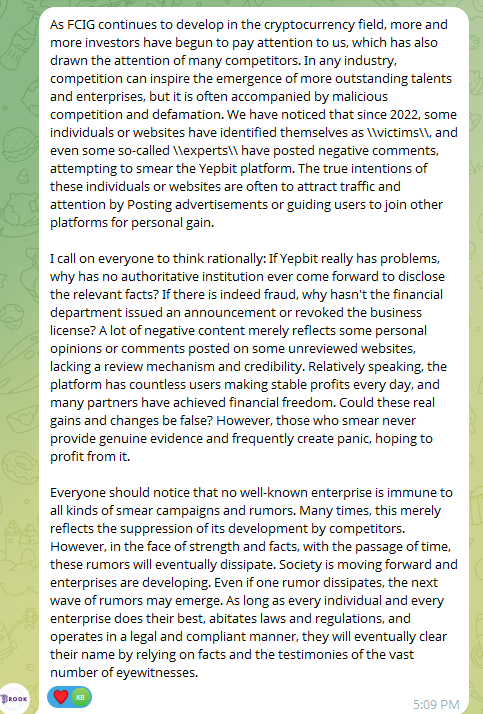
What made this particularly deceptive is that Professor Brook and FCIG were directly controlling the Yepbit exchange. In reality, a legitimate exchange should operate independently from any advisor or group. No external Telegram mentor should have the power to approve withdrawals, reset trading passwords, or influence account activity. Yet in this scam, Yepbit’s platform and FCIG were intertwined, making it appear that your success depended on following the professor’s instructions perfectly.
This is why the scam was so convincing. Everything — the profits, the small withdrawals, the social reinforcement, even the customer support — was coordinated between the Telegram group and the exchange. Victims were led to believe they were interacting with a legitimate exchange, while in fact, the “advisor” controlled both the platform and the social environment.
Sofia’s Team-Building Pressure Tactics
Another key element of this scam was Sofia, Professor Brook’s assistant, who played a central role in maintaining control over members and enforcing the recruitment system. Sofia was presented as the “number one team builder,” someone to admire and emulate. Members were constantly reminded that they should aspire to become like her — disciplined, efficient, and committed to building their teams. This created a social benchmark that combined admiration with subtle pressure, making it easier for the scammers to manipulate participants psychologically.
The team-building element was central to the scam. Victims were encouraged, sometimes daily, to recruit new members and expand their “teams” using affiliate links. Success was measured not just by personal trading profits, but by the number of people you could bring into the fold. Those who resisted or failed to comply faced consequences: access to daily signals was blocked, praise was withheld, and subtle insults were used to reinforce compliance.
My husband, for example, was blocked from daily signals after he refused to comply with this relentless recruitment pressure. A friend who had referred us to the group was also blocked for the same reason. Both of them found the constant “harassment” from Sofia and Professor Brook unacceptable. They did not respond to the pressure tactics and were immediately removed from the benefits of the scam, showing how tightly control was enforced over participants.
In our case, the social manipulation even extended to national stereotypes. My husband was labeled “lazy,” and the French team as a whole was described as the least effective, supposedly because of “French personality traits.” These comments were designed to provoke guilt, motivate action, and make victims feel personally responsible for failure, further encouraging participation in recruiting new members.
I personally prolonged the experiment because I challenged the professor, questioning his instructions and tactics. For a time, he allowed me to continue receiving daily signals, but eventually, I too was blocked. The condition for regaining access was to recruit at least 10 active members, demonstrating that the platform and its “profits” were entirely contingent on submission to the team-building system.
This combination of controlled access to profits, social pressure, admiration for key figures, and psychological manipulation shows how sophisticated the scam was. It wasn’t just about fake trading — it was also about exploiting human behavior, emotions, and social influence to maximize compliance and extract as much as possible from participants.
What a Typical Day in the Yepbit/FCIG Scam Looked Like
To help readers visualize how these scams operate, here’s what a typical day looked like in my experience:
1. Receive daily trading codes from Professor Brook in the Telegram group.
2. Enter the codes into the futures section on Yepbit.
3. Watch your balance grow by small amounts — usually 1% per trade, twice a day.
4. Receive personal messages from Professor Brook or Sofia praising progress or giving team-building instructions.
5. Be reminded to recruit new members and expand your “team” using an affiliate link.
6. Repeat verification steps or respond to messages from support if minor technical issues appear.
7. If you don’t comply with recruitment tasks, access to signals is blocked.
This repetitive cycle reinforces trust, dependence, and compliance. Small profits, daily attention, and social pressure all work together to maintain the illusion of legitimacy.
The Bait: Why Small, Fake Profits Felt Real
The first few weeks were the most convincing part of the experience. I watched my balance grow little by little each day. The profits weren’t enormous — usually about one or two percent daily — but they were steady, predictable, and completely in line with what the professor had promised. He often reminded us that patience was key and that consistency was how professionals built wealth. It sounded reasonable, and the results on my screen seemed to confirm it.
After a few weeks, I decided to test the system by withdrawing a small amount — 100 USDT. To my surprise, the withdrawal went through smoothly. The money arrived in my wallet within hours. That simple transaction erased any remaining doubt I had. I told myself that scammers wouldn’t allow withdrawals, and since the system worked, it must be genuine.
My husband also opened an account, investing 500 USDT, and his results mirrored mine. He managed to grow his balance to 1,300 USDT, while I reached around 1,800 USDT. We both felt that we had discovered a rare opportunity — a small but reliable income stream in a market full of risk.
What we didn’t realize was that this initial phase — the stage where everything feels effortless and trustworthy — is an intentional part of the scam. The small profits, the occasional successful withdrawal, and the personal attention from “Professor Brook” were all designed to create trust. The moment you believe it’s real, you let your guard down. And that’s when the manipulation truly begins.
The Interaction Between the Telegram Group (Fidelity Capital Investment Group aka Professor Brook & Sofia) and the Exchange
To clarify for readers, here’s what is unusual about this connection:
-
Legitimate exchanges are independent. They have their own customer support, withdrawal policies, and security measures. External advisors or Telegram groups cannot alter account balances or approve withdrawals.
-
In this scam, the professor had de facto control. When my withdrawal was blocked for “IP security reasons,” support instructed me to consult Professor Brook — a step that would never happen on a legitimate platform.
-
The Telegram group reinforced the illusion. Daily codes, team-building tasks, and personal messages all contributed to trust. Without this connection, the platform alone would appear suspicious — it’s the combination of social manipulation and fake trading data that made it seem real.
This dual-layer manipulation — fake exchange + controlled social environment — is a hallmark of sophisticated crypto scams.
Early Red Flags That I Ignored
Even while I was seeing consistent profits, a few things started to feel a little off. At first, they seemed minor or easy to dismiss, but looking back, they were early warning signs.
One of the first oddities was the constant emphasis on building a team. Professor Brook encouraged us to recruit others, explaining that each country had to form its own “FCIG team.” He joked about the French team being lazy and promised rewards if we could improve our country’s participation. At the time, it felt like harmless motivation, a kind of gamified approach to learning trading, but it was actually part of a psychological tactic to make us feel invested in the group beyond just our own account balances.
Another thing I noticed was the attention and time Professor Brook and his assistant “Sofia” gave. They messaged individually, checked on our progress, and praised us for following instructions. It felt personal, almost like mentorship, but it was really a method to build trust and dependence. The longer they kept us engaged, the more likely we were to follow their directions unquestioningly.
Lastly, there were minor inconsistencies and unusual behavior that I ignored because I was focused on the profits. Sometimes their explanations were vague or repeated the same line over and over. Occasionally, the support agents seemed confused or spoke in different languages. At the time, I brushed it off as cultural differences or technical difficulties. In hindsight, these were all early signs that the operation wasn’t as professional as it appeared.
When Things Started to Go Wrong
The first major problem came when my husband was suddenly blocked from trading. He had been following the professor’s signals exactly as instructed, and there was no apparent reason for the restriction. The explanation he was given was strange — something about not contributing enough to his team’s growth. It was a bizarre and unconvincing excuse, but we still held onto the belief that the platform was legitimate.
A few weeks later, similar issues started happening to me. Logging into my account became increasingly difficult. The system kept rejecting my trading password, and every attempt to resolve the problem required multiple identity verification steps. Customer support repeatedly asked for photos of me holding my passport, even though my account had already been fully verified. Each new request seemed more absurd than the last, and no one gave consistent explanations.
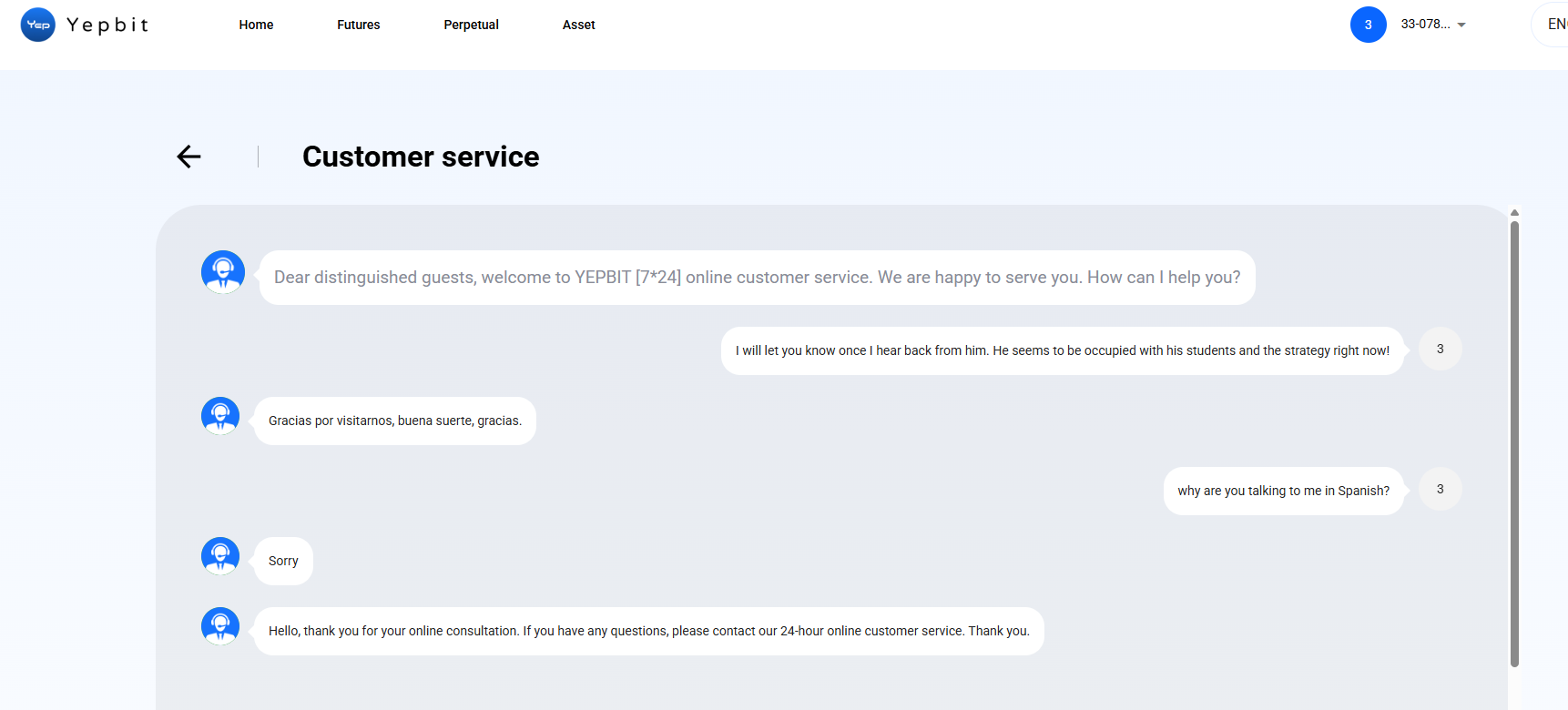
The interactions with professor Brook and the support from yepbit felt scripted. Their responses often didn’t answer my questions and sometimes changed languages unexpectedly. At one point, I realized that no matter how carefully I followed instructions, there was always another “problem” preventing me from accessing or using my account fully.
Here is the last message I received from Professor Brook via his Telegram channel on the 8th of October 2025 when I came back from my summer holiday and this happened right before I made my final withdrawal of 1,819.06 USDT that he suggested.
During october 2025 I was already banned from the FCIG Telegram channel and from receiving my two daily signals because I did not fulfill our “spiritual contract” as he called it. He pressured me every day into finding 5 to 10 active members for my team. Active meaning people who sign up to Yepbit and who deposit a minimum of 300 USDT.

I finally got banned for not following this weird spiritual contract because I did not bring in 5 formal active members.
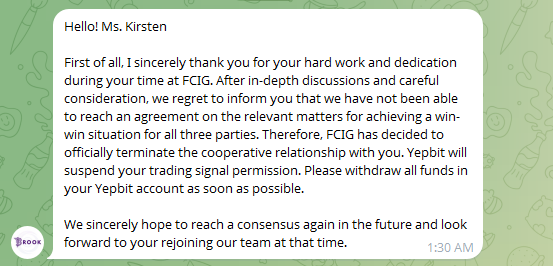
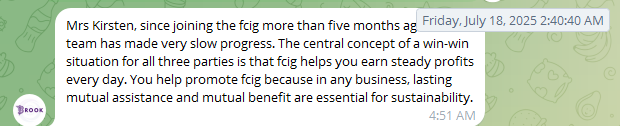
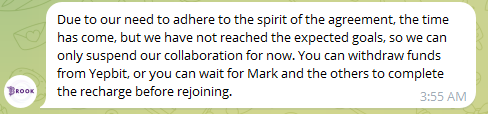
I found his methods pretty annoying and weird plus my friend got banned for the same reason so I made this social experiment with Professor Brook my mission. I wanted to find out how he ticks and if he would let me back into the FCIG Telegram channel after my vacation.
So I contacted him right after my summer vacation on the 8th of October to see what he was up to and if he would let me back in. Here is his last reply back to me:
“Yes, because you previously mentioned your upcoming trip to Ischia. I believe this journey must have incurred significant expenses. I recommend completing a withdrawal, which will not only cover your travel bills but also better demonstrate FCIG’s legitimacy.”
I tried to recontact him after that because Yepbit customer support told me to contact my supervisor without directly mentioning his name but I knew by then that Yepbit and FCIG aka Professor Brook were connected and played a game with their members. He has been staying silent the entire time after my withdrawal from Yepbit was refused even though I contacted him several times.
In the past he answered all my messages pretty quickly, but this time it feels different and he probably rather focuses his time on getting new victims into this Yepbit/FCIG connection game instead of wasting any more time with someone who is useless to him. He knows I am done because I want to get my money out and he knows I will not bring him in more active users so he is done playing his smiling face with me.
To be honest I am done, too, I lost my valuable time over this, too, especially on the day I was trying to withdraw my money. The stupid support experience that felt like a robot with all the hoops that I had to jump through just felt more than frustrating and a complete waste of time. However I am happy I went through this stressful experience because otherwise I could not have written this article to warn innocent new victims about these crooks.
The Fake Withdrawal Fee
The Yepbit platform also displayed a shocking message: any withdrawal over 100 USDT would incur a 20% fee — in my case, $363.96 USDC. They explained it as a “handling fee” and claimed my funds were temporarily frozen while under system custody. According to them, this was a normal security procedure, and the funds would supposedly be available after 24 hours.
At the time, the wording sounded technical and somewhat convincing. They instructed me to check whether my wallet supported the currency and network, framing it as a precaution to prevent “losses.” But in reality, no legitimate exchange charges a 20% withdrawal fee. The entire explanation was designed to confuse, delay, and pressure me into paying — a tactic often used in scams to extract a final payment before disappearing.
When I refused to pay, the platform reset my visible balance to zero and communication from both support and Professor Brook ceased entirely. His last message was manipulative, referencing my personal trip to my vacation destination and implying that completing the withdrawal would somehow prove the legitimacy of FCIG. It was the final stage of psychological manipulation, designed to make me feel guilty, pressured, and still invested in the scam.
At that moment, it became clear that the small profits and previous successful withdrawal were nothing more than bait — designed to build trust and lower my defenses before attempting the “final squeeze.”

The Final Trap: Blocking Withdrawals
The turning point came when I tried to withdraw my 1,819.06 USDT. After navigating the endless verification hoops, the withdrawal was submitted — only to be declined almost immediately. The platform claimed there was a security issue related to my IP address. This didn’t make sense. I was logging in from my home in France using my verified phone, with no VPN or unusual activity.
When I asked who I needed to contact about this, support vaguely referred to a “supervisor.” After insisting, I was told that I should speak with Professor Brook. It became clear that Yepbit, the exchange, and FCIG were not separate entities at all. The so-called exchange was operating under the professor’s control.
The moment I pressed withdrawal my account balance dropped to zero, and all communication from both the professor and support ceased. His last message was manipulative, referencing my personal travel plans to make me feel guilty and suggesting that completing the withdrawal would demonstrate the legitimacy of the yepbit exchange — a final attempt to extract money and maintain my trust.
At that moment, it became painfully clear: the profits I had seen, the successful small withdrawals, and the personal attention were all part of a carefully orchestrated scam. The system was designed to make me trust it, to invest more, and ultimately to lose everything — or pay unnecessary fees that would never have gone to a legitimate platform.


Red Flags in Customer Support
Customer support can be a huge giveaway in these scams. Some of the red flags I encountered included:
-
Copy-paste or robotic responses that didn’t answer questions.
-
Multiple language switches, sometimes to confuse or avoid giving a direct answer.
-
Repeated requests for identity verification, even after already submitting valid documents.
-
Evasive explanations about security issues, IP addresses, or “supervisor approvals.”
If you notice any of these signs while dealing with a financial platform, it is a strong indication that something is not right. Real exchanges maintain consistent, clear, and professional communication.


Why This Setup is Unusual for an Exchange
One of the most important red flags in this experience is that the Telegram group and the exchange were directly connected. In a legitimate crypto exchange, advisors, mentors, or external groups do not have the ability to block withdrawals, reset passwords, or control access to funds. Exchanges operate independently, with their own security systems, customer support, and regulatory oversight.
If you are ever instructed to follow a specific person’s instructions to access your money or rely on messages from a group for trading, it is a clear warning that the system may be compromised. The fact that Professor Brook and Sofia could manipulate both the platform and the social environment was a central reason the scam was so convincing.
How This Scam Actually Works (Analysis)
Once I stepped back and analyzed the situation, I realized how carefully the scam was structured. Here’s the sequence they used to lure and manipulate victims:
1. Trust-Building: The scammers create a professional-looking platform and present a friendly, knowledgeable “advisor.” They build personal connections, praise adherence to instructions, and make the victim feel part of a legitimate team.
2. Fake Profits: The trading results shown on the platform are controlled. Victims see small but consistent gains, reinforcing the illusion of success.
3. Small Successful Withdrawals: Allowing minor withdrawals strengthens trust. Victims believe the platform is real because they can “test it” and receive their money.
4. Pressure to Deposit More or Recruit Others: The scammers encourage reinvestment or team-building to expand their reach and increase potential profits from new deposits.
5. Withdrawal Blocking: When victims attempt larger withdrawals, the platform invents obstacles — IP issues, supervisor approvals, frozen funds — that prevent access to the money.
6. Final Extraction Attempt: They demand fees, taxes, or special approvals, often using guilt or urgency to manipulate victims into paying more.
7. Disappearance: Once they’ve extracted as much as possible, they cut off communication, zero out balances, or vanish completely. The cycle then continues with new victims.
The small profits and early withdrawals are deliberate psychological tools. By showing “success” first, they make victims more likely to invest larger amounts or comply with arbitrary fees, believing that the platform is legitimate.
How Scammers Trap You During Withdrawals
Withdrawals are often where victims get caught. Key tactics I experienced:
-
Fees and handling charges: Yepbit demanded $300 or 20% of the withdrawal.
-
System excuses: Funds “frozen under custody” or blocked due to “IP security issues.”
-
Supervisor references: Victims are told to seek approval from someone outside the normal support team, often the scam operator.
-
Account balance manipulation: If fees aren’t paid, the visible balance is zeroed.
Recognizing these tactics can help readers avoid sending money or losing access to their funds.
The Hidden Risk: Identity Theft
One of the most concerning aspects of this scam is the personal information collected during verification. Both my husband and I had uploaded:
-
Photos holding our passports
-
Scans of the front and back of our passports
-
Phone numbers and email addresses
These details are highly valuable to scammers. They can be used to:
-
Open fake accounts for money laundering
-
Create “proof of legitimacy” for new victims
-
Sell identity verification data on the dark web
Even though my husband and I did not lose our initial deposits and were fortunate to withdraw small amounts, the risk of identity misuse remains. There is no way to delete personal information from a scam platform like Yepbit.
To protect ourselves, we took several steps:
-
Renewing our passports and invalidating the old ones
-
Reporting the incident to cybermalveillance.gouv.fr, France’s cybercrime assistance service
-
Changing all passwords for accounts linked to the same email or phone number
-
Monitoring credit reports and potential misuse of our identity
If you have been caught in a similar situation, it is crucial to treat personal information exposure seriously, even if no money was lost.
Lessons Learned & Why Small Wins Don’t Mean Safety
Looking back, there are several clear lessons from my experience — things I wish I had recognized earlier.
-
Unrealistic Profit Promises: Any platform promising near-perfect results or daily profits without risk is almost certainly a scam. No legitimate trading system can guarantee consistent wins.
-
Unofficial Communication Channels: Legitimate exchanges rarely, if ever, rely on Telegram groups or personal “advisors” to deliver trading instructions.
-
Excessive Identity Verification Requests: Multiple requests for selfies, passport photos, or repeated KYC verification are red flags. Real platforms will not repeatedly demand the same documentation.
-
Suspicious Withdrawal Processes: High fees, frozen balances, or requiring “supervisor approval” to release funds are clear warning signs.
-
Emotional Manipulation: Scammers use personal messages, flattery, and guilt to keep you engaged and compliant. Pay attention to how much your emotions are being manipulated.
-
Look Beyond the Surface: Even if a platform shows small profits or allows a withdrawal, it doesn’t guarantee legitimacy. Small wins are often bait to build trust.
Recognizing these warning signs early can prevent significant financial and personal harm.
One of the most deceptive parts of this scam was the small profits and initial successful withdrawals. These are deliberate strategies to:
-
Build trust and create confidence in the platform.
-
Encourage reinvestment or further engagement.
-
Make victims believe the platform is legitimate before implementing blocking or fees.
Even if your account shows profits, it doesn’t mean the platform is safe. The initial wins are part of the bait.
Tips from Professionals on How to Spot, Resist Social Engineering & Recruitment Pressure
Cybersecurity experts and experienced traders offer guidance to help spot scams:
-
Verify the Exchange: Always check whether the exchange is regulated, has proper licensing, and is registered with relevant authorities.
-
Use Official Sources: Avoid taking financial advice from Telegram groups, social media, or unknown messaging apps. Legitimate advisors will operate through verifiable, official channels.
-
Trust Your Instincts: If anything feels off — confusing rules, inconsistent responses, high fees — step back.
-
Limit Personal Information: Only provide KYC details to reputable, verified platforms. Never share your passport, driver’s license, or personal photos with unverified sources.
-
Learn to Identify Social Engineering: Scammers are skilled at building trust, flattering you, and creating urgency. If pressure tactics are used, treat it as a warning.
Scammers often rely on psychological manipulation to make you comply. Here’s how to protect yourself:
-
Set boundaries: Never feel obliged to recruit others or expand teams.
-
Question pressure tactics: If someone is using guilt, urgency, or praise to influence decisions, step back.
-
Focus on the platform: Your only concern should be trading or withdrawing your funds, not building networks for someone else.
-
Document everything: Keep screenshots of messages, codes, and any instructions in case you need evidence.
Resisting these tactics can help you maintain control and avoid falling deeper into the scam.
Psychological Tricks Used in Crypto Scams
Scammers are experts at manipulating human behavior. Some tricks I experienced included:
-
Flattery and attention: Personal messages praising performance.
-
Guilt and obligation: Using your personal life or national stereotypes to pressure you.
-
Urgency and scarcity: Suggesting profits or signals are available only if you act quickly.
-
Social comparison: Highlighting top performers (like Sofia) to create envy or motivation.
Understanding these tactics helps readers recognize when their emotions are being exploited.
Next Steps if Your Identity is Compromised
If you’ve uploaded personal documents to a scam platform, immediate action is essential:
1. Renew your passport if it was exposed.
2. Change all passwords associated with emails, wallets, or financial accounts.
3. Enable two-factor authentication on all accounts.
4. Report the scam to local authorities or cybercrime organizations.
5. Monitor your credit and financial accounts for unusual activity.
6. Be alert for phishing attempts using your stolen personal information.
Even if you didn’t lose money, protecting your identity is crucial because scammers can misuse it in other ways.
More Resources, Books & Tools to Protect Yourself from Crypto Scams
If you or someone you know has been affected by a scam like Yepbit or FCIG, there are official organizations and resources available:
-
France: cybermalveillance.gouv.fr — report cybercrime and identity theft.
-
Europe: Europol Cybercrime Reporting Portal — report scams online.
-
United States: FTC Scam Reporting — report fraud and scams.
-
Educational Resources:
-
Binance Academy: Guides on spotting crypto scams
-
CoinMarketCap Learn: How to evaluate exchanges
-
Chainalysis Blog: Understanding investment scams
-
Sharing knowledge and reporting incidents not only protects you but also helps prevent others from becoming victims.
Protect Your Identity and Information (Your Essential Tools for Defense)
Sophisticated scams like the one you experienced often harvest vast amounts of personal data for future exploitation. Protecting your identity and digital footprint is crucial to preventing long-term financial damage that could occur long after the initial scam.
Identity Guard (Understanding Identity Theft Protection)
What is it? Identity Theft Protection is a service that actively monitors your personal information (Social Security number, bank accounts, and credit reports) across the dark web and public records for any signs of misuse or fraud.
How it Works (The Mechanics of Protection): Identity monitoring services continuously scan billions of data points across public records, credit bureaus, and the vast, hidden corners of the dark web. If your sensitive information is discovered—whether as part of a data breach, a new credit card application, or an unauthorized change of address—the service immediately issues an alert. This critical early warning allows you to lock down accounts or contact authorities before major financial damage occurs.
Why it Matters After a Scam: After an incident involving personal contact and financial transactions (like Yepbit/FCIG), monitoring your identity is critical. This service provides an essential layer of defense by alerting you to unauthorized account openings, credit checks, or other signs that your stolen data is being exploited, allowing you to react immediately and mitigate harm.
- Recommended Resource: Identity Guard (Reader Discount)
For readers seeking different features, monitoring scope, or integrated digital security, the following services are highly rated alternatives, often including crucial features like three-bureau credit monitoring and advanced dark web scanning.
Aura (Best for All-In-One Protection and Speed)
LifeLock by Norton (Best for Comprehensive Security Bundle)
Recommended Reading
To continue your education on cryptocurrency safety, fraud prevention, and sound investment principles, consider exploring the following books.
Focus on Scams and Security
These titles offer deep dives into the complex social engineering tactics used by scammers, similar to the one I experienced with the Yepbit scam:
- The Pig Butchering Scam: How I fell for it & everything I learned by M.L.
- Why read it: This book is a raw, first-hand account from a victim of a sophisticated “pig butchering” crypto scam, offering vital emotional and practical lessons on recognizing the manipulation tactics.
- The Little Book of Crypto Crime (Metropolitan Police)
- Why read it: A concise guide detailing various types of crypto fraud, including investment scams, romance fraud, and technical attacks like phishing, along with practical prevention tips.
- The Crypto Launderers: Crime and Cryptocurrencies from the Dark Web to DeFi and Beyond by David Carlisle
- Why read it: Provides a wider context on how criminals exploit the cryptocurrency ecosystem, helping you understand the financial and technical landscape of fraud.
Building Foundational Crypto Knowledge
A strong understanding of the basics is your best defense against complex scams. These books cover the fundamentals of crypto and smart investing:
- The Basics of Bitcoins and Blockchains: An Introduction to Cryptocurrency and the Technology That Powers It by Antony Lewis
- Why read it: Excellent for beginners, it demystifies the technical concepts of Bitcoin and blockchain, which is essential for evaluating a platform’s true legitimacy.
- Cryptoassets: The Innovative Investor’s Guide to Bitcoin and Beyond by Chris Burniske & Jack Tatar
- Why read it: Offers a strategic framework for assessing and valuing digital assets, helping you identify what constitutes a realistic investment versus a fraudulent promise of easy money.
- Cryptocurrency Investing for Dummies by Kiana Danial
- Why read it: A practical, step-by-step guide on buying, securing, and developing investment strategies for crypto while focusing on minimizing risks.
Conclusion: The Truth About the Yepbit / FCIG Scam
The bottom line is clear: Fidelity Capital Investment Group, ‘Professor Brook,’ and ‘Sofia’ are not legitimate. The entire Yepbit platform is a fraudulent operation designed to steal your money.
Looking back, I am grateful that I was able to withdraw some funds and protect most of my investment. But the experience was a powerful reminder that even small, seemingly harmless scams can be sophisticated and emotionally manipulative.
The Yepbit / FCIG scam illustrates how carefully scammers build trust, create the illusion of legitimacy, and exploit human psychology to extract money and personal information. Falling for it does not mean you are careless — it means the scammers were skilled at convincing you their operation was real.
By sharing my story, my hope is to prevent others from making the same mistakes. Take time to verify every platform, protect your personal information, and always trust your instincts. With awareness and caution, you can participate safely in the cryptocurrency world and avoid becoming the next victim. Use this experience as your guide to spot and resist these sophisticated psychological traps, ensuring you protect your finances, your identity, and your loved ones.
I recommend you report all fraudulent activity to the relevant authorities. I wish you the best of luck in your future financial crypto endeavors.
Q&A Section
Q: Why did they let me withdraw money at first?
A: Small, early withdrawals are part of the scam. They create trust and convince you the platform is legitimate, encouraging larger deposits later.
Q: Can scammers use my passport for anything?
A: Yes. They may use it for identity theft, opening fake accounts, or selling your information online.
Q: Is there a way to get my funds back?
A: Often, no. Once scammers block withdrawals and disappear, recovery is extremely difficult. Reporting the incident is the safest course.
Q: What if I already sent the withdrawal fee?
A: Consider reporting the payment to your bank or wallet provider, as it may be classified as fraud. Document all communication as evidence.
Q: Can I still use my Telegram account safely?
A: Yes, but block and report the scam accounts. Avoid engaging with anyone connected to the scam group.
Your Next Steps – Where to Go From Here
If you’ve been affected by Yepbit, FCIG, or a similar scam:
1. Stop Communication: Do not reply to scammers or advisors.
2. Secure Your Accounts: Change passwords, enable two-factor authentication, and monitor email and financial accounts.
3. Report the Scam: Submit reports to cybercrime authorities in your country. Include all evidence, screenshots, and correspondence.
4. Protect Your Identity: Renew passports, monitor credit reports, and watch for suspicious activity.
5. Educate Yourself: Read credible resources about cryptocurrency safety and scams.
6. Share Your Story: Your experience may help prevent others from falling victim.
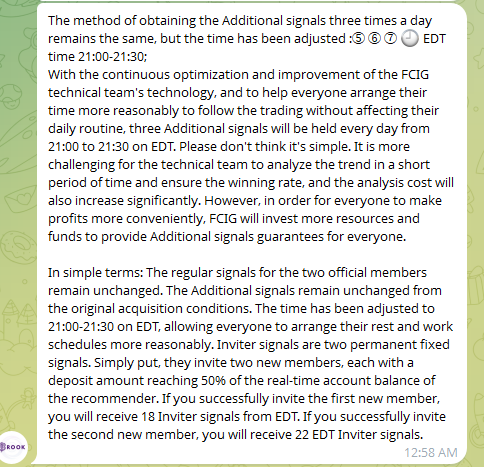
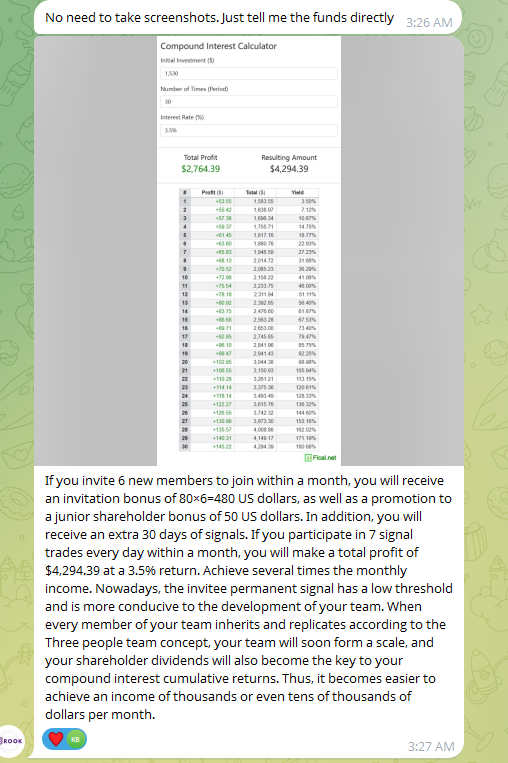
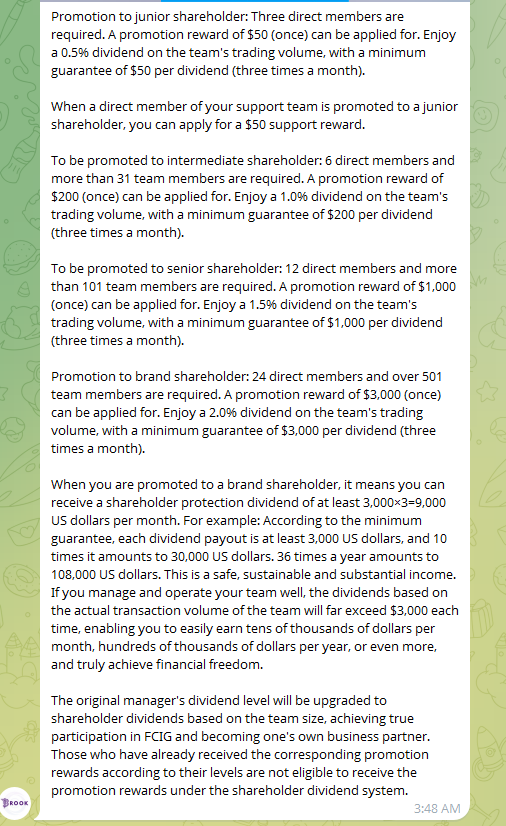
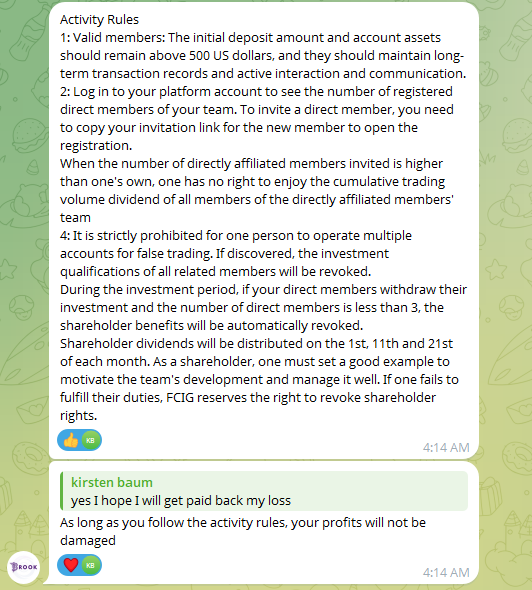
More Screenshot Proof of How this Yepbit/FCIG Scam Works (All Screenshots assembled from the Jonathan Brook Telegram Channel)
At the time I am writing this article I was already banned from the main FCIG Telegram group, but he kept chatting with me via his Jonathan Brook Telegram channel to pressure me into finding new active team members. An active team member needs to put at least 300 USDT into the Yepbit exchange. So here are all the screenshots I assembled during out daily conversations.
These screenshots prove the kind of pressure tactics Professor Brook is using to grow his team of members that he then can exploit in order to get more and more active people under his control. In my case and that of my husband and our friend we did not lose our initial investments, but there might be a couple of other related motives behind this scams like identity theft and what not.
We are all three reporting this to the authorities so the necessary work can be done to find out what is going on behind closed doors.
If I can find out more elements regarding this scam I will report them here and I will update this article accordingly.
Let’s get into some more proof of how this Yepbit / FCIG / Professor Brook scam works…